

U.S. History I - Jacksonian Democracy
- History
- Texas A&M University
- 9 pages
- Shared March 2026
Preview 3 of 9 pages
See the first 3 pages exactly as they appear in the document.
Page 1 Read page 1 as text
Study Guide U.S. History I – Jacksonian Democracy 1. Jackson as President When Andrew Jackson became president in 1829 , his inauguration was unlike any before. A rowdy crowd filled the White House , shocking Washington society. Many attendees were looking for government jobs , and Jackson’s speech mentioned “rotation in office” , meaning the replacement of some officeholders with political supporters. • Critics called this the “spoils system.” • Jackson didn’t completely replace all officials, and most turnover during his two terms was modest. • He relied heavily on friends, newspaper editors, and political allies for advice, forming an informal advisory group called the Kitchen Cabinet . Only Martin Van Buren , Secretary of State, was a government official in this group. 1.1 Van Buren and Internal Improvements Van Buren worked to strengthen his political influence and weaken Vice President John Calhoun , especially over issues like internal improvements (roads, canals, etc.). • Van Buren drafted Jackson’s veto message on the Maysville Road bill , which would have funded a road entirely within Kentucky. • Jackson argued the federal government shouldn’t fund projects benefiting just one state. • Despite the veto, federal spending on infrastructure was higher under Jackson than under Adams . 1.2 The Eaton Affair Jackson’s conflict with Calhoun became personal over social snubs in Washington: • Peggy Eaton , wife of Jackson’s Secretary of War, was shunned by other cabinet wives. • Jackson, still grieving the death of his wife Rachel, took the snubs personally. • This feud escalated, contributing to the growing rift between Jackson and Calhoun, especially during the nullification crisis .
Page 2 Read page 2 as text
Study Guide 1.3 The Nullification Controversy The Tariff of 1828 angered Southerners, who felt it unfairly benefited Northern industries. • Calhoun argued states could nullify (refuse to obey) federal laws they considered unconstitutional. • In 1832, South Carolina passed an ordinance refusing to collect tariffs in its ports. • Jackson responded firmly: o Nullification was unconstitutional. o The Constitution created a single nation , not separate states. o He threatened military force to enforce tariffs. Henry Clay’s compromise helped avoid war: 1. Compromise Tariff – reduced duties gradually over 10 years. 2. Force Bill – authorized Jackson to enforce federal law with military action. South Carolina backed down, and both Jackson and Calhoun claimed victory. 1.4 The Bank Crisis Jackson hated banks and paper money , especially the Second Bank of the United States : • The bank was privately controlled but held federal deposits and lent money to state banks. • Nicholas Biddle , the bank’s president, tried to recharter it early in 1832, supported by Henry Clay. • Jackson vetoed the recharter bill , calling the bank a privileged monopoly . During his second term: • Jackson removed federal deposits from the Second Bank and put them into selected state “pet” banks loyal to the Democratic Party. • The pet banks lent money and issued paper notes, fueling speculation in public lands . • To curb speculation, Jackson issued the Specie Circular (1836) , requiring land to be bought with gold or silver , not paper money.
Page 3 Read page 3 as text
Study Guide Results: • Speculation slowed, but western settlers criticized the policy , as hard currency was scarce. • Jackson’s bank policies contributed to a serious economic crisis , which his chosen successor inherited. Jackson’s presidency was marked by: • Expanding presidential power . • Using the spoils system to reward allies. • Firmly confronting states’ rights challenges (nullification). • Taking on the Second Bank of the United States and reshaping the nation’s financial system. 2. Van Buren and New Political Alignments By 1834 , a new political group called the Whigs had formed to oppose President Andrew Jackson. • Leaders included Daniel Webster of Massachusetts and Henry Clay of Virginia. • They nicknamed Jackson “King Andrew I” because they felt he was abusing presidential power. • Whigs drew support from New England, the mid - Atlantic, the upper Midwest, and some southern planters who disagreed with Jackson on issues like nullification, internal improvements, and tariffs. • Their economic ideas appealed to industrialists, successful farmers, and reformers who wanted better public education and social change. Meanwhile, the Democrats were strongest in the South and West , especially among middle - class people, small farmers, and recent immigrants. Many Democrats supported Jackson’s fight against the Second Bank of the United States , which they saw as a tool of monopoly and privilege. Key difference: • Whigs wanted an active national government . • Democrats wanted more power for states and local governments .
6 more pages in the full document
Unlock it once and it stays in your library, ready to chat with or turn into flashcards.
Unlock the full documentMore History study materials
See all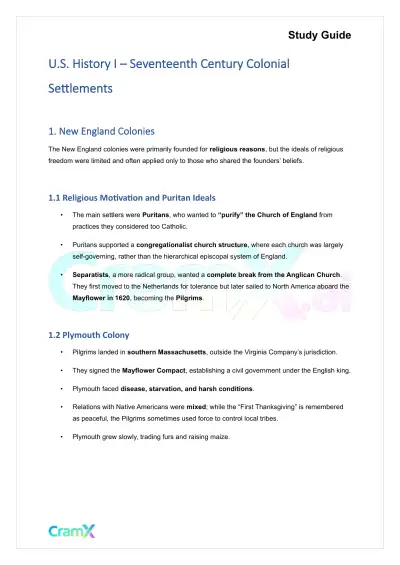 Quick Guides
U.S. History I - Seventeenth Century Colonial Settlements
History
8 pagesMar 2026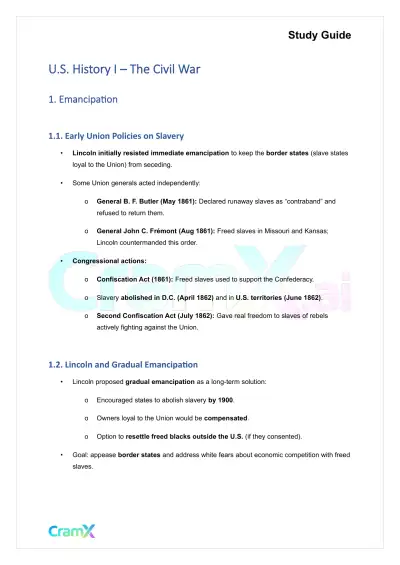 Quick Guides
U.S. History I - The Civil War
History
9 pagesMar 2026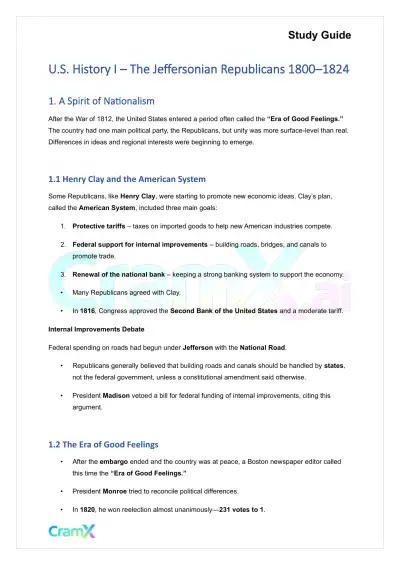 Quick Guides
U.S. History I - The Jeffersonian Republicans 1800–1824
History
11 pagesMar 2026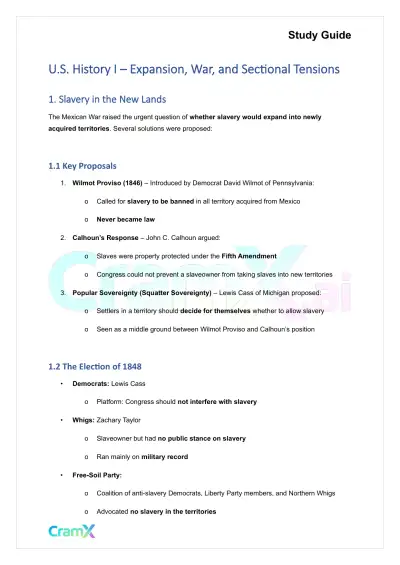 Quick Guides
U.S. History I - Expansion, War, and Sectional Tensions
History
9 pagesMar 2026 Quick Guides
U.S. History I - Challenges for a New Nation
History
9 pagesMar 2026 Quick Guides
U.S. History I - American Society and Culture 1815–1860
History
9 pagesMar 2026 Quick Guides
U.S. History I - Era of Reconstruction
History
9 pagesMar 2026 Quick Guides
U.S. History I - Economic Growth and Development 1815–1860
History
8 pagesMar 2026
Study this document with CramX
Once it is in your library, every tool can work from it.