

U.S. History I - Exploration and Early Colonization
- History
- Texas A&M University
- 12 pages
- Shared March 2026
Preview 4 of 12 pages
See the first 4 pages exactly as they appear in the document.
Page 1 Read page 1 as text
Study Guide U.S. History I – Exploration and Early Colonization 1. Columbus and the Spanish Explorations Christopher Columbus and the Spanish explorations marked the beginning of sustained European contact with the Americas and laid the groundwork for Spain’s vast empire in the Western Hemisphere. 1.1 Christopher Columbus: Motives and Miscalculations Christopher Columbus was a Genoese (Italian) sailor who believed that sailing west across the Atlantic was the fastest route to Asia. His plan was based on two major errors: • He did not know the Americas existed • He greatly underestimated the size of the Earth , believing Japan was only about 3,000 miles west of Europe Columbus sought financial backing from several European powers. Portugal rejected him twice, and England and France were uninterested. Spain eventually agreed to support his plan in part because: • Spain had just completed the Reconquista by capturing Granada in 1492 • Ferdinand and Isabella were eager to expand Spanish power and influence overseas With help from supporters at court, Columbus convinced the Spanish monarchs to fund his expedition. 1.2 The Voyages of Columbus • First voyage (1492 – 1493): Columbus sailed with three ships and 87 men , leaving on August 2, 1492. On October 12, he landed on an island in the Bahamas, naming it San Salvador . He later explored Cuba and Hispaniola , where gold was found. • Second voyage (1493 – 1496):
Page 2 Read page 2 as text
Study Guide Spain financed a much larger expedition of 17 ships and over 1,200 men . Columbus explored Puerto Rico and Jamaica and established the first permanent Spanish settlement on Hispaniola. • Third voyage (1498 – 1500): Columbus explored the Caribbean and the northern coast of South America . • Fourth voyage (1502 – 1504): He explored the coast of Central America . Despite multiple voyages, Columbus never accepted that he had reached a new continent , believing instead that he had arrived in the “Indies.” 1.3 Spain, Portugal, and the Treaty of Tordesillas Columbus’s discoveries raised fears of conflict between Spain and Portugal , the two leading maritime powers. • In 1493 , Pope Alexander VI issued an edict granting Spain lands west of an imaginary Atlantic line. • Portugal objected, leading to the Treaty of Tordesillas (1494) , which moved the line farther west. • This agreement unintentionally placed Brazil in the Portuguese sphere. In 1500, Pedro Cabral reached the Brazilian coast. 1.4 Amerigo Vespucci and the Naming of America Unlike Columbus, Amerigo Vespucci realized that the lands encountered were not part of Asia but an entirely “New World.” In 1507 , a map was published labeling the new continents “America” in his honor. 1.5 Spanish Conquests in Central and South America In the decades after Columbus, Spain built a vast empire stretching from Mexico to South America and into the Pacific .
Page 3 Read page 3 as text
Study Guide • Ferdinand Magellan’s voyage (1519 – 1522) proved the true size of the Earth and helped establish Spanish claims in the Philippines . • Hernán Cortés conquered the Aztec Empire (1519 – 1521) by: o Exploiting internal divisions o Forming alliances with local enemies of the Aztecs o Using horses and superior weapons • Francisco Pizarro defeated the Inca Empire (1531 – 1533) with fewer than 200 men, aided by civil war within the empire. Other native cultures in Central America fell soon afterward. 1.6 Conquistadors and Native Peoples Spanish conquerors, known as conquistadors , were primarily interested in gold and silver , not settlement. They relied on Native labor for: • Sugar plantations in the Caribbean • Mining operations in Mexico and Peru Although critics such as Bartolomé de Las Casas spoke out against mistreatment of Native peoples, disease caused the greatest devastation. Smallpox, measles, and other illnesses killed millions. Labor shortages led Spain to begin importing African slaves as early as 1503 . 1.7 Spain in North America Spanish exploration extended into what is now the United States: • Juan Ponce de León explored Florida in 1513 while searching for the “Fountain of Youth.” • Pánfilo de Narváez explored the Gulf Coast in 1528; survivors led by Cabeza de Vaca crossed Texas and the Southwest. • Hernando de Soto traveled from Florida across the Southeast and into the Mississippi Valley (1539 – 1543), spreading smallpox. • Francisco Vásquez de Coronado searched for the Seven Cities of Cíbola (1541 – 1543), reaching present - day Kansas; his expedition discovered the Grand Canyon .
Page 4 Read page 4 as text
Study Guide • Juan Rodríguez Cabrillo explored the California coast. The most lasting results of Spanish exploration were the founding of: • St. Augustine, Florida (1565) — the oldest permanent European settlement in the U.S. • Santa Fe, New Mexico (1609) 2. French and Dutch Explorations French fishermen were already sailing to the waters near Newfoundland as early as 1504 to catch cod. However, fishing was not the main reason France sponsored major exploration. Instead, King Francis I wanted to find a northwest passage to Asia , which he hoped would lead to trade and wealth. In 1524 , Italian explorer Giovanni da Verrazano , sailing for France, explored the Atlantic coast of North America from present - day North Carolina to Nova Scotia while searching for this passage. 2.1 Jacques Cartier and French Claims to Canada The same goal guided Jacques Cartier , who made three voyages between 1534 and 1542 . Cartier: • Explored the Gulf of St. Lawrence • Discovered and sailed along the St. Lawrence River • Helped establish France’s future claim to Canada Members of Cartier’s expedition founded a short - lived settlement near present - day Quebec , but it did not last. 2.2 Failed French Colonies and Religious Conflict France also attempted to create colonies farther south: • South Carolina (1562 – 1564) • Florida (1564 – 1565) These colonies were established by French Huguenots , who were Protestants. However, none of these settlements succeeded.
8 more pages in the full document
Unlock it once and it stays in your library, ready to chat with or turn into flashcards.
Unlock the full documentMore History study materials
See all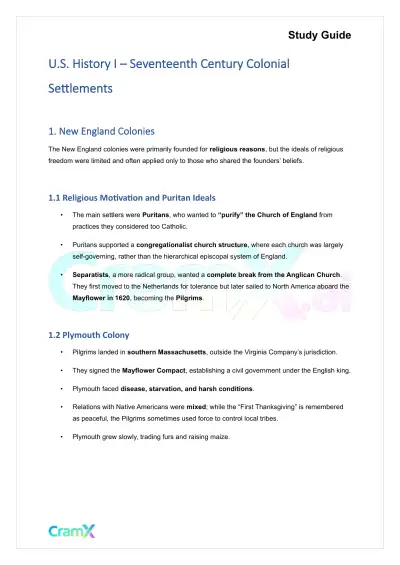 Quick Guides
U.S. History I - Seventeenth Century Colonial Settlements
History
8 pagesMar 2026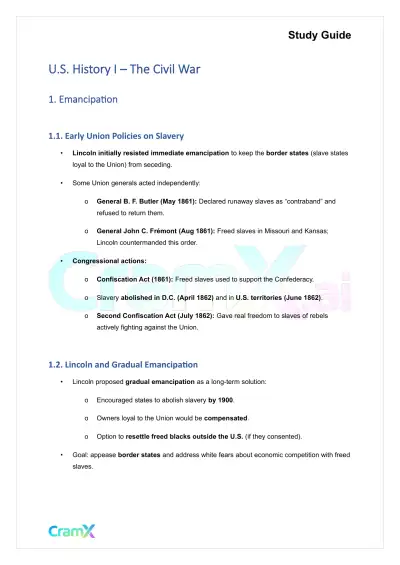 Quick Guides
U.S. History I - The Civil War
History
9 pagesMar 2026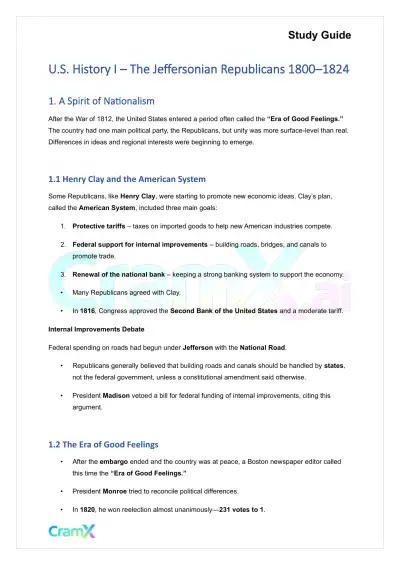 Quick Guides
U.S. History I - The Jeffersonian Republicans 1800–1824
History
11 pagesMar 2026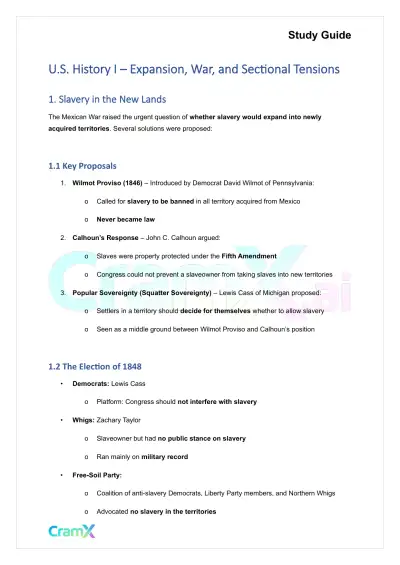 Quick Guides
U.S. History I - Expansion, War, and Sectional Tensions
History
9 pagesMar 2026 Quick Guides
U.S. History I - Challenges for a New Nation
History
9 pagesMar 2026 Quick Guides
U.S. History I - American Society and Culture 1815–1860
History
9 pagesMar 2026 Quick Guides
U.S. History I - Era of Reconstruction
History
9 pagesMar 2026 Quick Guides
U.S. History I - Economic Growth and Development 1815–1860
History
8 pagesMar 2026
Study this document with CramX
Once it is in your library, every tool can work from it.