

U.S. History I - From Compromise to Crisis
- History
- Texas A&M University
- 6 pages
- Shared March 2026
Preview 2 of 6 pages
See the first 2 pages exactly as they appear in the document.
Page 1 Read page 1 as text
Study Guide U.S. History I – From Compromise to Crisis 1. Compromise of 1850 The Compromise of 1850 attempted to address the slavery issue in the territories acquired from Mexico and to reduce sectional tensions, but it ultimately highlighted the deepening divide between North and South. 1.1 Background • California was ready for statehood , which threatened the balance between free and slave states. • President Zachary Taylor had little political influence. • Henry Clay was tasked with devising a compromise, drawing on his experience with the Missouri Compromise (1820) and the Nullification Crisis (1830s). 1.2 Clay’s Omnibus Bill (January 1850) Clay proposed a single package of resolutions addressing multiple issues: 1. California admitted as a free state 2. New Mexico and Utah organized as territories; slavery decided by popular sovereignty 3. Slave trade abolished (but not slavery itself) in the District of Columbia 4. Fugitive Slave Law strengthened 5. Congress would not interfere in the interstate slave trade 6. Texas - New Mexico boundary settled; U.S. assumed $10 million of Texas debt Outcome: The omnibus bill initially failed , because all measures had to pass together. 1.3 Stephen Douglas and the Final Compromise • Senator Stephen Douglas split the omnibus bill into five separate laws , each of which passed independently:
Page 2 Read page 2 as text
Study Guide 1. California admitted as a free state 2. Texas and New Mexico Act – New Mexico territory with popular sovereignty , boundary settled, $10 million paid to Texas 3. Utah Act – Utah territory under popular sovereignty 4. Fugitive Slave Act – federal enforcement of runaway slave capture 5. Act Abolishing Slave Trade in D.C. – ended slave trade in the capital 1.4 Fugitive Slave Act of 1850 • Key provisions: o Special commissioners handled cases; slave testimony not allowed o Commissioners received $10 for returning a slave , $5 if freed o Severe penalties for interfering with capture • Northern resistance: o Many states passed personal liberty laws o Abolitionist crowds sometimes resisted capture attempts o The law was largely unenforceable in practice 1.5 Cultural Impact: Uncle Tom’s Cabin • Written by Harriet Beecher Stowe in response to the Fugitive Slave Act • Serialized in 1851; published as a book in 1852 • Portrayed the cruelty of slavery , including family separations and physical abuse • Sold two million copies by 1852 • Northern attitudes hardened toward slavery • Famous (possibly apocryphal) quote attributed to Lincoln: “So this is the little lady who started the Civil War”
4 more pages in the full document
Unlock it once and it stays in your library, ready to chat with or turn into flashcards.
Unlock the full documentMore History study materials
See all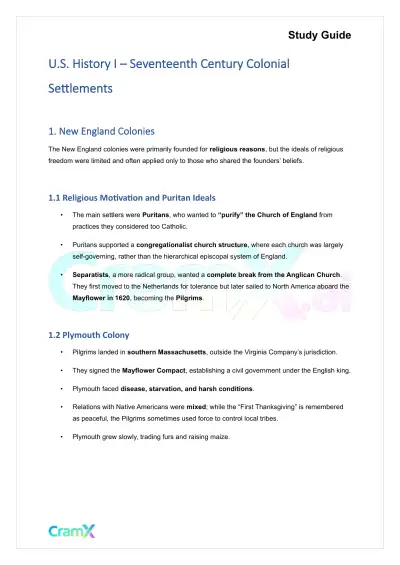 Quick Guides
U.S. History I - Seventeenth Century Colonial Settlements
History
8 pagesMar 2026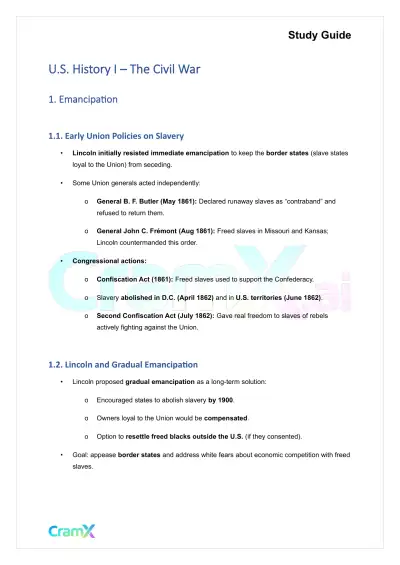 Quick Guides
U.S. History I - The Civil War
History
9 pagesMar 2026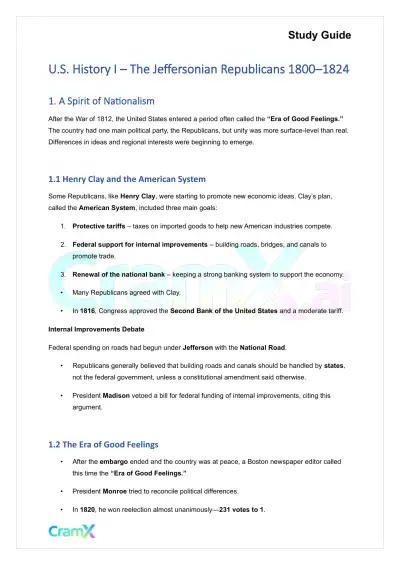 Quick Guides
U.S. History I - The Jeffersonian Republicans 1800–1824
History
11 pagesMar 2026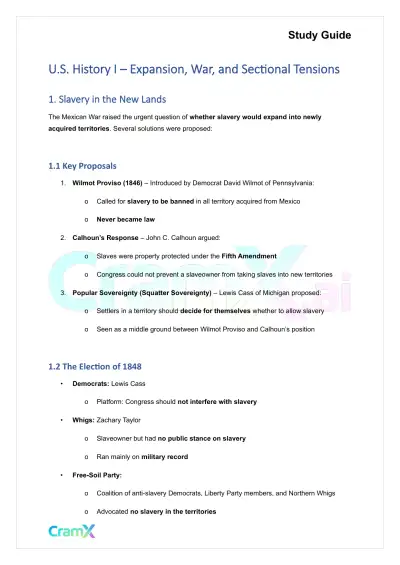 Quick Guides
U.S. History I - Expansion, War, and Sectional Tensions
History
9 pagesMar 2026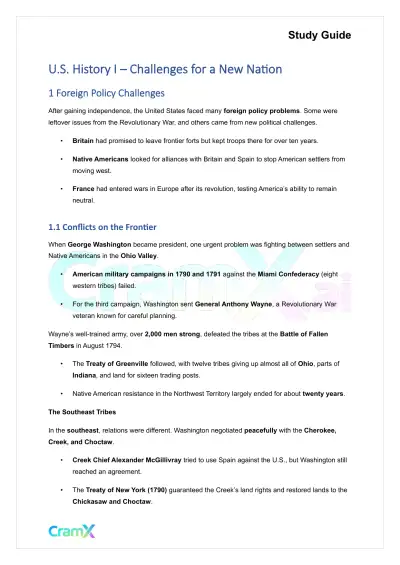 Quick Guides
U.S. History I - Challenges for a New Nation
History
9 pagesMar 2026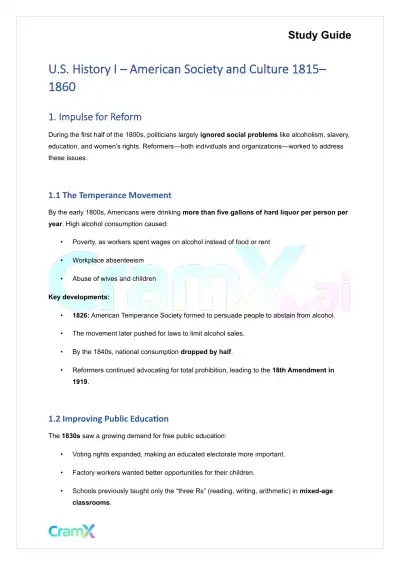 Quick Guides
U.S. History I - American Society and Culture 1815–1860
History
9 pagesMar 2026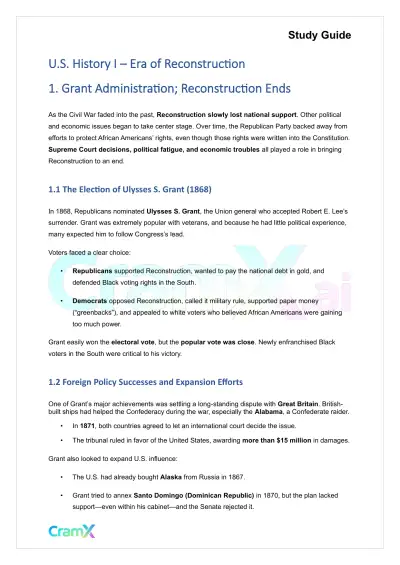 Quick Guides
U.S. History I - Era of Reconstruction
History
9 pagesMar 2026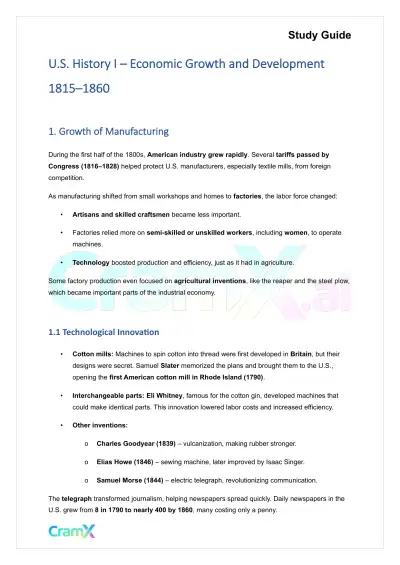 Quick Guides
U.S. History I - Economic Growth and Development 1815–1860
History
8 pagesMar 2026
Study this document with CramX
Once it is in your library, every tool can work from it.