

U.S. History I - Slavery and the South
- History
- Texas A&M University
- 6 pages
- Shared March 2026
Preview 2 of 6 pages
See the first 2 pages exactly as they appear in the document.
Page 1 Read page 1 as text
Study Guide U.S. History I – Slavery and the South 1. Slave Society and Culture Life for enslaved people in the South varied depending on the size of the plantation, the work assigned, and the master's attitude . • Household slaves, blacksmiths, carpenters, and drivers were generally better off than field hands. • Ultimately, the owner controlled all aspects of a slave’s life , including punishment and privileges. 1.1 Labor and Daily Life • Field work: o Harvest: up to 16 hours/day o Winter: 10+ hours/day o Workweek: 6 days, with a half - day on Saturday • Work organization: o Gang system: groups of ~25 under a driver and overseer o Task system: assigned specific daily jobs • Discipline: o Whippings, extra work, or reduced food rations o Good work could earn extra food, visits to other plantations, or small gardens Clothing and food: • Men: clothes twice a year, shoes once a year • Women: cloth to make dresses and children’s clothing • Food: cornmeal, salt pork or bacon, molasses; sometimes supplemented with fish, game, or vegetables • Housing: one - or two - room dirt - floored cabins; multiple families often shared one cabin • Health: poor diet, hard labor, and lack of medical care contributed to high infant mortality (20%) and shorter life expectancy
Page 2 Read page 2 as text
Study Guide 1.2 Slave Families • Marriage: o No legal standing, but often accepted by planters to reduce escape risk o Could involve “jumping the broom,” a simple agreement, or a formal ceremony o Family separations were common; women faced sexual abuse • Roles: o Husband: provider — fishing, hunting, firewood, cabin maintenance o Wife: child care, cooking, sewing, other domestic chores o Extended family (aunts, uncles, grandparents) helped provide support • Challenges: Despite constant threats to family stability, slaves worked to maintain strong family and community ties 1.3 Religion and Culture • Planters encouraged religion to control slaves, focusing on obedience and morality • Slaves created their own religious practices: o Blended evangelical Christianity and West African traditions o Secret meetings emphasized freedom from bondage o Biblical stories of Moses and the Israelites resonated with the hope for deliverance • Music: o “Negro spirituals” expressed sorrow, family separation, hard labor, and hope for freedom o Whites often misinterpreted singing as contentment, ignoring the deeper meaning
4 more pages in the full document
Unlock it once and it stays in your library, ready to chat with or turn into flashcards.
Unlock the full documentMore History study materials
See all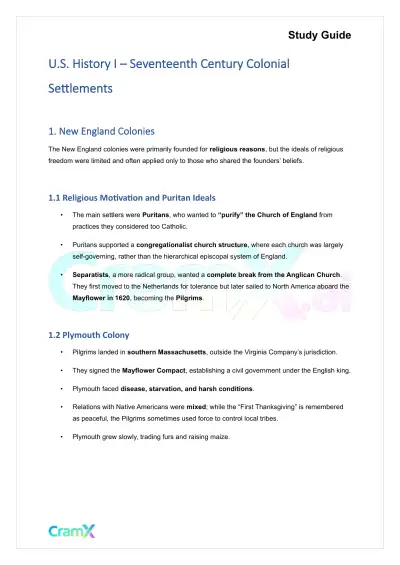 Quick Guides
U.S. History I - Seventeenth Century Colonial Settlements
History
8 pagesMar 2026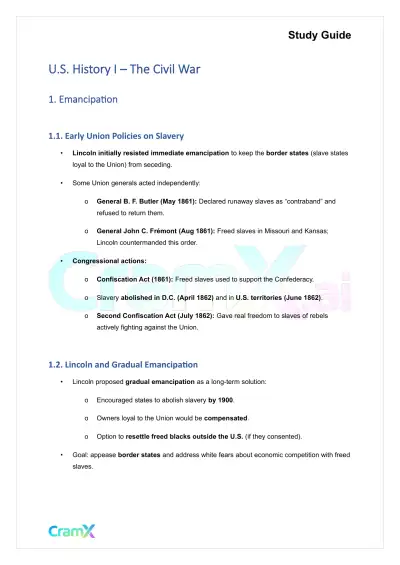 Quick Guides
U.S. History I - The Civil War
History
9 pagesMar 2026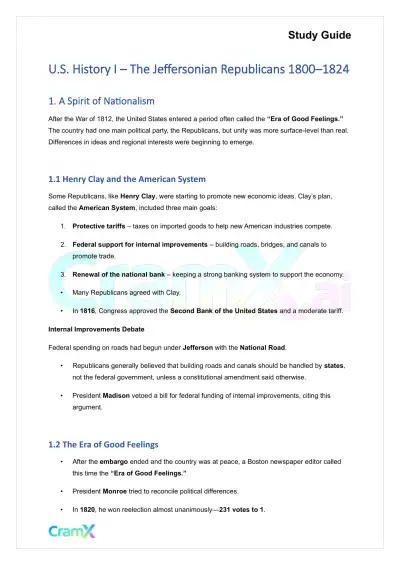 Quick Guides
U.S. History I - The Jeffersonian Republicans 1800–1824
History
11 pagesMar 2026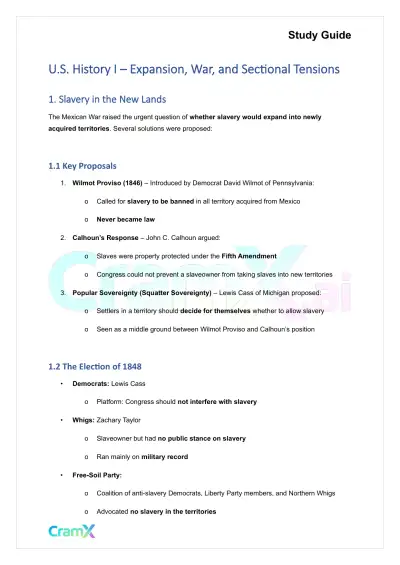 Quick Guides
U.S. History I - Expansion, War, and Sectional Tensions
History
9 pagesMar 2026 Quick Guides
U.S. History I - Challenges for a New Nation
History
9 pagesMar 2026 Quick Guides
U.S. History I - American Society and Culture 1815–1860
History
9 pagesMar 2026 Quick Guides
U.S. History I - Era of Reconstruction
History
9 pagesMar 2026 Quick Guides
U.S. History I - Economic Growth and Development 1815–1860
History
8 pagesMar 2026
Study this document with CramX
Once it is in your library, every tool can work from it.