

U.S. History I - Seventeenth Century Colonial Settlements
- History
- Texas A&M University
- 8 pages
- Shared March 2026
Preview 3 of 8 pages
See the first 3 pages exactly as they appear in the document.
Page 1 Read page 1 as text
Study Guide U.S. History I – Seventeenth Century Colonial Settlements 1. New England Colonies The New England colonies were primarily founded for religious reasons , but the ideals of religious freedom were limited and often applied only to those who shared the founders’ beliefs. 1.1 Religious Motivation and Puritan Ideals • The main settlers were Puritans , who wanted to “purify” the Church of England from practices they considered too Catholic. • Puritans supported a congregationalist church structure , where each church was largely self - governing, rather than the hierarchical episcopal system of England. • Separatists , a more radical group, wanted a complete break from the Anglican Church . They first moved to the Netherlands for tolerance but later sailed to North America aboard the Mayflower in 1620 , becoming the Pilgrims . 1.2 Plymouth Colony • Pilgrims landed in southern Massachusetts , outside the Virginia Company’s jurisdiction. • They signed the Mayflower Compact , establishing a civil government under the English king. • Plymouth faced disease, starvation, and harsh conditions . • Relations with Native Americans were mixed ; while the “First Thanksgiving” is remembered as peaceful, the Pilgrims sometimes used force to control local tribes. • Plymouth grew slowly, trading furs and raising maize.
Page 2 Read page 2 as text
Study Guide 1.3 Massachusetts Bay Colony • Founded by Non - Separatist Puritans between 1630 – 1640 as part of the Great Migration (over 20,000 people). • Led by John Winthrop , who envisioned the colony as “a city upon a hill” , a model of piety. • Churches operated under congregationalist principles , controlled finances, and hired ministers. • Membership was restricted to “saints” , those who passed rigorous spiritual examinations. • Education was vital for literacy and Bible study; Harvard College was founded in 1636 . 1.4 Religious Dissent and Rhode Island • Roger Williams advocated for separation of church and state and religious freedom; he founded Providence , later Rhode Island. • Anne Hutchinson challenged clerical authority and gender norms; she was exiled and later killed in New Netherland. 1.5 Society, Law, and the Half - Way Covenant • Massachusetts Bay was a theocracy , with laws based on Puritan values. • Church membership was required for voting, and personal behavior was strictly regulated. • The Half - Way Covenant (1662) allowed baptized children of non - church - member parents limited membership, addressing declining church participation. • 1691 royal charter shifted voting rights to property owners and allowed religious toleration. 1.6 Salem Witch Trials • Witchcraft hysteria (1692 – 1693) led to over 100 imprisoned and 20 executed . • Causes included family rivalries, social tensions , and conflicts with Puritan beliefs.
Page 3 Read page 3 as text
Study Guide 1.7 Other New England Colonies • Connecticut (1636 – 1639) : Founded by Thomas Hooker and others from Massachusetts; the Fundamental Orders of Connecticut (1639) established self - rule and voting for all freemen. • New Hampshire and Maine : Originally proprietary colonies; Massachusetts controlled New Hampshire until 1679 and Maine until 1820 . 2. Chesapeake Colonies: Virginia and Maryland 2.1 Virginia: Tobacco and Government By 1700 , Virginia colonists had made their fortunes growing tobacco , a trend followed in Maryland and the Carolinas . • Religion: The Church of England was the official church, supported by taxes. However, because there were few churches and clergy, religion was less important in daily life. • Government: Virginia’s government was modeled after English county courts. A royal governor appointed justices of the peace to set taxes and oversee public works like bridges and roads. • In the 1650s , Virginia created a bicameral assembly : o House of Burgesses – elected lower house o Governor’s Council – appointed upper house 2.2 Maryland: A Haven for Catholics Maryland was the first proprietary colony , granted to Cecilius Calvert, Lord Baltimore . • Lord Baltimore named the colony after Queen Henrietta Maria and intended it as a safe place for English Catholics . • Few Catholics settled there; instead, Protestants came for cheap land. • Large estates, similar to medieval manors, created the plantation system . • In 1649 , the Act of Religious Toleration allowed freedom of worship for Christians. But by 1654 , Protestants repealed it, leading to near civil war until 1658 . Religious tension remained for years.
5 more pages in the full document
Unlock it once and it stays in your library, ready to chat with or turn into flashcards.
Unlock the full documentMore History study materials
See all Quick Guides
U.S. History I - The Civil War
History
9 pagesMar 2026 Quick Guides
U.S. History I - The Jeffersonian Republicans 1800–1824
History
11 pagesMar 2026 Quick Guides
U.S. History I - Expansion, War, and Sectional Tensions
History
9 pagesMar 2026 Quick Guides
U.S. History I - Challenges for a New Nation
History
9 pagesMar 2026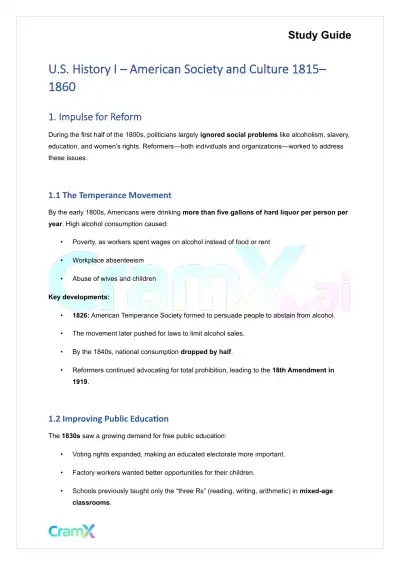 Quick Guides
U.S. History I - American Society and Culture 1815–1860
History
9 pagesMar 2026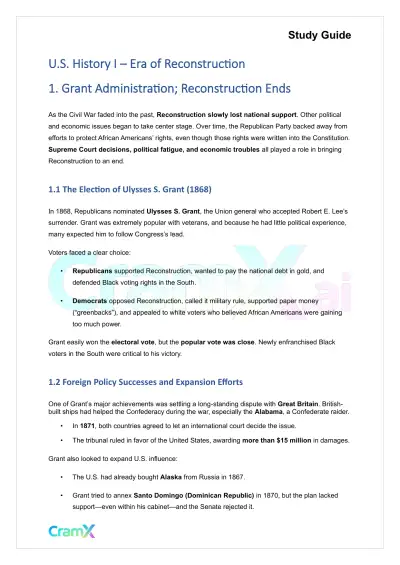 Quick Guides
U.S. History I - Era of Reconstruction
History
9 pagesMar 2026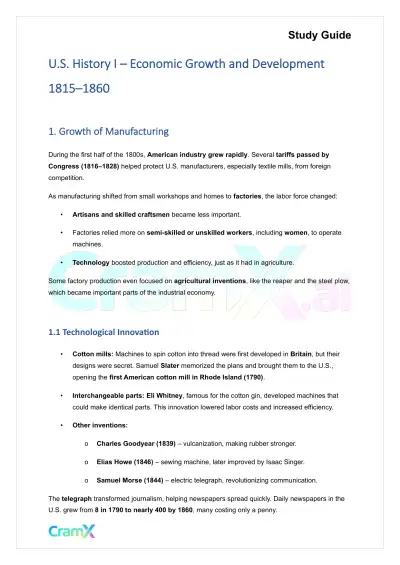 Quick Guides
U.S. History I - Economic Growth and Development 1815–1860
History
8 pagesMar 2026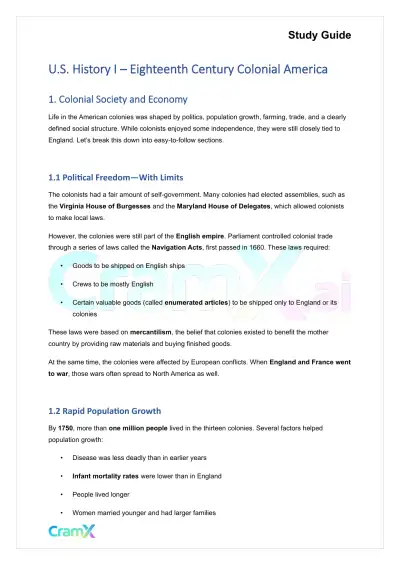 Quick Guides
U.S. History I - Eighteenth Century Colonial America
History
11 pagesMar 2026
Study this document with CramX
Once it is in your library, every tool can work from it.