

U.S. History I - The Civil War
- History
- Texas A&M University
- 9 pages
- Shared March 2026
Preview 3 of 9 pages
See the first 3 pages exactly as they appear in the document.
Page 1 Read page 1 as text
Study Guide U.S. History I – The Civil War 1. Emancipation 1. 1. Early Union Policies on Slavery • Lincoln initially resisted immediate emancipation to keep the border states (slave states loyal to the Union) from seceding. • Some Union generals acted independently: o General B. F. Butler (May 1861): Declared runaway slaves as “contraband” and refused to return them. o General John C. Frémont (Aug 1861): Freed slaves in Missouri and Kansas; Lincoln countermanded this order. • Congressional actions: o Confiscation Act (1861): Freed slaves used to support the Confederacy. o Slavery abolished in D.C. (April 1862) and in U.S. territories (June 1862) . o Second Confiscation Act (July 1862): Gave real freedom to slaves of rebels actively fighting against the Union. 1. 2. Lincoln and Gradual Emancipation • Lincoln proposed gradual emancipation as a long - term solution: o Encouraged states to abolish slavery by 1900 . o Owners loyal to the Union would be compensated . o Option to resettle freed blacks outside the U.S. (if they consented). • Goal: appease border states and address white fears about economic competition with freed slaves.
Page 2 Read page 2 as text
Study Guide 1. 3. The Emancipation Proclamation • Preliminary Proclamation: Sept 22, 1862 o Declared freedom for slaves in Confederate states as of Jan 1, 1863. o Did not apply to border states or Confederate areas that rejoined the Union early. • Formal Proclamation: Jan 1, 1863 o Freed slaves in rebelling Confederate territories o Urged slaves to avoid violence except in self - defense o Allowed African Americans to serve in the Union army and navy • Impact: o Redefined the war’s purpose: from preserving the Union to ending slavery o North and South realized its moral and military significance o Many slaves fled to Union lines, seeking freedom 1. 4. African Americans in the Civil War • Nearly 200,000 African Americans served , mostly former slaves. • Initially assigned to support roles , later fought in combat . • Pay inequity: Blacks received lower pay until June 1864. • Casualties: ~37,000 killed, a higher rate than white soldiers. • Confederacy: o Used slaves for labor, cooking, and military support o In 1865, legislation was passed to enlist 300,000 slaves , but the war ended before it took effect o Irony: slaves would have fought to defend a system committed to keeping them enslaved
Page 3 Read page 3 as text
Study Guide 2. Politics and Economics of the War: 2. 1 Republican Domestic Program (North) • Transcontinental Railroad: o Pacific Railroad Act (1862): Authorized building a line from Omaha, Nebraska, and Sacramento, California. o Land & Loans: Union Pacific and Central Pacific received 60+ million acres and $20 million in loans. o Completed in 1869 . • Homestead Act (1862): Granted 160 acres free to anyone working the land for 5 years. • Morrill Land Grant Act (1862): Public lands given to states to create colleges focused on agriculture and mechanical arts , laying the foundation for modern state universities. 2. 2 Financing the War (North & South) Union: • Revenue sources: Higher tariffs, excise taxes, first federal income tax. • Bureau of Internal Revenue collected taxes. • Greenbacks: Paper money issued as legal tender. • Bonds: Sold widely, raising national debt to ~$3 billion by 1865. Profiteering: • Contractors sometimes provided poor - quality goods. • Example: Shoddy uniforms — cheap, falling apart; “shoddy” became a term for poor quality. Confederacy: • Expected foreign loans did not materialize . • Taxes raised poorly; less than 5% of revenue. • Paper money lacked public confidence → hyperinflation : Confederate dollar worth ~1.5 cents in gold by 1865; prices rose over 9,000% .
6 more pages in the full document
Unlock it once and it stays in your library, ready to chat with or turn into flashcards.
Unlock the full documentMore History study materials
See all Quick Guides
U.S. History I - Seventeenth Century Colonial Settlements
History
8 pagesMar 2026 Quick Guides
U.S. History I - The Jeffersonian Republicans 1800–1824
History
11 pagesMar 2026 Quick Guides
U.S. History I - Expansion, War, and Sectional Tensions
History
9 pagesMar 2026 Quick Guides
U.S. History I - Challenges for a New Nation
History
9 pagesMar 2026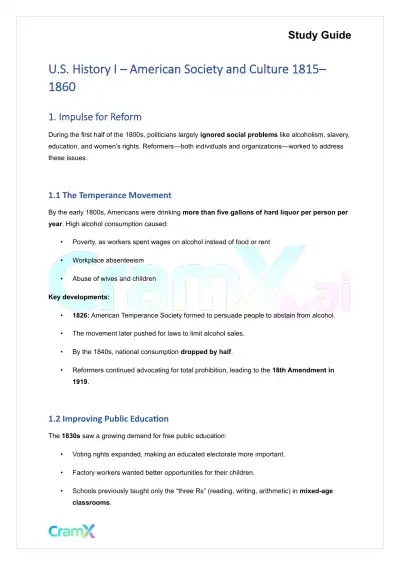 Quick Guides
U.S. History I - American Society and Culture 1815–1860
History
9 pagesMar 2026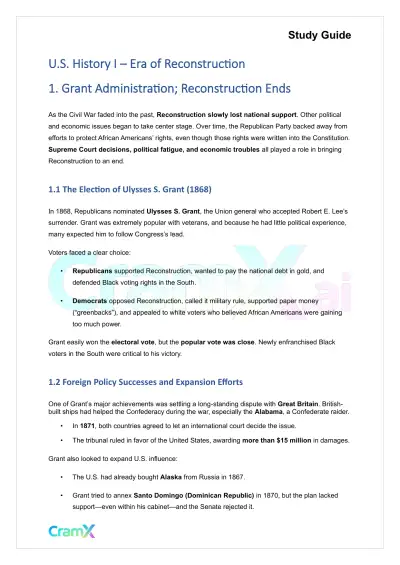 Quick Guides
U.S. History I - Era of Reconstruction
History
9 pagesMar 2026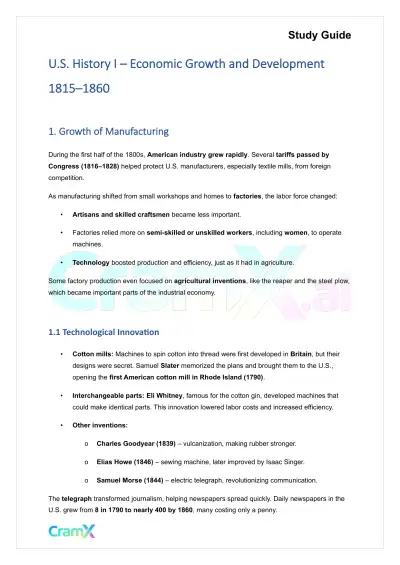 Quick Guides
U.S. History I - Economic Growth and Development 1815–1860
History
8 pagesMar 2026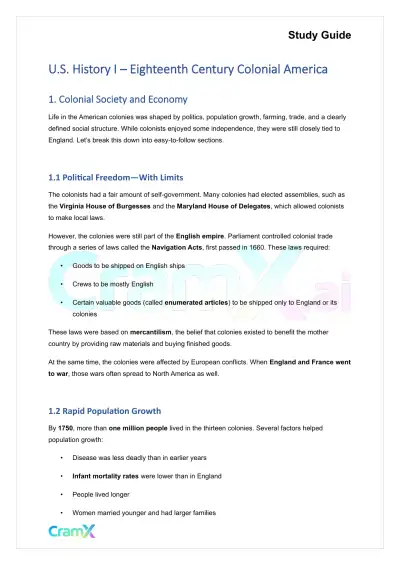 Quick Guides
U.S. History I - Eighteenth Century Colonial America
History
11 pagesMar 2026
Study this document with CramX
Once it is in your library, every tool can work from it.