

U.S. History I - Creating a New Nation
- History
- Texas A&M University
- 13 pages
- Shared March 2026
Preview 4 of 13 pages
See the first 4 pages exactly as they appear in the document.
Page 1 Read page 1 as text
Study Guide U.S. History I – Creating a New Nation 1. Governing the New Nation After winning independence, the United States faced a new and difficult challenge: how to govern itself . The war had lasted eight years and followed more than a decade of political tension. Even before the fighting ended, Americans were already debating what kind of government they wanted and how power should be shared between the national government and th e states. 1.1 Creating New State Governments When the Revolutionary War began, colonial governments collapsed . Royal governors fled, and Britain’s authority disappeared. In response, 11 of the 13 states held revolutionary conventions to write new state constitutions . Most of these new governments shared similar features: • A strong legislature with two houses • The legislature usually chose the governor • Governors had limited power Because Americans distrusted strong executive authority, governors often: • Served only one - year terms • Had no veto power • Could not appoint officials without legislative approval Voting and holding office required owning property , so political power was limited to a portion of white men . These governments were not democratic by modern standards . At the time, “democracy” was associated with chaos and mob rule, which people feared as much as monarchy. However, many states did include a bill of rights in their constitutions to protect basic freedoms such as speech and religion.
Page 2 Read page 2 as text
Study Guide 1.2 The Articles of Confederation: America’s First National Government The new nation’s first national government was created by the Articles of Confederation , adopted in 1777 and fully ratified in 1781 . Until then, the Continental Congress continued running the government and the war effort. Why Ratification Took So Long The delay was caused by disagreements over western land claims . Some states, like Virginia and New York , claimed land all the way to the Mississippi River. Smaller states, especially Maryland , worried these states would become too powerful. Maryland finally ratified the Articles after those claims were given up. 1.3 How the Articles of Confederation Worked Under the Articles: • The national government had one legislative body (a unicameral Congress) • There was no president and no national court system • States appointed delegates to Congress • Each state had one vote , no matter its size • Nine out of thirteen votes were needed to pass laws • All thirteen states had to agree to amend the Articles Congress had the power to: • Declare war • Conduct foreign policy • Coin money • Manage Native American affairs in the territories • Run the post office • Borrow money • Appoint military officers Most importantly, any power not given to Congress stayed with the states .
Page 3 Read page 3 as text
Study Guide 1.4 Weaknesses of the Articles The Articles created a very weak national government , and problems quickly became clear. Congress: • Could not tax the states (it could only ask for money) • Could not regulate trade between states or with other countries • Could not raise an army on its own, only request troops from states As a result: • States taxed each other’s goods • Trade suffered • The national government struggled to pay its debts or enforce laws 1.5 Money Problems and Shays’s Rebellion After the war, the United States owed about $160 million . To create a national currency, Congress printed paper money backed by foreign loans. However, too much money was printed, causing: • Inflation • A sharp drop in the value of money States printed their own money as well, which made the problem worse. High taxes and debts led to farm foreclosures , especially in Massachusetts. In 1786 , Daniel Shays , a former Revolutionary War captain and struggling farmer, led about 2,000 men to shut down courthouses to stop foreclosures. When Shays marched on an arsenal in Springfield , the rebellion ended quickly after the militia intervened. Although the rebellion failed, it frightened many leaders. Massachusetts responded by: • Lowering taxes • Protecting essential personal property from seizure Shays’s Rebellion convinced many Americans that the country needed a stronger national government .
Page 4 Read page 4 as text
Study Guide 1.6 Successes of the Confederation Congress Despite its weaknesses, the Confederation Congress achieved important successes, especially in organizing western lands. The Land Ordinance of 1785 This law created a clear system for surveying land: • Townships were 6 miles by 6 miles • Each township had 36 sections , each 640 acres • Sections could be divided into smaller farms • 160 acres was considered enough for a family to live independently • One section in each township was set aside to fund public education 1.7 The Northwest Ordinance of 1787 This ordinance created the Northwest Territory , which later became: • Ohio • Indiana • Illinois • Wisconsin • Michigan It also established a clear process for becoming a state: 1. Congress appointed a governor and judges 2. When 5,000 adult males lived there, residents elected a legislature 3. At 60,000 people, residents wrote a state constitution 4. Congress could then admit the territory as a state This process became a model for future expansion.
9 more pages in the full document
Unlock it once and it stays in your library, ready to chat with or turn into flashcards.
Unlock the full documentMore History study materials
See all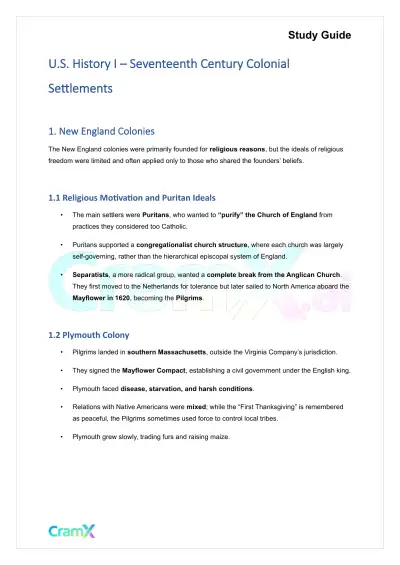 Quick Guides
U.S. History I - Seventeenth Century Colonial Settlements
History
8 pagesMar 2026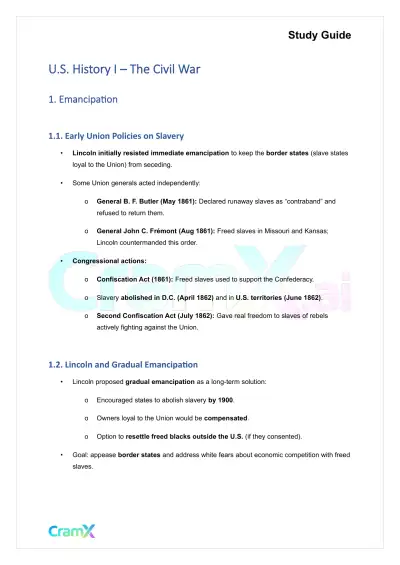 Quick Guides
U.S. History I - The Civil War
History
9 pagesMar 2026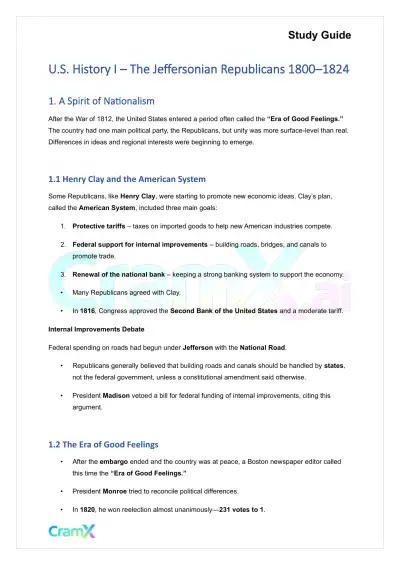 Quick Guides
U.S. History I - The Jeffersonian Republicans 1800–1824
History
11 pagesMar 2026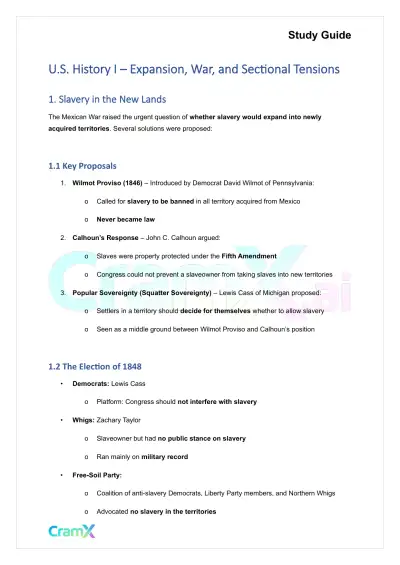 Quick Guides
U.S. History I - Expansion, War, and Sectional Tensions
History
9 pagesMar 2026 Quick Guides
U.S. History I - Challenges for a New Nation
History
9 pagesMar 2026 Quick Guides
U.S. History I - American Society and Culture 1815–1860
History
9 pagesMar 2026 Quick Guides
U.S. History I - Era of Reconstruction
History
9 pagesMar 2026 Quick Guides
U.S. History I - Economic Growth and Development 1815–1860
History
8 pagesMar 2026
Study this document with CramX
Once it is in your library, every tool can work from it.