

U.S. History I - Era of Reconstruction
- History
- Texas A&M University
- 9 pages
- Shared March 2026
Preview 3 of 9 pages
See the first 3 pages exactly as they appear in the document.
Page 1 Read page 1 as text
Study Guide U.S. History I – Era of Reconstruction 1. Grant Administration; Reconstruction Ends A s the Civil War faded into the past, Reconstruction slowly lost national support . Other political and economic issues began to take center stage. Over time, the Republican Party backed away from efforts to protect African Americans’ rights, even though those rights were written into the Constitution. Supreme Court decisions, political fatigue, and economic troubles all played a role in bringing Reconstruction to an end. 1.1 The Election of Ulysses S. Grant (1868) In 1868, Republicans nominated Ulysses S. Grant , the Union general who accepted Robert E. Lee’s surrender. Grant was extremely popular with veterans, and because he had little political experience, many expected him to follow Congress’s lead. Voters faced a clear choice: • Republicans supported Reconstruction, wanted to pay the national debt in gold, and defended Black voting rights in the South. • Democrats opposed Reconstruction, called it military rule, supported paper money (“greenbacks”), and appealed to white voters who believed African Americans were gaining too much power. Grant easily won the electoral vote , but the popular vote was close . Newly enfranchised Black voters in the South were critical to his victory. 1.2 Foreign Policy Successes and Expansion Efforts One of Grant’s major achievements was settling a long - standing dispute with Great Britain . British - built ships had helped the Confederacy during the war, especially the Alabama , a Confederate raider. • In 1871 , both countries agreed to let an international court decide the issue. • The tribunal ruled in favor of the United States, awarding more than $15 million in damages. Grant also looked to expand U.S. influence: • The U.S. had already bought Alaska from Russia in 1867. • Grant tried to annex Santo Domingo (Dominican Republic) in 1870, but the plan lacked support — even within his cabinet — and the Senate rejected it.
Page 2 Read page 2 as text
Study Guide 1.3 Scandals and Corruption at Home Grant’s presidency was plagued by scandals , often involving people close to him: • His brother - in - law joined financiers Jay Gould and Jim Fisk in a scheme to control the gold market. • Vice President Schuyler Colfax was tied to the Crédit Mobilier scandal , involving railroad corruption. • In New York City, political boss William “Boss” Tweed and the Tweed Ring stole millions through bribery and fraud. These scandals hurt public trust and weakened Grant’s leadership. 1.4 The Republican Party Splits (1872) Concern about corruption and Reconstruction caused a split within the Republican Party. • Liberal Republicans broke away and nominated Horace Greeley , a newspaper editor. • Greeley was also supported by the Democrats. • He favored ending Reconstruction immediately , civil service reform, and stopping land giveaways to railroads. Despite these challenges, Grant won reelection in 1872 , with even larger margins than in 1868. 1.5 The Panic of 1873 and Economic Crisis Grant’s second term coincided with a major economic disaster. • Overinvestment in railroads led to financial collapse. • The failure of Jay Cooke’s bank triggered a stock market crash. • Thousands of businesses failed, unemployment rose, and crop prices fell. A major debate followed over money: • Hard - money supporters wanted currency backed by gold. • Farmers and manufacturers wanted more paper money to make credit easier.
Page 3 Read page 3 as text
Study Guide 1.6 Reconstruction Begins to Collapse Several actions weakened Reconstruction: • General Amnesty Act (1872): Removed restrictions on former Confederate leaders. • Slaughterhouse Cases (1873): The Supreme Court ruled that the Fourteenth Amendment protected only national citizenship, not state citizenship, limiting federal power to protect civil rights. Congress made one final effort: • Civil Rights Act of 1875 banned racial discrimination in public places and protected jury service. • The law was poorly enforced and later struck down by the Supreme Court in 1883 . By the mid - 1870s, both political parties were ready to abandon Reconstruction . 1.7 The Controversial Election of 1876 The 1876 election was one of the most disputed in U.S. history. • Republicans: Rutherford B. Hayes of Ohio, known for honesty. • Democrats: Samuel J. Tilden of New York, famous for fighting corruption. Tilden won more popular votes , but was one electoral vote short of victory. Twenty electoral votes from four states were disputed. Congress formed a special commission: • 8 Republicans and 7 Democrats • The commission voted 8 – 7 each time — in favor of Hayes. 1.8 The Compromise of 1877: Reconstruction Ends Democrats in Congress threatened to block Hayes’s presidency unless concessions were made. The Compromise of 1877 settled the crisis: • Hayes became president.
6 more pages in the full document
Unlock it once and it stays in your library, ready to chat with or turn into flashcards.
Unlock the full documentMore History study materials
See all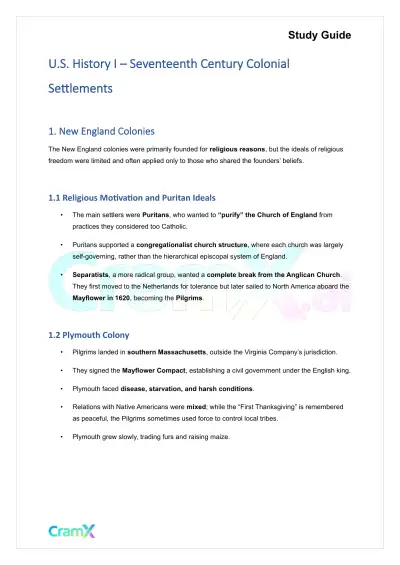 Quick Guides
U.S. History I - Seventeenth Century Colonial Settlements
History
8 pagesMar 2026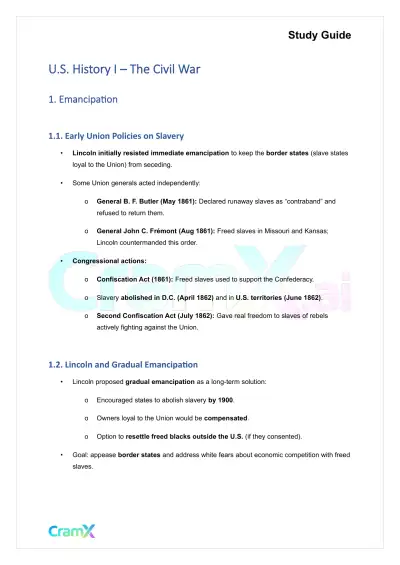 Quick Guides
U.S. History I - The Civil War
History
9 pagesMar 2026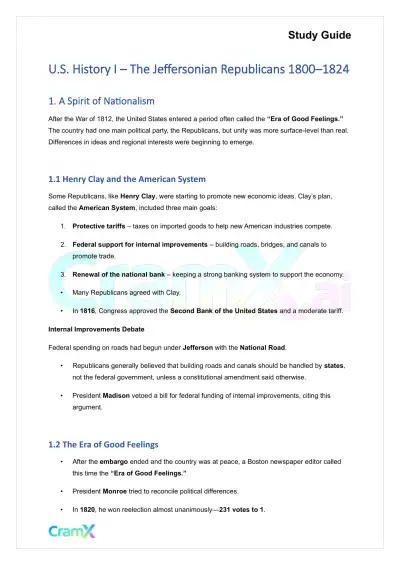 Quick Guides
U.S. History I - The Jeffersonian Republicans 1800–1824
History
11 pagesMar 2026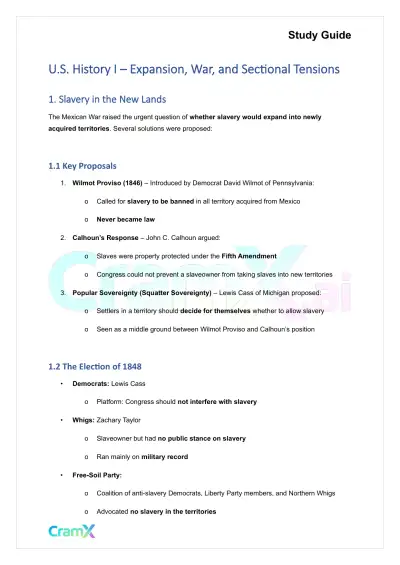 Quick Guides
U.S. History I - Expansion, War, and Sectional Tensions
History
9 pagesMar 2026 Quick Guides
U.S. History I - Challenges for a New Nation
History
9 pagesMar 2026 Quick Guides
U.S. History I - American Society and Culture 1815–1860
History
9 pagesMar 2026 Quick Guides
U.S. History I - Economic Growth and Development 1815–1860
History
8 pagesMar 2026 Quick Guides
U.S. History I - Eighteenth Century Colonial America
History
11 pagesMar 2026
Study this document with CramX
Once it is in your library, every tool can work from it.