

U.S. History II - America in the Fifties
- History
- Texas A&M University
- 12 pages
- Shared March 2026
Preview 4 of 12 pages
See the first 4 pages exactly as they appear in the document.
Page 1 Read page 1 as text
Study Guide U.S. History II – America in the Fifties 1. American Foreign Policy During the 1952 presidential campaign , Dwight D. Eisenhower criticized President Truman’s policy of containment , arguing it was too weak against communism. However, once in office, Eisenhower did not try to roll back communism where it already existed. Instead, he focused on preventing its spread while avoiding direct war with the Soviet Union. Although Secretary of State John Foster Dulles often talked about freeing the “ captive peoples ” of Eastern Europe, the United States did not act when chances arose. For example, the U.S. offered no help during labor unrest in East Germany (1953) or the Hungarian revolt (1956) . Eisenhower believed it was safer to limit Soviet influence in other ways rather than risk a direct military conflict. 1.1 Brinkmanship, Massive Retaliation, and Nuclear Strategy Eisenhower relied heavily on the United States’ nuclear weapons to maintain power in the Cold War. This approach led to two key strategies: Brinkmanship Brinkmanship meant being willing to go to the edge of war , even nuclear war, to force an enemy to back down. The idea was that the Soviet Union or China would retreat rather than risk total destruction. Massive Retaliation Massive retaliation was the promise that the U.S. would respond to aggression with overwhelming nuclear force . This strategy was seen as cheaper and more effective than maintaining large conventional armies — giving the U.S. “ more bang for the buck .” These threats were sometimes effective. In 1953 , Eisenhower’s suggestion that the U.S. might use nuclear weapons helped end the Korean War . The U.S. also threatened nuclear action to defend the islands of Quemoy and Matsu in 1955 when Communist China challenged Taiwan. 1.2 The Domino Theory and Southeast Asia Another key idea shaping U.S. policy was the domino theory . According to this theory, if one country fell to communism, nearby countries would soon follow. Eisenhower first explained this idea while discussing events in Indochina .
Page 2 Read page 2 as text
Study Guide In 1954 , France ended its long colonial war in Indochina by signing the Geneva Accords . The agreements: • Made Laos and Cambodia neutral • Divided Vietnam at the 17th parallel • Put Ho Chi Minh and the Vietminh in control of the North • Left South Vietnam under a pro - Western government • Called for nationwide elections in 1956 to reunite the country Fearing that the Communists would win the elections, the United States and South Vietnam refused to support the Accords. Instead, the U.S.: • Backed Ngo Dinh Diem’s government in South Vietnam with military and economic aid • Helped form SEATO (Southeast Asia Treaty Organization) to limit communist expansion Unlike NATO, SEATO was weak . It did not require members to defend one another and mainly served as a consultation group. 1.3 The Middle East and the Eisenhower Doctrine In the Middle East , Eisenhower wanted to block Soviet influence and protect access to oil . In 1953 , the CIA helped overthrow Iran’s government and restore the pro - Western shah to power. Trouble also arose in Egypt , where nationalist leader Gamal Abdel Nasser planned to build the Aswan High Dam . When Egypt strengthened ties with the USSR, the U.S. and Britain withdrew financial support. Nasser responded by nationalizing the Suez Canal in 1956. This led to the Suez Crisis , when Israel, Britain, and France attacked Egypt. Both the United States and the Soviet Union opposed the invasion and pressured the attackers to withdraw through the United Nations . Although the U.S. helped end the crisis, Soviet influence in the region actually increased. In response, Eisenhower announced the Eisenhower Doctrine , promising U.S. military aid to Middle Eastern countries resisting communism. In 1958 , this policy led to the deployment of 14,000 American troops to Lebanon .
Page 3 Read page 3 as text
Study Guide 1.4 Covert Action in Latin America Even though the U.S. officially followed a non - intervention policy in Latin America, it continued to influence the region through covert operations . In 1954 , the CIA helped overthrow Jacobo Arbenz of Guatemala after he pushed land reforms that threatened the United Fruit Company , an American business. These actions fueled anti - American sentiment , which became clear during Vice President Nixon’s 1958 tour of Latin America, where protests broke out. Meanwhile, in 1959 , Fidel Castro took power in Cuba . At first, the U.S. supported the revolution, but relations quickly worsened when Castro aligned with Communists. After the U.S. placed an embargo on Cuban sugar, Castro turned to the Soviet Union for support. 1.5 Relations with the Soviet Union and the Space Race Eisenhower believed that meeting Soviet leaders in person could reduce tensions. The first summit conference was held in Geneva in 1955 , producing a brief easing of tensions known as the “spirit of Geneva.” That spirit faded quickly. In 1956 , the USSR crushed the Hungarian uprising. In 1957 , the Soviets shocked the world by launching Sputnik , the first artificial satellite. This event: • Started the space race • Raised fears of a missile gap • Led to the National Defense Education Act (1958) , which increased funding for science, math, and language education 1.6 The U - 2 Incident and Eisenhower’s Warning Summit talks resumed in 1959 when Eisenhower met Nikita Khrushchev at Camp David. However, relations collapsed in 1960 when the Soviets shot down a U.S. U - 2 spy plane over their territory. Khrushchev exposed the incident by showing the captured pilot, Francis Gary Powers , and spy equipment, forcing Eisenhower to admit that U.S. surveillance flights had been ongoing. Although Eisenhower’s diplomacy with the Soviet Union ultimately failed, he left an important warning. In his farewell address , he cautioned Americans about the growing power of the military - industrial complex — the close relationship between the military and defense industries. He warned that this alliance could gain too much influence over U.S. foreign policy if left unchecked.
Page 4 Read page 4 as text
Study Guide 2. The Civil Rights Movement After World War II, the struggle for civil rights in the United States gained new energy. While progress was slow at first, the 1950s became a turning point as African Americans challenged segregation through the courts and through organized, peaceful prot est. Presidents, Congress, and the Supreme Court all played roles — but change came largely because ordinary people demanded it. 2.1 Early Federal Action on Civil Rights Under President Harry Truman , the federal government took limited but important steps: • Truman issued executive orders that: o Ended discrimination in federal government jobs o Desegregated the armed forces These actions showed federal support for civil rights, but they did not end segregation in everyday life, especially in the South. During the Eisenhower administration , the focus shifted to enforcing court decisions. Eisenhower did not strongly believe that courts alone could end discrimination, but he did believe in upholding the law and made it clear that federal rulings had to be obeyed. 2.2 Brown v. Board of Education (1954) The biggest legal breakthrough came from the courts. • The NAACP Legal Defense and Education Fund targeted the foundation of segregation: • Plessy v. Ferguson (1896) , which had allowed “separate but equal” facilities. • In Brown v. Board of Education of Topeka, Kansas , the Supreme Court ruled in 1954 that: o Separate schools for black and white students were inherently unequal o School segregation violated the Fourteenth Amendment’s equal protection clause Chief Justice Earl Warren , appointed by Eisenhower, worked to ensure the decision was unanimous , believing unity would give the ruling more authority. • In 1955 , the Court ordered school desegregation to proceed “with all deliberate speed” • The Court did not explain exactly how desegregation should happen, leaving that to states and local governments
8 more pages in the full document
Unlock it once and it stays in your library, ready to chat with or turn into flashcards.
Unlock the full documentMore History study materials
See all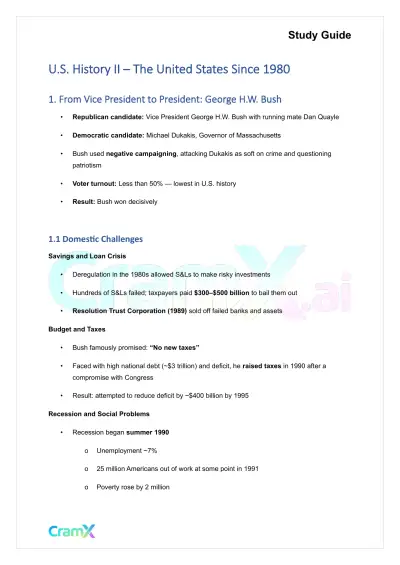 Quick Guides
U.S. History II - The United States Since 1980
History
16 pagesMar 2026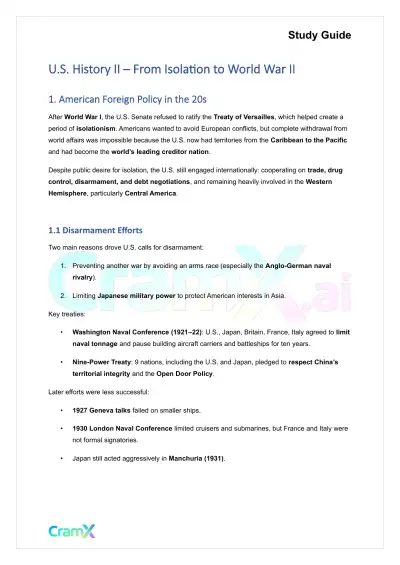 Quick Guides
U.S. History II - From Isolation to World War II
History
9 pagesMar 2026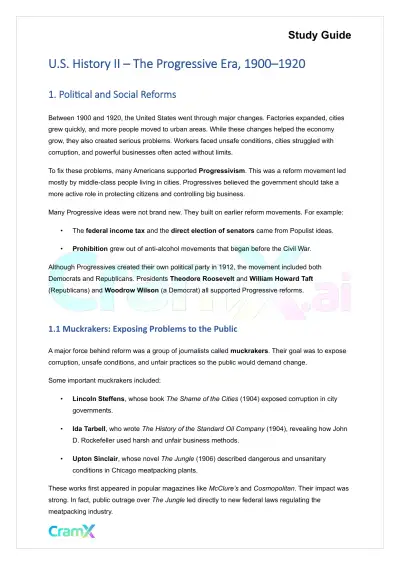 Quick Guides
U.S. History II - The Progressive Era, 1900–1920
History
10 pagesMar 2026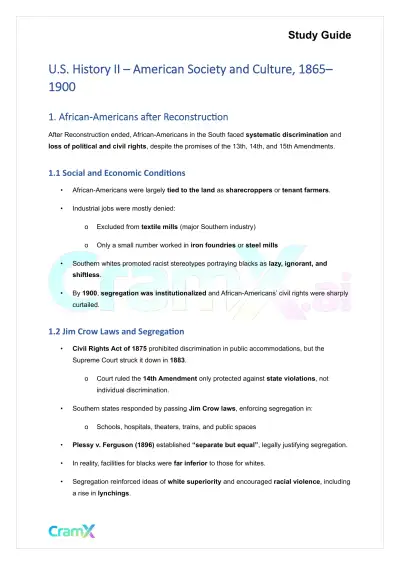 Quick Guides
U.S. History II - American Society and Culture, 1865–1900
History
7 pagesMar 2026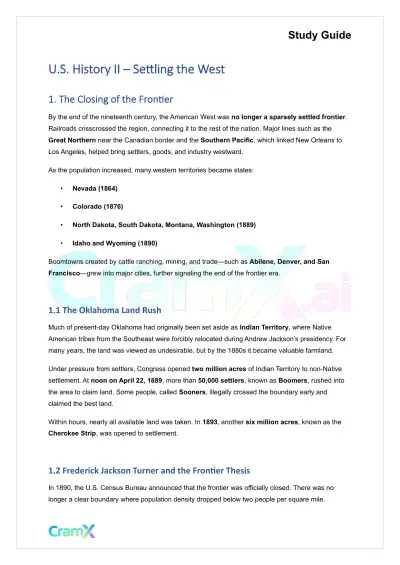 Quick Guides
U.S. History II - Settling the West
History
13 pagesMar 2026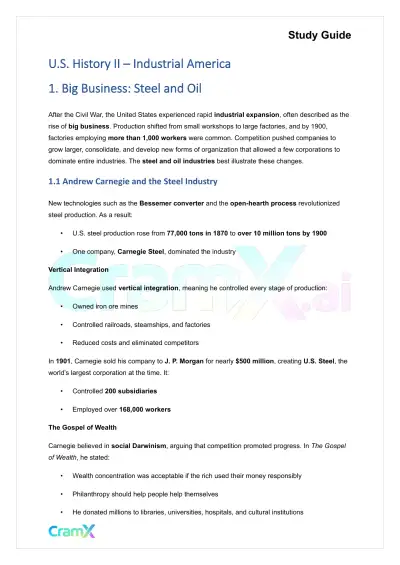 Quick Guides
U.S. History II - Industrial America
History
12 pagesMar 2026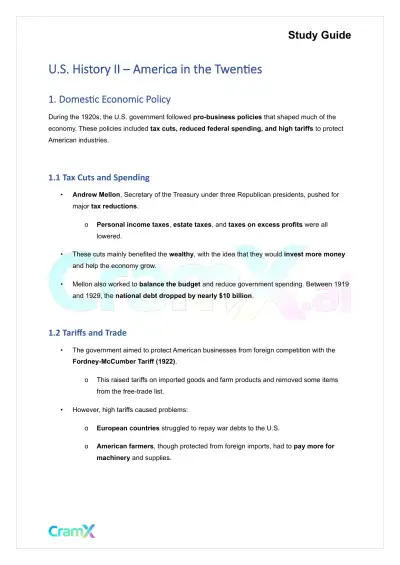 Quick Guides
U.S. History II - America in the Twenties
History
9 pagesMar 2026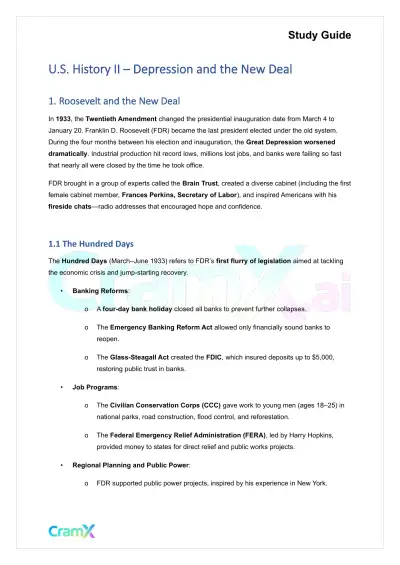 Quick Guides
U.S. History II - Depression and the New Deal
History
10 pagesMar 2026
Study this document with CramX
Once it is in your library, every tool can work from it.