

U.S. History II - American Society and Culture, 1865–1900
- History
- Texas A&M University
- 7 pages
- Shared March 2026
Preview 3 of 7 pages
See the first 3 pages exactly as they appear in the document.
Page 1 Read page 1 as text
Study Guide U.S. History II – American Society and Culture, 1865 – 1900 1. African ‐ Americans after Reconstruction After Reconstruction ended, African - Americans in the South faced systematic discrimination and loss of political and civil rights , despite the promises of the 13th, 14th, and 15th Amendments. 1.1 Social and Economic Conditions • African - Americans were largely tied to the land as sharecroppers or tenant farmers . • Industrial jobs were mostly denied: o Excluded from textile mills (major Southern industry) o Only a small number worked in iron foundries or steel mills • Southern whites promoted racist stereotypes portraying blacks as lazy, ignorant, and shiftless . • By 1900 , segregation was institutionalized and African - Americans’ civil rights were sharply curtailed. 1.2 Jim Crow Laws and Segregation • Civil Rights Act of 1875 prohibited discrimination in public accommodations, but the Supreme Court struck it down in 1883 . o Court ruled the 14th Amendment only protected against state violations , not individual discrimination. • Southern states responded by passing Jim Crow laws , enforcing segregation in: o Schools, hospitals, theaters, trains, and public spaces • Plessy v. Ferguson (1896) established “separate but equal” , legally justifying segregation. • In reality, facilities for blacks were far inferior to those for whites. • Segregation reinforced ideas of white superiority and encouraged racial violence , including a rise in lynchings .
Page 2 Read page 2 as text
Study Guide 1.3 Voting Restrictions • Despite the 15th Amendment , Southern states disenfranchised African - Americans through: o Poll taxes o Literacy tests o Residency requirements o Criminal disenfranchisement o Grandfather clauses (e.g., Louisiana) favoring whites • By 1900 , African - Americans were largely prevented from voting in the South, even where loopholes existed. 1.4 African - American Responses • Great Migration began in the 1890s: blacks moved from rural South to urban North • Small emigration to Africa occurred • All - black towns established in Tennessee, Kansas, and Oklahoma Territory Early civil rights organizations: o Citizens Equal Rights Association (1887) o Afro - American League (1890) Leadership and Philosophies 1. Booker T. Washington (Tuskegee Institute, 1882) o Advocated economic self - improvement first o Promoted vocational and agricultural education o Supported accommodation with segregation ( Atlanta Compromise , 1895) 2. W. E. B. Du Bois (Harvard, The Souls of Black Folks , 1903) o Rejected Washington’s philosophy o Advocated higher education for African - Americans o Believed in educated elite leading equality via: • Voting where possible , Protest and agitation where voting was denied
Page 3 Read page 3 as text
Study Guide 2. Everyday Life in America 2.1 Shopping and Mass Production After the Civil War, mass production changed how Americans bought clothes, food, and household goods. Handmade clothing was replaced by ready - to - wear clothes sold in stores. People in small towns and farms could also shop without traveling far thanks to mail - order catalogs . • Aaron Montgomery Ward started the first mail - order business in 1872 with a one - page catalog of 150 items. By 1884, his catalog had over 10,000 items. • Sears, Roebuck and Company became even more successful, offering clothing, tools, and farm equipment. • In 1896, the first Rural Free Delivery (RFD) service made catalog shopping even easier for people outside cities. Food also became more widely available. Easterners could buy California oranges, Wyoming beef, and fresh milk shipped by refrigerated rail cars. Famous brands like Campbell’s Soup, Nabisco crackers, and Coca - Cola appeared in the 1890s. Chain stores such as A & P and the five - and - dime stores like Woolworth’s grew because of mass buying and advertising. 2.2 Education Expands Education grew rapidly after the Civil War: • Public schools doubled enrollment between 1870 and 1900, with high school attendance increasing sharply. Immigrant families sent children to school to learn English and American culture, while middle - class families expanded secondary education. • Schools introduced new subjects: American history, science, and manual arts . Vocational high schools appeared by the end of the century. Higher education also expanded: • Colleges and universities grew to nearly 250,000 students by 1900, four times more than 30 years earlier. • The Morrill Act (1862) created land - grant colleges for agriculture and mechanical arts; the Second Morrill Act (1890) expanded funding, including support for black colleges.
4 more pages in the full document
Unlock it once and it stays in your library, ready to chat with or turn into flashcards.
Unlock the full documentMore History study materials
See all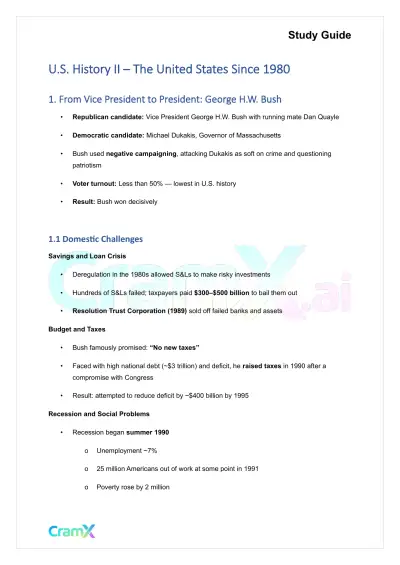 Quick Guides
U.S. History II - The United States Since 1980
History
16 pagesMar 2026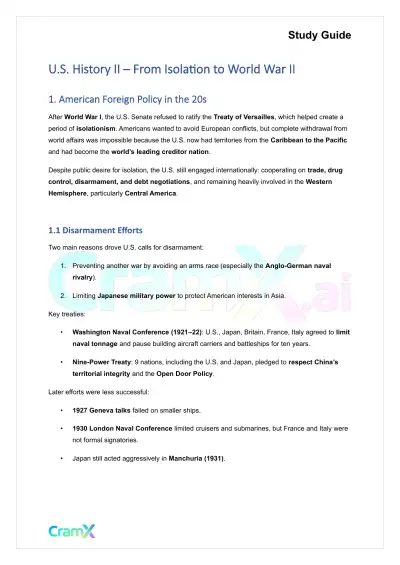 Quick Guides
U.S. History II - From Isolation to World War II
History
9 pagesMar 2026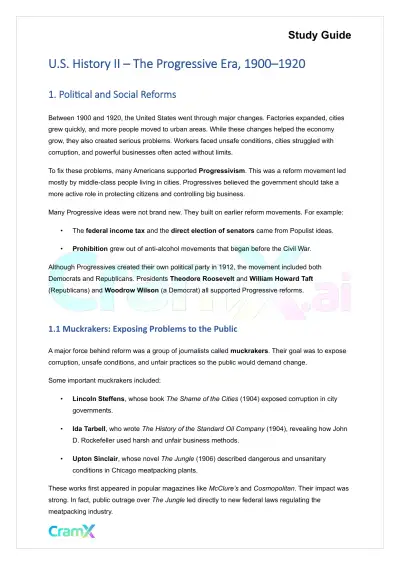 Quick Guides
U.S. History II - The Progressive Era, 1900–1920
History
10 pagesMar 2026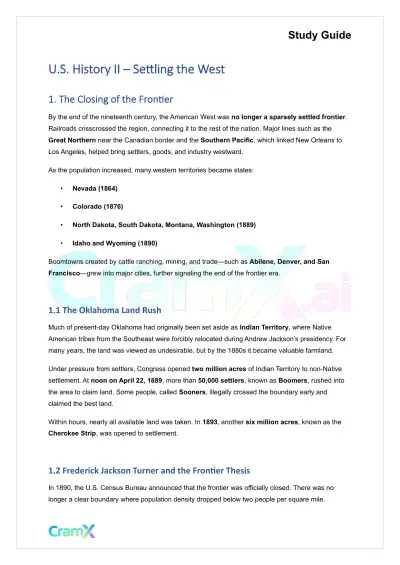 Quick Guides
U.S. History II - Settling the West
History
13 pagesMar 2026 Quick Guides
U.S. History II - Industrial America
History
12 pagesMar 2026 Quick Guides
U.S. History II - America in the Twenties
History
9 pagesMar 2026 Quick Guides
U.S. History II - America in the Fifties
History
12 pagesMar 2026 Quick Guides
U.S. History II - Depression and the New Deal
History
10 pagesMar 2026
Study this document with CramX
Once it is in your library, every tool can work from it.