

U.S. History II - From Isolation to World War II
- History
- Texas A&M University
- 9 pages
- Shared March 2026
Preview 3 of 9 pages
See the first 3 pages exactly as they appear in the document.
Page 1 Read page 1 as text
Study Guide U.S. History II – From Isolation to World War II 1. American Foreign Policy in the 20s After World War I , the U.S. Senate refused to ratify the Treaty of Versailles , which helped create a period of isolationism . Americans wanted to avoid European conflicts, but complete withdrawal from world affairs was impossible because the U.S. now had territories from the Caribbean to the Pacific and had become the world’s leading creditor nation . Despite public desire for isolation, the U.S. still engaged internationally: cooperating on trade, drug control, disarmament, and debt negotiations , and remaining heavily involved in the Western Hemisphere , particularly Central America . 1.1 Disarmament Efforts Two main reasons drove U.S. calls for disarmament: 1. Preventing another war by avoiding an arms race (especially the Anglo - German naval rivalry ). 2. Limiting Japanese military power to protect American interests in Asia. Key treaties: • Washington Naval Conference (1921 – 22) : U.S., Japan, Britain, France, Italy agreed to limit naval tonnage and pause building aircraft carriers and battleships for ten years. • Nine - Power Treaty : 9 nations, including the U.S. and Japan, pledged to respect China’s territorial integrity and the Open Door Policy . Later efforts were less successful: • 1927 Geneva talks failed on smaller ships. • 1930 London Naval Conference limited cruisers and submarines, but France and Italy were not formal signatories. • Japan still acted aggressively in Manchuria (1931) .
Page 2 Read page 2 as text
Study Guide 1.2 War Debts and Reparations European nations owed the U.S. over $10 billion from WWI. Hardship and trade barriers made repayment difficult: • Fordney - McCumber Tariff (1922) made European exports to the U.S. more expensive. • Germany defaulted on reparations in 1923, leading to the French occupation of the Ruhr Valley and runaway inflation. American solutions: • Dawes Plan (1924) : reorganized Germany’s payments and gave loans from U.S. banks, allowing Britain and France to pay debts to the U.S. • Young Plan (1929) : reduced total reparations and extended the payment period to 1988. The Great Depression soon made these debt agreements largely irrelevant. 1.3 The Kellogg - Briand Peace Pact • 1928 : U.S., France, and 13 other nations (eventually 62 total) signed a pact outlawing war as a tool of foreign policy . • However, enforcement was weak. When Japan invaded Manchuria (1931 – 32) , the U.S. and League of Nations did nothing except refuse to recognize the conquest ( Stimson Doctrine ). 1.4 Relations in the Western Hemisphere • The 1920s saw mixed U.S. involvement in Latin America: o Dominican Republic : Marines left in 1924 after elections. o Nicaragua : Marines withdrew in 1925 but returned in 1927 due to civil war. President Coolidge justified intervention to protect U.S. business interests . • Under President Hoover , policy shifted toward non - intervention : o The Clark Memorandum (1928) rejected using the Monroe Doctrine to justify intervention. o Hoover undertook a 10 - nation goodwill tour in Latin America , improving relations.
Page 3 Read page 3 as text
Study Guide 2. Foreign Policy and the New Deal During Roosevelt’s presidency, U.S. foreign policy shifted in two major ways: 1. The Good Neighbor Policy — ending U.S. military intervention in Latin America. 2. Recognition of the Soviet Union — reestablishing diplomatic and economic relations. At the same time, Congress passed neutrality laws to keep the U.S. out of another European war, though Roosevelt sometimes opposed strict isolationism. 2.1 The Good Neighbor Policy • Roosevelt promised to make the U.S. a “good neighbor” to Latin American countries. • Actions included: o Pan - American Conference (1933): U.S. accepted nonintervention rules. o Cuba (1934): Ended the Platt Amendment , limiting U.S. intervention. o Haiti (1934): U.S. troops withdrew. o Panama (1936 – 1939): Expanded commercial rights in the Canal Zone. o Mexico (1938): Recognized Mexico’s nationalization of U.S. oil properties, with negotiations for compensation. • The U.S. still supported conservative governments to maintain stability and protect economic interests. 2.2 Recognition of the Soviet Union • The U.S. had previously refused recognition because of the Soviet revolution, unpaid debts, and anti - capitalist propaganda. • In 1933, Roosevelt reestablished diplomatic relations to: o Expand trade with the USSR. o Possibly counter Japanese expansion in Asia. • Conditions agreed upon by the USSR (but not kept) included: o No propaganda in the U.S. o Protection of American citizens in the USSR o Settlement of war debts
6 more pages in the full document
Unlock it once and it stays in your library, ready to chat with or turn into flashcards.
Unlock the full documentMore History study materials
See all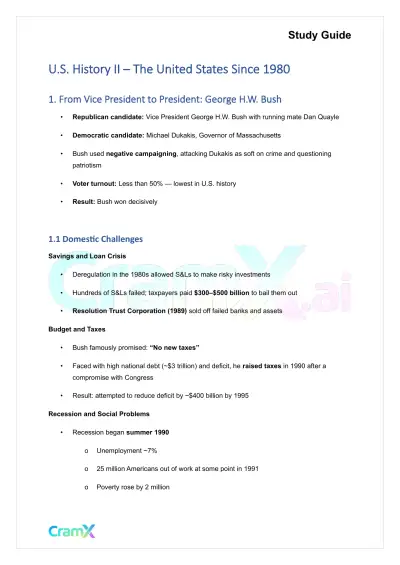 Quick Guides
U.S. History II - The United States Since 1980
History
16 pagesMar 2026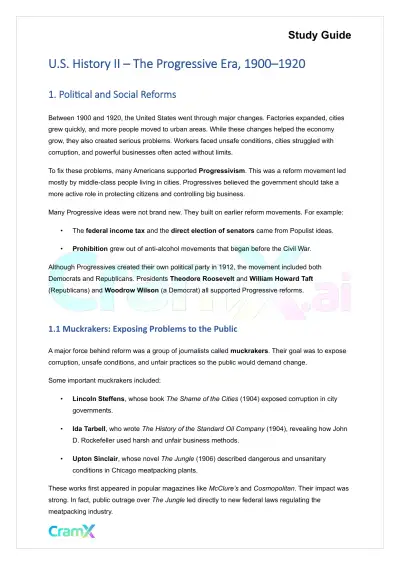 Quick Guides
U.S. History II - The Progressive Era, 1900–1920
History
10 pagesMar 2026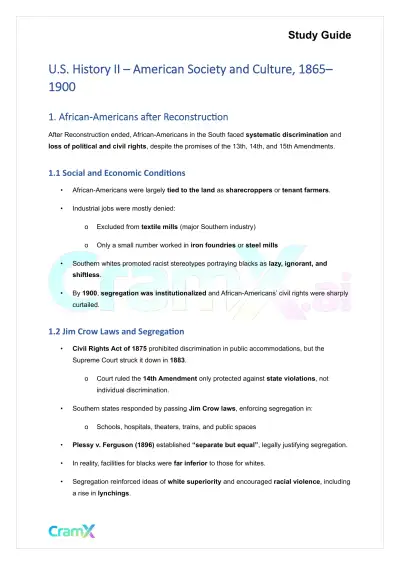 Quick Guides
U.S. History II - American Society and Culture, 1865–1900
History
7 pagesMar 2026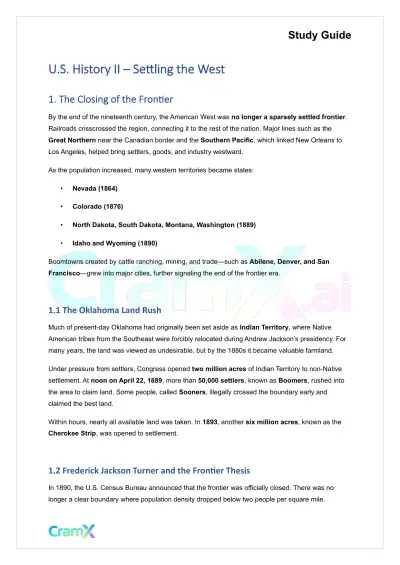 Quick Guides
U.S. History II - Settling the West
History
13 pagesMar 2026 Quick Guides
U.S. History II - Industrial America
History
12 pagesMar 2026 Quick Guides
U.S. History II - America in the Twenties
History
9 pagesMar 2026 Quick Guides
U.S. History II - America in the Fifties
History
12 pagesMar 2026 Quick Guides
U.S. History II - Depression and the New Deal
History
10 pagesMar 2026
Study this document with CramX
Once it is in your library, every tool can work from it.