

West,The: A Narrative History, Combined Volume, 3rd Edition Test Bank
- History
- 484 pages
- Shared May 2025
Get step-by-step explanations and proven study techniques with West,The: A Narrative History, Combined Volume, 3rd Edition Test Bank, an essential exam prep resource.
Preview 16 of 484 pages
See the first 16 pages exactly as they appear in the document.
Page 1 Read page 1 as text
TEST ITEM FILE T HE W EST A Narrative History THIRD EDITION A. Daniel Frankforter The Pennsylvania State University William M. Spellman University of North Carolina, Asheville
Page 2 Page 3 Read page 3 as text
Contents Chapter 1 The Birth of Civilization..............................................................................1 Chapter 2 The Rise of Empires and the Beginning of the Iron Age...........................22 Chapter 3 Aegean Civilizations..................................................................................40 Chapter 4 The Hellenic Era ........................................................................................59 Chapter 5 The Hellenistic Era and the Rise of Rome.................................................76 Chapter 6 Rome’s Empire and the Unification of the Western World.......................93 Chapter 7 The West’s Medieval Civilizations..........................................................111 Chapter 8 The Emergence of Europe .......................................................................131 Chapter 9 Europe Turns Outward.............................................................................149 Chapter 10 Europe’s High Middle Ages ....................................................................167 Chapter 11 Challenges to the Medieval Order ...........................................................185 Chapter 12 Renaissance and Exploration ...................................................................206 Chapter 13 Reformation, Religious Wars, and National Conflicts ............................227 Chapter 14 The Early Modern State ...........................................................................247 Chapter 15 New World Views: Europe’s Scientific Revolution................................265 Chapter 16 The Age of Enlightenment: Rationalism and Its Uses.............................285 Chapter 17 Rebellion and Revolution: American Independence and the French Revolution................................................................................................303 Chapter 18 Industry, Society, and the Environment ..................................................322 Chapter 19 The Age of Ideology ................................................................................339 Chapter 20 The Consolidation of Nation-States.........................................................357 iii
Page 4 Read page 4 as text
iv Chapter 21 Global Empire and European Culture......................................................375 Chapter 22 World War I: The End of Enlightenment ................................................394 Chapter 23 The Troubled Interwar Years...................................................................411 Chapter 24 World War II: Europe in Eclipse .............................................................428 Chapter 25 Decolonization and the Cold War............................................................446 Chapter 26 Western Civilization and the Global Community....................................464
Page 5 Read page 5 as text
1 CHAPTER ONE THE BIRTH OF CIVILIZATION Multiple Choice 1) What is the species name of modern humans? A) Homo sapiens sapiens B) Homo erectus C) Homo ergaster D) Homo habilis E) Neanderthals Answer: A Page Ref: 6 Skill: Factual Topic: The Evolution of Prehistoric Cultures 2) The triangular indentations used for the script of Sumerians are called A) cuneiform. B) lugal. C) runes. D) pictographs. E) hieroglyphics. Answer: A Page Ref: 20 Skill: Factual Topic: The Origin of Civilization in Mesopotamia: Sumer 3) The Great Pyramid was built for which Egyptian pharaoh? A) Khufu B) Imhotep C) Djoser D) Menkaure E) Kamerernebti Answer: A Page Ref: 29 Skill: Factual Topic: The Rise of Civilization in Egypt
Page 6 Read page 6 as text
2 4) Objects made from what material were used much more frequently by Neolithic man than by Paleolithic man? A) fired clay B) bronze C) iron D) glass E) wood Answer: A Page Ref: 12 Skill: Factual Topic: The Archaic States 5) Which metal was used for tools as early as 7500 B .C .E .? A) copper B) iron C) bronze D) silver E) lead Answer: A Page Ref: 13 Skill: Factual Topic: The Archaic States 6) The legendary king Gilgamesh ruled the city of A) Uruk. B) Babylon. C) Eridu. D) Kish. E) Akkad. Answer: A Page Ref: 6 Skill: Factual Topic: Key Question
Page 7 Read page 7 as text
3 7) Which of the following technologies was NOT used by the earliest Western civilizations? A) forging iron B) agriculture C) metal working D) building E) irrigation Answer: A Page Ref: 32 Skill: Factual Topic: Key Question Revisited 8) Study of the Iceman and the materials found with him suggest that he was most likely to have been a A) hunter or shepherd. B) soldier. C) tradesman. D) farmer or gatherer. E) homeless nomad. Answer: A Page Ref: 9 Skill: Factual Topic: People in Context 9) Discovered in the Alps in 1991, the Iceman was from what era? A) Bronze Age B) Iron Age C) Neanderthal D) Paleolithic E) Neolithic Answer: A Page Ref: 9 Skill: Factual Topic: People in Context
Page 8 Read page 8 as text
4 10) As shown on Map 1-2, the land between the Tigris and Euphrates Rivers is known as A) Mesopotamia B) Babylonia C) the Delta D) Anatolia. E) Libya Answer: A Page Ref: 14 Skill: Factual Topic: Map 1-2 11) Which archaic states shown in Map 1-2 are described in the text as the first civilizations? A) Sumerian and Egyptian B) Egyptian and Iranian C) Egyptian and Hittite D) Hittite and Iranian E) Sumerian and Iranian Answer: A Page Ref: 14 Skill: Factual Topic: Map 1-1 12) What critical problem did the first farmers in Mesopotamia have to overcome before enough food could be grown to support a dense population? A) trapping flood waters for distribution during the growing season B) defeating barbarian invaders C) developing sturdy iron tools. D) conquering the Hittite Kingdom E) finding water sources in a desert Answer: A Page Ref: 14-15 Skill: Factual Topic: The Origin of Civilization in Mesopotamia: Sumer
Page 9 Read page 9 as text
5 13) What common characteristic was shared by primal civilizations in Egypt, Sumer, China, and India? A) They sprang up along flooding rivers. B) They relied on transportation by sea. C) Agriculture developed only after large cities developed. D) The first arose on islands E) They all arose in areas of mild climate. Answer: A Page Ref: 14 Skill: Factual Topic: The Origin of Civilization in Mesopotamia: Sumer 14) The middle area of the Fertile Crescent differed from Egypt and Mesopotamia because it A) had enough rainfall to sustain crops. B) subsisted on fishing. C) built complex irrigation systems. D) was an extension of the Sinai Desert. E) flourished through Mediterranean trade. Answer: A Page Ref: 14 Skill: Factual Topic: Map 1-2 15) The first farmers in Mesopotamia migrated into the area from A) the Iranian highlands. B) Anatolia. C) the Arabian Desert. D) the Aegean Sea region. E) the Mediterranean coast. Answer: A Page Ref: 14 Skill: Factual Topic: The Origin of Civilization in Mesopotamia: Sumer
Page 10 Read page 10 as text
6 16) The axe found with the body of the Iceman had a head made of A) copper. B) iron. C) polished stone. D) flaked flint. E) forged steel. Answer: A Page Ref: 9 Skill: Factual Topic: People in Context 17) Historians estimate that the existence of Homo sapiens sapiens goes back how many years? A) 150,000 B) 300,000 C) 50,000 D) 100,000 E) 200,000 Answer: A Page Ref: 6 Skill: Factual Topic: The Evolution of Prehistoric Cultures 18) Historians speculate that the shift from hunting and gathering to farming and herding occurred in the Western world about how many years ago? A) 10,000 B) 40,000 C) 30,000 D) 20,000 E) 50,000 Answer: A Page Ref: 5 Skill: Factual Topic: Key Question
Page 11 Read page 11 as text
7 19) What was the name of the pharaoh who was credited with setting a style for pyramid construction that lasted for centuries? A) Djoser B) Cheops C) Khufu D) Narmer E) Imhotep Answer: A Page Ref: 29 Skill: Factual Topic: The Rise of Civilization in Egypt 20) What material began to be used as the Neolithic gave way to the dawn of civilization? A) metals B) fired bronze C) burnished pottery D) pressure-chip tools E) fired pottery Answer: A Page Ref: 13 Skill: Factual Topic: The Archaic States 21) In which global area did the transition to civilization happen last? A) Mesoamerica B) China C) Egypt D) Indus River valley E) Mesopotamia Answer: A Page Ref: 13 Skill: Factual Topic: The Archaic States 22) One of the earliest works of literature was the epic story of what Sumerian king? A) Gilgamesh B) Enmerbaragesi C) Sargon D) Menes E) Enlil Answer: A Page Ref: 6 Skill: Factual Topic: Key Question
Page 12 Read page 12 as text
8 23) The main task of the Egyptian pharaoh was to preserve justice, otherwise known as A) ma’at . B) nomes. C) karma. D) mastaba . E) lugal . Answer: A Page Ref: 27 Skill: Factual Topic: The Rise of Civilization in Egypt 24) The first true city to arise in Mesopotamia, in the fourth millennium B.C.E., was A) Uruk. B) Akkad. C) Babylon. D) Kish. E) Nippur. Answer: A Page Ref: 16 Skill: Factual Topic: The Origin of Civilization in Mesopotamia: Sumer 25) Early Sumerian cities would be best described as A) uncomfortable and unhealthy. B) built to last out of stone and fired brick. C) much less prone to disease than the surrounding countryside. D) well planned and carefully laid out. E) small and uncomplicated. Answer: A Page Ref: 17-18 Skill: Factual Topic: The Origin of Civilization in Mesopotamia: Sumer
Page 13 Read page 13 as text
9 26) The Neolithic era was considered revolutionary because it was the first period when Western mankind began to A) consciously transform the environment. B) harvest what nature produces. C) learn about the life cycles of plants and animals. D) increase its reliance on hunting and gathering. E) sow seeds to produce crops. Answer: A Page Ref: 10 Skill: Conceptual Topic: The Evolution of Prehistoric Cultures 27) Which of the following was a result of Ur-Nammu becoming aware of the antiquity of Sumerian civilization? A) the archiving of ancient documents B) updates to the road system C) the reconstruction of the palace D) the reinforcement of religious practices E) the securing of Sumerian borders Answer: A Page Ref: 23 Skill: Conceptual Topic: The Origin of Civilization in Mesopotamia: Sumer 28) Which of the following best explains the fact that ancient Egypt left no written law codes? A) The pharaoh was a god on earth and thus the source of all law and justice. B) Egyptian society was so unsophisticated that laws were not needed. C) Ancient Egyptians had no means of writing down their laws. D) Egyptians were expected to care for themselves without government oversight. E) Families—not the pharaoh or abstract laws—held final power. Answer: A Page Ref: 28 Skill: Conceptual Topic: The Rise of Civilization in Egypt
Page 14 Read page 14 as text
10 29) The Iceman’s trappings were not just utilitarian. What decorative element distinguished him? A) tattoos B) pattern in his woven cloak C) nose ring D) finger ring E) feathers in his hair Answer: A Page Ref: 9 Skill: Conceptual Topic: People in Context 30) In 1897 a palette was discovered at Hierakonpolis that A) provided clues on how Egypt was unified. B) pictured Narmer as the ruler of a totally unified state. C) recorded the names of the major Egyptian gods. D) explained the divisions of the empire. E) commemorated the victories of Upper Egypt. Answer: A Page Ref: 26 Skill: Conceptual Topic: The Rise of Civilization in Egypt 31) The leaders of Sumerian city-states A) benefited their subjects but were also oppressive. B) spared their subjects hardship by using foreign slave labor. C) had little effect on the state of the physical environment. D) provided few benefits or services to their subjects. E) were aware of the responsibilities and duties of power. Answer: A Page Ref: 6 Skill: Conceptual Topic: Key Question 32) Which common factor is true of both prehistoric cultures and early civilizations? A) People altered the natural environment. B) Societies relied on written records to maintain traditions. C) Hunting and gathering provided more food than agriculture. D) Human populations were small and scattered. E) Cultural change was usually intentional and carefully planned. Answer: A Page Ref: 31 Skill: Conceptual Topic: Key Question Revisited
Page 15 Read page 15 as text
11 33) Scientific study of the Iceman has shown that A) human remains can provide information about an era without written records. B) people lived in Mesopotamia much earlier than historians had suspected. C) Bronze Age people lived simple lives with few possessions. D) the Alps formed a barrier that Bronze Age people could not cross. E) the inability to adapt to the environment greatly limited early human culture. Answer: A Page Ref: 9 Skill: Conceptual Topic: People in Context 34) Which of the following developments marked man’s evolution from prehistory to history? A) development of writing systems B) development of fired pottery C) development of city-states D) ornamentation of utilitarian objects E) use of bronze Answer: A Page Ref: 6 Skill: Conceptual Topic: Key Topic: The Evolution of Prehistoric Cultures 35) The Iceman provided an unusual amount of information about Neolithic man because he A) was frozen. B) had been embalmed. C) was mummified using Egyptian methods. D) carried documents that were decipherable. E) had tattooed identification. Answer: A Page Ref: 9 Skill: Conceptual Topic: People in Context
Page 16 Read page 16 as text
12 36) As a result of the Amorite invasions and the founding of Babylon, Sumerian civilization A) was assimilated and preserved by its conquerors. B) disappeared without a trace. C) spread into the Nile River valley. D) had little influence on later Mesopotamian cultures. E) was united into a single state for the first time. Answer: A Page Ref: 23 Skill: Conceptual Topic: The Origin of Civilization in Mesopotamia: Sumer 37) Historians now believe that the centrality of religious life in Sumer A) may be illusory because most surviving documents come from temple archives. B) is proven by the centrality of religion and faith in the Epic of Gilgamesh. C) is supported by the extensive archives of royal documents. D) was much greater than they had originally suspected. E) was based primarily on the king’s claims to be a god on earth.. Answer: A Page Ref: 17 Skill: Conceptual Topic: The Origin of Civilization in Mesopotamia: Sumer 38) The Ubaid period of Sumerian history was characterized by A) villages sustained by hunting, fishing, and farming. B) complex city-states with large populations. C) the strict separation of church and state. D) a complicated, centralized bureaucracy. E) the fact that religion played a small role in people’s lives. Answer: A Page Ref: 15 Skill: Conceptual Topic: The Origin of Civilization in Mesopotamia: Sumer
468 more pages in the full document
Unlock it once and it stays in your library, ready to chat with or turn into flashcards.
Unlock the full documentMore History study materials
See all Exam Guides
Test Bank For Visions of America: A History of the United States, Combined Volume 2nd Edition Test Bank
History
1084 pages111downloadsFeb 2025 Exam Guides
Cengage Advantage Books: Making America, Volume 1 To 1877: A History Of The United States, 7th Edition Test Bank
History
170 pages60downloadsFeb 2025 Exam Guides
Test Bank for The American Journey: A History of the United States, Combined Volume, 8th Edition
History
447 pagesMay 2025 Exam Guides
Palmer, A History of Europe in the Modern World, 11th Edition Test Bank
History
766 pagesMay 2025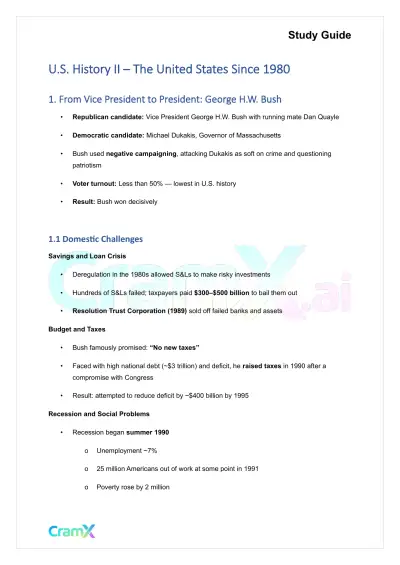 Quick Guides
U.S. History II - The United States Since 1980
History
16 pagesMar 2026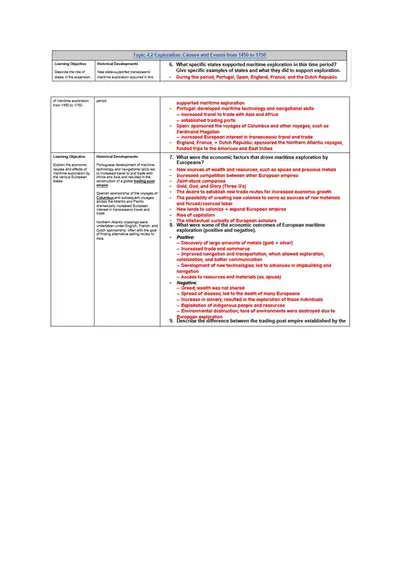 Solved Assignments
AP World History Unit 4 Study Guide (Transoceanic
History
14 pagesJun 2025 Solved Assignments
Liberty University CSTU 101 Quiz 3 Complete Solutions Correct Answers Key Four different versions
History
9 pagesMay 2025 Solved Assignments
Liberty University HIUS 221 Quiz 2 Complete Solutions Correct Answers Key
History
31 pagesMay 2025
Study this document with CramX
Once it is in your library, every tool can work from it.