

Exploring Statistical Design and Analysis in Experimental Research
- Statistics
- 12 pages
- Shared May 2025
Explores statistical design and analysis in experimental research.
Preview 4 of 12 pages
See the first 4 pages exactly as they appear in the document.
Page 1 Read page 1 as text
Exploring Statistical Design and Analysis in Experimental Research 2. Explain the difference between multiple independent variables and multiple levels of independent variables. Which is better? Answer:
Page 2 Page 3 Read page 3 as text
The general purpose of multivariate analysis of variance (MANOVA) is to determine whether multiple levels of independent variables on their own or in combination with one another have an effect on the dependent variables. MANOVA requires that the dependent variables meet parametric requirements. MANOVA is used under the same circumstances as ANOVA but when there are multiple dependent variables as well as independent variables within the model which the researcher wishes to test. MANOVA is also considered a valid alternative to the repeated measures ANOVA when sphericity is violated. Like an ANOVA, MANOVA examines the degree of variance within the independent variables and determines whether it is smaller than the degree of variance between the independent variables. If the within subjects variance is smaller than the betw- een subjects variance it means the independent variable has had a significant effect on the dependent variables. There are two main differences between MANOVAs and ANOVAs. The first is that MANOVAs are able to take into account multiple independent and multiple dependent variables within the same model, permitting greater complexity. Secondly,rather than using the F value as the indicator of significance a number of multivariate measures. MANOVAs the independent variables relevant to each main effect are weighted to give them priority in the calculations performed. In interactions the independent variables are equally weighted to determine whether or not they have an additive effect in terms of the combined variance they account for in the dependent variable/s. The main effects of the independent variables and of the interactions are examined with all else held constant. The effect of each of the independent variables is tested separately. Any multiple interactions are tested separately from one another and from any significant main effects. Assuming there are equal sample sizes both in the main effects and the inter- actions, each test performed will be independent of the next or previous calculation (exce- pt for the error term which is calculated across the independent variables). 3. What is blocking and how does it reduce “noise”? What is a disadvantage of blocking?
Page 4 Read page 4 as text
Sol: The Randomized Block Design is research design's equivalent to stratified random sampling. Like stratified sampling, randomized block designs are constructed to reduce noise or variance in the data (see Classifying the Exper- imental Designs). How do they do it? They require that the researcher divide the sample into relatively homogeneous subgroups or blocks (analogous to "strata" in stratified sampling). Then, the experimental design you want to impl- ement is implemented within each block or homogeneous subgroup. The key idea is that the variability within each block is less than the variability of the entire sample. Thus each estimate of the treatment effect within a block is more efficient than estimates across the entire sample. And, when we pool these more efficient estimates across blocks, we should get an overall more efficient estimate than we would without blocking. How Blocking Reduces Noise So how does blocking work to reduce noise in the data? To see how it works, you have to begin by thinking about the non-blocked study. The figure shows the pretest-posttest distribution for a hypothetical pre-post randomized experi- mental design. We use the 'X' symbol to indicate a program group case and the 'O' symbol for a comparison group member. You can see that for any specific pretest value, the program group tends to outscore the comparison group by about 10 points on the posttest. That is, there is about a 10-point posttest mean difference.
8 more pages in the full document
Unlock it once and it stays in your library, ready to chat with or turn into flashcards.
Unlock the full documentMore Statistics study materials
See all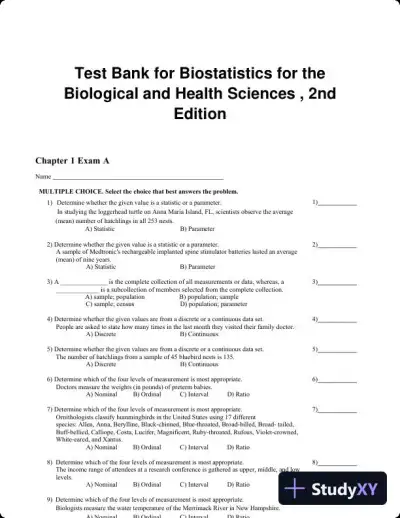 Exam Guides
Test Bank for Biostatistics for the Biological and Health Sciences , 2nd Edition
Statistics
182 pages161downloadsFeb 2025 Exam Guides
Elementary Statistics, 13th Edition Test Bank
Statistics
239 pages160downloadsFeb 2025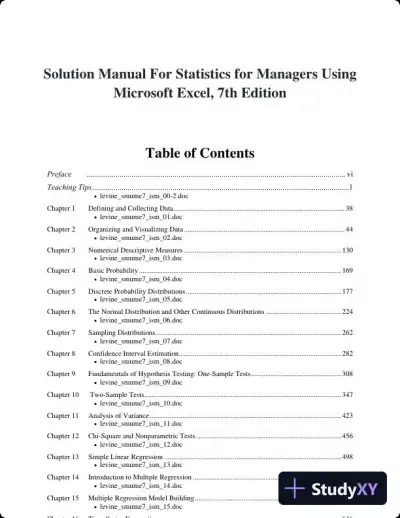 Textbook Guides
Solution Manual For Statistics for Managers Using Microsoft Excel, 7th Edition
Statistics
1418 pages158downloadsFeb 2025 Textbook Guides
Statistics for Managers Using Microsoft Excel 8th Edition Solution Manual
Statistics
1343 pages156downloadsFeb 2025 Textbook Guides
Essentials of Social Statistics for a Diverse Society Second Edition Solution Manual
Statistics
137 pages135downloadsFeb 2025 Exam Guides
Test Bank For Elementary Statistics, 3rd Edition
Statistics
969 pages126downloadsFeb 2025 Textbook Guides
Solution Manual for Business Statistics, 4th Edition
Statistics
582 pages125downloadsFeb 2025 Exam Guides
Test Bank for Business Statistics: A Decision-Making Approach, 10th Edition
Statistics
881 pages110downloadsFeb 2025
Study this document with CramX
Once it is in your library, every tool can work from it.