

Mathematical Statistics With Applications, 7th Edition Solution Manual
- Statistics
- 334 pages
- Shared May 2025
Gain deeper insight into your textbook problems with Mathematical Statistics With Applications, 7th Edition Solution Manual, featuring well-explained solutions.
Preview 16 of 334 pages
See the first 16 pages exactly as they appear in the document.
Page 1 Read page 1 as text
1 Chapter 1: What is Statistics? 1.1 a. Population: all tires manufactured by the company for the specific year. Objective: to estimate the proportion of tires with unsafe tread. b. Population: all adult residents of the particular state. Objective: to estimate the proportion who favor a unicameral legislature. c. Population: times until recurrence for all people who have had a particular disease. Objective: to estimate the true average time until recurrence. d. Population: lifetime measurements for all resistors of this type. Objective: to estimate the true mean lifetime (in hours). e. Population: all generation X age US citizens (specifically, assign a ‘1’ to those who want to start their own business and a ‘0’ to those who do not, so that the population is the set of 1’s and 0’s). Objective: to estimate the proportion of generation X age US citizens who want to start their own business. f. Population: all healthy adults in the US. Objective: to estimate the true mean body temperature g. Population: single family dwelling units in the city. Objective: to estimate the true mean water consumption 1.2 a. This histogram is above. Histogram of wind wind Density 5 10 15 20 25 30 35 0.00 0.05 0.10 0.15 0.20 0.25 0.30 b. Yes, it is quite windy there. c. 11/45, or approx. 24.4% d. it is not especially windy in the overall sample.
Page 2 Page 3 Read page 3 as text
2 Chapter 1: What is Statistics? ’s Solutions Manual 1.3 The histogram is above. Histogram of U235 U235 Density 0 2 4 6 8 10 12 0.00 0.05 0.10 0.15 0.20 0.25 1.4 a. The histogram is above. Histogram of stocks stocks Density 2 4 6 8 10 12 0.00 0.05 0.10 0.15 0.20 0.25 0.30 b. 18/40 = 45% c. 29/40 = 72.5% 1.5 a. The categories with the largest grouping of students are 2.45 to 2.65 and 2.65 to 2.85. (both have 7 students). b. 7/30 c. 7/30 + 3/30 + 3/30 + 3/30 = 16/30 1.6 a. The modal category is 2 (quarts of milk). About 36% (9 people) of the 25 are in this category. b. .2 + .12 + .04 = .36 c. Note that 8% purchased 0 while 4% purchased 5. Thus, 1 – .08 – .04 = .88 purchased between 1 and 4 quarts.
Page 4 Read page 4 as text
Chapter 1: What is Statistics? 3 ’s Solutions Manual 1.7 a. There is a possibility of bimodality in the distribution. b. There is a dip in heights at 68 inches. c. If all of the students are roughly the same age, the bimodality could be a result of the men/women distributions. 1.8 a. The histogram is above. Histogram of AlO AlO Density 10 12 14 16 18 20 0.00 0.05 0.10 0.15 0.20 b. The data appears to be bimodal. Llanederyn and Caldicot have lower sample values than the other two. 1.9 a. Note that 9.7 = 12 – 2.3 and 14.3 = 12 + 2.3. So, (9.7, 14.3) should contain approximately 68% of the values. b. Note that 7.4 = 12 – 2(2.3) and 16.6 = 12 + 2(2.3). So, (7.4, 16.6) should contain approximately 95% of the values. c. From parts (a) and (b) above, 95% - 68% = 27% lie in both (14.3. 16.6) and (7.4, 9.7). By symmetry, 13.5% should lie in (14.3, 16.6) so that 68% + 13.5% = 81.5% are in (9.7, 16.6) d. Since 5.1 and 18.9 represent three standard deviations away from the mean, the proportion outside of these limits is approximately 0. 1.10 a. 14 – 17 = -3. b. Since 68% lie within one standard deviation of the mean, 32% should lie outside. By symmetry, 16% should lie below one standard deviation from the mean. c. If normally distributed, approximately 16% of people would spend less than –3 hours on the internet. Since this doesn’t make sense, the population is not normal. 1.11 a. ∑ = n i c 1 = c + c + … + c = nc . b. i n i y c ∑ = 1 = c ( y 1 + … + y n ) = ∑ = n i i y c 1 c. ( ) ∑ = + n i i i y x 1 = x 1 + y 1 + x 2 + y 2 + … + x n + y n = ( x 1 + x 2 + … + x n ) + ( y 1 + y 2 + … + y n )
Page 5 Read page 5 as text
4 Chapter 1: What is Statistics? ’s Solutions Manual Using the above, the numerator of s 2 is ∑ = − n i i y y 1 2 ) ( = ∑ = + − n i i i y y y y 1 2 2 ) 2 ( = ∑ = − n i i y 1 2 ∑ = + n i i y n y y 1 2 2 Since ∑ = = n i i y y n 1 , we have ∑ = − n i i y y 1 2 ) ( = ∑ = − n i i y n y 1 2 2 . Let ∑ = = n i i y n y 1 1 to get the result. 1.12 Using the data, ∑ = 6 1 i i y = 14 and ∑ = 6 1 2 i i y = 40. So, s 2 = (40 - 14 2 /6)/5 = 1.47. So, s = 1.21. 1.13 a. With ∑ = 45 1 i i y = 440.6 and ∑ = 45 1 2 i i y = 5067.38, we have that y = 9.79 and s = 4.14. b. k interval frequency Exp. frequency 1 5.65, 13.93 44 30.6 2 1.51, 18.07 44 42.75 3 -2.63, 22.21 44 45 1.14 a. With ∑ = 25 1 i i y = 80.63 and ∑ = 25 1 2 i i y = 500.7459, we have that y = 3.23 and s = 3.17. b. 1.15 a. With ∑ = 40 1 i i y = 175.48 and ∑ = 40 1 2 i i y = 906.4118, we have that y = 4.39 and s = 1.87. b. 1.16 a. Without the extreme value, y = 4.19 and s = 1.44. b. These counts compare more favorably: k interval frequency Exp. frequency 1 0.063, 6.397 21 17 2 -3.104, 9.564 23 23.75 3 -6.271, 12.731 25 25 k interval frequency Exp. frequency 1 2.52, 6.26 35 27.2 2 0.65, 8.13 39 38 3 -1.22, 10 39 40 k interval frequency Exp. frequency 1 2.75, 5.63 25 26.52 2 1.31, 7.07 36 37.05 3 -0.13, 8.51 39 39
Page 6 Read page 6 as text
Chapter 1: What is Statistics? 5 ’s Solutions Manual 1.17 For Ex. 1.2, range/4 = 7.35, while s = 4.14. For Ex. 1.3, range/4 = 3.04, while = s = 3.17. For Ex. 1.4, range/4 = 2.32, while s = 1.87. 1.18 The approximation is (800–200)/4 = 150. 1.19 One standard deviation below the mean is 34 – 53 = –19. The empirical rule suggests that 16% of all measurements should lie one standard deviation below the mean. Since chloroform measurements cannot be negative, this population cannot be normally distributed. 1.20 Since approximately 68% will fall between $390 ($420 – $30) to $450 ($420 + $30), the proportion above $450 is approximately 16%. 1.21 (Similar to exercise 1.20) Having a gain of more than 20 pounds represents all measurements greater than one standard deviation below the mean. By the empirical rule, the proportion above this value is approximately 84%, so the manufacturer is probably correct. 1.22 (See exercise 1.11) ∑ = − n i i y y 1 ) ( = ∑ = n i i y 1 – 0 1 1 = − = ∑ ∑ = = n i i n i i y y y n . 1.23 a. (Similar to exercise 1.20) 95 sec = 1 standard deviation above 75 sec, so this percentage is 16% by the empirical rule. b. (35 sec., 115 sec) represents an interval of 2 standard deviations about the mean, so approximately 95% c. 2 minutes = 120 sec = 2.5 standard deviations above the mean. This is unlikely. 1.24 a. (112-78)/4 = 8.5 b. The histogram is above. Histogram of hr hr Frequency 80 90 100 110 0 1 2 3 4 5 c. With ∑ = 20 1 i i y = 1874.0 and ∑ = 20 1 2 i i y = 117,328.0, we have that y = 93.7 and s = 9.55.
Page 7 Read page 7 as text
6 Chapter 1: What is Statistics? ’s Solutions Manual d. 1.25 a. (716-8)/4 = 177 b. The figure is omitted. c. With ∑ = 88 1 i i y = 18,550 and ∑ = 88 1 2 i i y = 6,198,356, we have that y = 210.8 and s = 162.17. d. 1.26 For Ex. 1.12, 3/1.21 = 2.48. For Ex. 1.24, 34/9.55 = 3.56. For Ex. 1.25, 708/162.17 = 4.37. The ratio increases as the sample size increases. 1.27 (64, 80) is one standard deviation about the mean, so 68% of 340 or approx. 231 scores. (56, 88) is two standard deviations about the mean, so 95% of 340 or 323 scores. 1.28 (Similar to 1.23) 13 mg/L is one standard deviation below the mean, so 16%. 1.29 If the empirical rule is assumed, approximately 95% of all bearing should lie in (2.98, 3.02) – this interval represents two standard deviations about the mean. So, approximately 5% will lie outside of this interval. 1.30 If μ = 0 and σ = 1.2, we expect 34% to be between 0 and 0 + 1.2 = 1.2. Also, approximately 95%/2 = 47.5% will lie between 0 and 2.4. So, 47.5% – 34% = 13.5% should lie between 1.2 and 2.4. 1.31 Assuming normality, approximately 95% will lie between 40 and 80 (the standard deviation is 10). The percent below 40 is approximately 2.5% which is relatively unlikely. 1.32 For a sample of size n , let n ′ denote the number of measurements that fall outside the interval y ± ks , so that ( n – n ′ )/ n is the fraction that falls inside the interval. To show this fraction is greater than or equal to 1 – 1/ k 2 , note that ( n – 1) s 2 = ∑ ∈ − A i i y y 2 ) ( + ∑ ∈ − b i i y y 2 ) ( , (both sums must be positive) where A = { i : | y i - y | ≥ ks } and B = { i : | y i – y | < ks }. We have that ∑ ∈ − A i i y y 2 ) ( ≥ ∑ ∈ A i s k 2 2 = n ′ k 2 s 2 , since if i is in A , | y i – y | ≥ ks and there are n ′ elements in A . Thus, we have that s 2 ≥ k 2 s 2 n ′ /( n -1), or 1 ≥ k 2 n ′ /( n –1) ≥ k 2 n ′ / n . Thus, 1/ k 2 ≥ n ′ / n or ( n – n ′ )/ n ≥ 1 – 1/ k 2 . k interval frequency Exp. frequency 1 84.1, 103.2 13 13.6 2 74.6, 112.8 20 19 3 65.0, 122.4 20 20 k interval frequency Exp. frequency 1 48.6, 373 63 59.84 2 -113.5, 535.1 82 83.6 3 -275.7, 697.3 87 88
Page 8 Read page 8 as text
Chapter 1: What is Statistics? 7 ’s Solutions Manual 1.33 With k =2, at least 1 – 1/4 = 75% should lie within 2 standard deviations of the mean. The interval is (0.5, 10.5). 1.34 The point 13 is 13 – 5.5 = 7.5 units above the mean, or 7.5/2.5 = 3 standard deviations above the mean. By Tchebysheff’s theorem, at least 1 – 1/3 2 = 8/9 will lie within 3 standard deviations of the mean. Thus, at most 1/9 of the values will exceed 13. 1.35 a. (172 – 108)/4 =16 b. With ∑ = 15 1 i i y = 2041 and ∑ = 15 1 2 i i y = 281,807 we have that y = 136.1 and s = 17.1 c. a = 136.1 – 2(17.1) = 101.9, b = 136.1 + 2(17.1) = 170.3. d. There are 14 observations contained in this interval, and 14/15 = 93.3%. 75% is a lower bound. 1.36 a. The histogram is above. 0 10 20 30 40 50 60 70 ex1.36 0 1 2 3 4 5 6 8 b. With ∑ = 100 1 i i y = 66 and ∑ = 100 1 2 i i y = 234 we have that y = 0.66 and s = 1.39. c. Within two standard deviations: 95, within three standard deviations: 96. The calculations agree with Tchebysheff’s theorem. 1.37 Since the lead readings must be non negative, 0 (the smallest possible value) is only 0.33 standard deviations from the mean. This indicates that the distribution is skewed. 1.38 By Tchebysheff’s theorem, at least 3/4 = 75% lie between (0, 140), at least 8/9 lie between (0, 193), and at least 15/16 lie between (0, 246). The lower bounds are all truncated a 0 since the measurement cannot be negative.
Page 9 Read page 9 as text
121 Chapter 6: Functions of Random Variables 6.1 The distribution function of Y is ∫ − = − = y Y y y dt t y F 0 2 2 ) 1 ( 2 ) ( , 0 ≤ y ≤ 1. a. 2 2 1 2 1 2 1 2 1 1 ) ( ) ( 2 ) ( ) ( ) 1 2 ( ) ( ) ( 1 + + + + − = = ≤ = ≤ − = ≤ = u u u Y u U F Y P u Y P u U P u F . Thus, 1 1 , ) ( ) ( 2 1 1 1 ≤ ≤ − = ′ = − u u F u f u U U . b. 2 2 1 2 1 2 1 1 2 1 2 ) ( ) ( 2 1 ) ( ) ( ) 2 1 ( ) ( ) ( 2 + + − − = − = = ≤ = ≤ − = ≤ = u u u Y u U F Y P u Y P u U P u F . Thus, 1 1 , ) ( ) ( 2 1 2 2 ≤ ≤ − = ′ = + u u F u f u U U . c. u u u F u Y P u Y P u U P u F Y U − = = ≤ = ≤ = ≤ = 2 ) ( ) ( ) ( ) ( ) ( 2 3 3 Thus, 1 0 , 1 ) ( ) ( 1 3 3 ≤ ≤ − = ′ = u u F u f u U U . d. . 6 / 1 ) ( , 3 / 1 ) ( , 3 / 1 ) ( 3 2 1 = = − = U E U E U E e. . 6 / 1 ) ( , 3 / 1 ) 2 1 ( , 3 / 1 ) 1 2 ( 2 = = − − = − Y E Y E Y E 6.2 The distribution function of Y is ∫ − − = = y Y y dt t y F 1 3 2 ) 1 )( 2 / 1 ( ) 2 / 3 ( ) ( , –1 ≤ y ≤ 1. a. ) 1 18 / ( ) 3 / ( ) 3 / ( ) 3 ( ) ( ) ( 3 2 1 1 1 − = = ≤ = ≤ = ≤ = u u F u Y P u Y P u U P u F Y U . Thus, 3 3 , 18 / ) ( ) ( 2 1 1 ≤ ≤ − = ′ = u u u F u f U U . b. ] ) 3 ( 1 [ ) 3 ( 1 ) 3 ( ) 3 ( ) ( ) ( 3 2 1 2 2 u u F u Y P u Y P u U P u F Y U − − = − − = − ≥ = ≤ − = ≤ = . Thus, 4 2 , ) 3 ( ) ( ) ( 2 2 3 2 2 ≤ ≤ − = ′ = u u u F u f U U . c. 2 / 3 2 3 ) ( ) ( ) ( ) ( ) ( ) ( 3 u u F u F u Y u P u Y P u U P u F Y Y U = − − = ≤ ≤ − = ≤ = ≤ = . Thus, 1 0 , ) ( ) ( 2 3 3 3 ≤ ≤ = ′ = u u u F u f U U . 6.3 The distribution function for Y is ⎪ ⎩ ⎪ ⎨ ⎧ > ≤ < − ≤ ≤ = 5 . 1 1 5 . 1 1 2 / 1 1 0 2 / ) ( 2 y y y y y y F Y . a. ) ( ) ( ) 4 10 ( ) ( ) ( 10 4 10 4 + + = ≤ = ≤ − = ≤ = u Y u U F Y P u Y P u U P u F . So, ⎪ ⎩ ⎪ ⎨ ⎧ > ≤ < ≤ ≤ − = − + 11 1 11 6 6 4 ) ( 10 1 200 ) 4 ( 2 u u u u F u u U , and ⎪ ⎩ ⎪ ⎨ ⎧ ≤ < ≤ ≤ − = ′ = + elsewhere 0 11 6 6 4 ) ( ) ( 10 1 100 4 u u u F u f u U U . b. E ( U ) = 5.583. c. E (10 Y – 4) = 10(23/24) – 4 = 5.583. 6.4 The distribution function of Y is 4 / 1 ) ( y Y e y F − − = , 0 ≤ y . a. 12 / ) 1 ( 3 1 3 1 1 ) ( ) ( ) 1 3 ( ) ( ) ( − − − − − = = ≤ = ≤ + = ≤ = u u Y u U e F Y P u Y P u U P u F . Thus, 1 , ) ( ) ( 12 / ) 1 ( 12 1 ≥ = ′ = − − u e u F u f u U U . b. E ( U ) = 13.
Page 10 Read page 10 as text
122 Chapter 6: Functions of Random Variables ’s Solutions Manual 6.5 The distribution function of Y is 4 / ) ( y y F Y = , 1 ≤ y ≤ 5. 2 3 4 1 2 3 2 3 2 ) ( ) ( ) 3 2 ( ) ( ) ( − − − = = ≤ = ≤ + = ≤ = u u Y u U F Y P u Y P u U P u F . Differentiating, ( ) 53 5 , ) ( ) ( 2 / 1 2 3 16 1 ≤ ≤ = ′ = − − u u F u f u U U . 6.6 Refer to Ex. 5.10 ad 5.78. Define ) ( ) ( ) ( ) ( 2 1 2 1 u Y Y P u Y Y P u U P u F U + ≤ = ≤ − = ≤ = . a. For u ≤ 0, 0 ) ( ) ( ) ( 2 1 = ≤ − = ≤ = u Y Y P u U P u F U . For 0 ≤ u < 1, ∫ ∫ = = ≤ − = ≤ = + u u y y U u dy dy u Y Y P u U P u F 0 2 2 2 1 2 1 2 / 1 ) ( ) ( ) ( 2 2 . For 1 ≤ u ≤ 2, ∫ ∫ − + − − = − = ≤ − = ≤ = u u y U u dy dy u Y Y P u U P u F 2 0 2 2 2 1 2 1 2 / ) 2 ( 1 1 1 ) ( ) ( ) ( 2 . Thus, ⎪ ⎩ ⎪ ⎨ ⎧ ≤ ≤ − < ≤ = ′ = elsewhere 0 2 1 2 1 0 ) ( ) ( y u u u u F u f U U . b. E ( U ) = 1. 6.7 Let F Z ( z ) and f Z ( z ) denote the standard normal distribution and density functions respectively. a. ). ( ) ( ) ( ) ( ) ( ) ( 2 u F u F u Z u P u Z P u U P u F Z Z U − − = ≤ ≤ − = ≤ = ≤ = The density function for U is then 0 ), ( ) ( ) ( ) ( ) ( 1 2 1 2 1 ≥ = − + = ′ = u u f u f u f u F u f Z u Z u Z u U U . Evaluating, we find 0 ) ( 2 / 2 / 1 2 1 ≥ = − − π u e u u f u U . b. U has a gamma distribution with α = 1/2 and β = 2 (recall that Γ (1/2) = π ). c. This is the chi–square distribution with one degree of freedom. 6.8 Let F Y ( y ) and f Y ( y ) denote the beta distribution and density functions respectively. a. ). 1 ( 1 ) 1 ( ) 1 ( ) ( ) ( u F u Y P u Y P u U P u F Y U − − = − ≥ = ≤ − = ≤ = The density function for U is then 1 0 , ) 1 ( ) 1 ( ) ( ) ( 1 1 ) ( ) ( ) ( ≤ ≤ − = − = ′ = − α − β β Γ α Γ β + α Γ u u u u f u F u f Y U U . b. E ( U ) = 1 – E ( Y ) = β + α β . c. V ( U ) = V ( Y ). 6.9 Note that this is the same density from Ex. 5.12: 2 ) , ( 2 1 = y y f , 0 ≤ y 1 ≤ 1, 0 ≤ y 2 ≤ 1, 0 ≤ y 1 + y 2 ≤ 1. a. 2 0 0 2 1 2 1 2 1 2 2 ) ( ) ( ) ( ) ( u dy dy Y u Y P u Y Y P u U P u F u y u U = = − ≤ = ≤ + = ≤ = ∫ ∫ − . Thus, u u F u f U U 2 ) ( ) ( = ′ = , 0 ≤ u ≤ 1. b. E ( U ) = 2/3. c. (found in an earlier exercise in Chapter 5) E ( Y 1 + Y 2 ) = 2/3.
Page 11 Read page 11 as text
Chapter 6: Functions of Random Variables 123 ’s Solutions Manual 6.10 Refer to Ex. 5.15 and Ex. 5.108. a. u y u y y U e dy dy e Y u Y P u Y Y P u U P u F − ∞ + − − = = + ≤ = ≤ − = ≤ = ∫ ∫ 1 ) ( ) ( ) ( ) ( 0 2 1 2 1 2 1 2 2 1 , so that u U U e u F u f − = ′ = ) ( ) ( , u ≥ 0, so that U has an exponential distribution with β = 1. b. From part a above, E ( U ) = 1. 6.11 It is given that f i ( y i ) = i y e − , y i ≥ 0 for i = 1, 2. Let U = ( Y 1 + Y 2 )/2. a. , 2 1 ) 2 ( ) ( ) ( ) ( 2 2 2 0 2 2 1 2 1 2 2 2 2 1 2 1 u u u y u y y y Y Y U ue e dy dy e Y u Y P u P u U P u F − − − − − + − − = = − ≤ = ≤ = ≤ = ∫ ∫ so that u U U ue u F u f 2 4 ) ( ) ( − = ′ = , u ≥ 0, a gamma density with α = 2 and β = 1/2. b. From part (a), E ( U ) = 1, V ( U ) = 1/2. 6.12 Let F Y ( y ) and f Y ( y ) denote the gamma distribution and density functions respectively. a. ) / ( ) ( ) ( ) ( c u Y P u cY P u U P u F U ≤ = ≤ = ≤ = . The density function for U is then 0 , ) / ( ) ( ) ( / 1 ) )( ( 1 1 ≥ = = ′ = β − − α β α Γ α u e u c u f u F u f c u c Y c U U . Note that this is another gamma distribution. b. The shape parameter is the same ( α ), but the scale parameter is c β . 6.13 Refer to Ex. 5.8; ∫ ∫ − − − = − ≤ = ≤ + = ≤ = u y u y y U dy dy e Y u Y P u Y Y P u U P u F 0 0 2 1 2 1 2 1 2 2 1 ) ( ) ( ) ( ) ( = u u ue e − − − − 1 . Thus, u U U ue u F u f − = ′ = ) ( ) ( , u ≥ 0. 6.14 Since Y 1 and Y 2 are independent, so 2 2 2 1 1 2 1 ) ( 18 ) , ( y y y y y f − = , for 0 ≤ y 1 ≤ 1, 0 ≤ y 2 ≤ 1. Let U = Y 1 Y 2 . Then, ∫ ∫ − − = > = ≤ = ≤ = ≤ = 1 1 / 2 1 2 2 2 1 1 2 1 2 1 2 1 2 ) ( 18 1 ) / ( ) / ( ) ( ) ( ) ( u y u U dy dy y y y Y u Y P Y u Y P u Y Y P u U P u F = 9 u 2 – 8 u 3 + 6 u 3 ln u . ) ln 1 ( 18 ) ( ) ( u u u u u F u f U U + − = ′ = , 0 ≤ u ≤ 1. 6.15 Let U have a uniform distribution on (0, 1). The distribution function for U is u u U P u F U = ≤ = ) ( ) ( , 0 ≤ u ≤ 1. For a function G , we require G ( U ) = Y where Y has distribution function F Y ( y ) = 2 1 y e − − , y ≥ 0. Note that F Y ( y ) = P ( Y ≤ y ) = )] ( [ )] ( [ ) ) ( ( 1 1 y G F y G U P y U G P U − − = ≤ = ≤ = u . So it must be true that = − ) ( 1 y G 2 1 y e − − = u so that G ( u ) = [–ln(1– u )] –1/2 . Therefore, the random variable Y = [–ln( U – 1)] –1/2 has distribution function F Y ( y ).
Page 12 Read page 12 as text
124 Chapter 6: Functions of Random Variables ’s Solutions Manual 6.16 Similar to Ex. 6.15. The distribution function for Y is . , 1 ) ( 2 b y dt t b y F y b y b Y ≥ − = = ∫ − F Y ( y ) = P ( Y ≤ y ) = )] ( [ )] ( [ ) ) ( ( 1 1 y G F y G U P y U G P U − − = ≤ = ≤ = u . So it must be true that = − ) ( 1 y G y b − 1 = u so that G ( u ) = u b − 1 . Therefore, the random variable Y = b /(1 – U ) has distribution function F Y ( y ). 6.17 a. Taking the derivative of F ( y ), α − α θ α = 1 ) ( y y f , 0 ≤ y ≤ θ . b. Following Ex. 6.15 and 6.16, let u = ( ) α θ y so that y = θ u 1/ α . Thus, the random variable Y = θ U 1/ α has distribution function F Y ( y ). c. From part (b), the transformation is y = 4 u . The values are 2.0785, 3.229, 1.5036, 1.5610, 2.403. 6.18 a. Taking the derivative of the distribution function yields 1 ) ( − α − α αβ = y y f , y ≥ β . b. Following Ex. 6.15, let ( ) α β − = y u 1 so that α − β = / 1 ) 1 ( u y . Thus, α − − β = / 1 ) 1 ( U Y . c. From part (b), y = 3 u − 1 / . The values are 3.0087, 3.3642, 6.2446, 3.4583, 4.7904. 6.19 The distribution function for X is: F X ( x ) = P ( X ≤ x ) = P (1/ Y ≤ x ) = P ( Y ≥ 1/ x ) = 1 – F Y (1/ x ) = 1 – ( ) [ ] ( ) α α β = β − x x 1 , 0 < x < β –1 , which is a power distribution with θ = β –1 . 6.20 a. , ) ( ) ( ) ( ) ( ) ( 2 w w F w Y P w Y P w W P w F Y W = = ≤ = ≤ + ≤ = 0 ≤ w ≤ 1. b. , ) ( ) ( ) ( ) ( ) ( 2 2 2 w w F w Y P w Y P w W P w F Y W = = ≤ = ≤ + ≤ = 0 ≤ w ≤ 1. 6.21 By definition, P ( X = i ) = P [ F ( i – 1) < U ≤ F ( i )] = F ( i ) – F ( i – 1), for i = 1, 2, …, since for any 0 ≤ a ≤ 1, P ( U ≤ a ) = a for any 0 ≤ a ≤ 1. From Ex. 4.5, P ( Y = i ) = F ( i ) – F ( i – 1), for i = 1, 2, … . Thus, X and Y have the same distribution. 6.22 Let U have a uniform distribution on the interval (0, 1). For a geometric distribution with parameter p and distribution function F , define the random variable X as: X = k if and only if F ( k – 1) < U ≤ F ( k ), k = 1, 2, … . Or since F ( k ) = 1 – q k , we have that: X = k if and only if 1 – q k –1 < U ≤ 1 – q k , OR X = k if and only if q k , < 1– U ≤ q k –1 , OR X = k if and only if k ln q ≤ ln(1– U ) ≤ ( k –1)ln q , OR X = k if and only if k –1 < [ln(1– U )]/ln q ≤ k . 6.23 a. If U = 2 Y – 1, then Y = 2 1 + U . Thus, 2 1 = du dy and 2 1 2 1 2 1 ) 1 ( 2 ) ( u u U u f − + = − = , –1 ≤ u ≤ 1. b. If U = 1– 2 Y , then Y = 2 1 U − . Thus, 2 1 = du dy and 2 1 2 1 2 1 ) 1 ( 2 ) ( u u U u f + − = − = , –1 ≤ u ≤ 1. c. If U = Y 2 , then Y = U . Thus, u du dy 2 1 = and u u u U u u f − = − = 1 2 1 ) 1 ( 2 ) ( , 0 ≤ u ≤ 1.
Page 13 Read page 13 as text
Chapter 6: Functions of Random Variables 125 ’s Solutions Manual 6.24 If U = 3 Y + 1, then Y = 3 1 − U . Thus, 3 1 = du dy . With 4 / 4 1 ) ( y Y e y f − = , we have that [ ] 12 / ) 1 ( 12 1 12 / ) 1 ( 4 1 3 1 ) ( − − − − = = u u U e e u f , 1 ≤ u . 6.25 Refer to Ex. 6.11. The variable of interest is U = 2 2 1 Y Y + . Fix Y 2 = y 2 . Then, Y 1 = 2 u – y 2 and 2 1 = du dy . The joint density of U and Y 2 is g ( u , y 2 ) = 2 e –2 u , u ≥ 0, y 2 ≥ 0, and y 2 < 2 u . Thus, u u u U ue dy e u f 2 2 0 2 2 4 2 ) ( − − = = ∫ for u ≥ 0. 6.26 a. Using the transformation approach, Y = U 1/ m so that m m m du dy u / ) 1 ( 1 − − = so that the density function for U is α − α = / 1 ) ( u U e u f , u ≥ 0. Note that this is the exponential distribution with mean α . b. ∫ ∞ α − α = = 0 / 1 / / ) ( ) ( du e u U E Y E u m k m k k = ( ) m k m k / 1 α + Γ , using the result from Ex. 4.111. 6.27 a. Let W = Y . The random variable Y is exponential so β − β = / 1 ) ( y Y e y f . Then, Y = W 2 and w dw dy 2 = . Then, β − β = / 2 2 ) ( w Y we y f , w ≥ 0, which is Weibull with m = 2. b. It follows from Ex. 6.26 that E ( Y k /2 ) = ( ) 2 / 2 1 k k β + Γ 6.28 If Y is uniform on the interval (0, 1), 1 ) ( = u f U . Then, 2 / U e Y − = and 2 / 2 1 u du dy e − − = . Then, 2 / 2 1 2 / 2 1 | | 1 ) ( u u Y e e y f − − = − = , u ≥ 0 which is exponential with mean 2. 6.29 a. With 2 2 mV W = , m W V 2 = and mw dw dv 2 1 | | = . Then, kT w m a m bw mw m w a W e w e w f / 2 / 1 2 / 2 2 ) / 2 ( 2 / 3 ) ( − − = = , w ≥ 0. The above expression is in the form of a gamma density, so the constant a must be chosen so that the density integrate to 1, or simply 2 / 3 2 3 2 / 3 ) )( ( 1 2 kT m a Γ = . So, the density function for W is kT w kT W e w w f / 2 / 1 ) )( ( 1 2 / 3 2 3 ) ( − Γ = . b. For a gamma random variable, E ( W ) = kT 2 3 . 6.30 The density function for I is 2 / 1 ) ( = i f I , 9 ≤ i ≤ 11. For P = 2 I 2 , I = 2 / P and 2 / 1 2 / 3 ) 2 / 1 ( − = p dp di . Then, p p p f 2 4 1 ) ( = , 162 ≤ p ≤ 242.
Page 14 Read page 14 as text
126 Chapter 6: Functions of Random Variables ’s Solutions Manual 6.31 Similar to Ex. 6.25. Fix Y 1 = y 1 . Then, U = Y 2 / y 1 , Y 2 = y 1 U and 1 | | 2 y du dy = . The joint density of Y 1 and U is 2 / ) 1 ( 2 1 8 1 1 1 ) , ( u y e y u y f + − = , y 1 ≥ 0, u ≥ 0. So, the marginal density for U is 3 1 ) 1 ( 2 0 1 2 / ) 1 ( 2 1 8 1 ) ( u u y U dy e y u f + ∞ + − = = ∫ , u ≥ 0. 6.32 Now f Y ( y ) = 1/4, 1 ≤ y ≤ 5. If U = 2 Y 2 + 3, then Y = ( ) 2 / 1 2 3 − U and ( ) 3 2 4 1 | | − = u du dy . Thus, ) 3 ( 2 8 1 ) ( − = u U u f , 5 ≤ u ≤ 53. 6.33 If U = 5 – ( Y /2), Y = 2(5 – U ). Thus, 2 | | = du dy and ) 3 31 80 ( 4 ) ( 2 u u u f U + − = , 4.5 ≤ u ≤ 5. 6.34 a. If U = Y 2 , Y = U . Thus, u du dy 2 1 | | = and θ − θ = / 1 ) ( u U e u f , u ≥ 0. This is the exponential density with mean θ . b. From part a, E ( Y ) = E ( U 1/2 ) = 2 πθ . Also, E ( Y 2 ) = E ( U ) = θ , so V ( Y ) = ] 1 [ 4 π − θ . 6.35 By independence, 1 ) , ( 2 1 = y y f , 0 ≤ y 1 ≤ 0, 0 ≤ y 2 ≤ 1. Let U = Y 1 Y 2 . For a fixed value of Y 1 at y 1 , then y 2 = u / y 1 . So that 1 2 1 y du dy = . So, the joint density of Y 1 and U is 1 1 / 1 ) , ( y u y g = , 0 ≤ y 1 ≤ 0, 0 ≤ u ≤ y 1 . Thus, ) ln( ) / 1 ( ) ( 1 1 1 u dy y u f u U − = = ∫ , 0 ≤ u ≤ 1. 6.36 By independence, ) ( 4 2 1 2 2 2 1 2 2 1 ) , ( y y y y e y y f + − θ = , y 1 > 0, y 2 > 0. Let U = 2 2 2 1 Y Y + . For a fixed value of Y 1 at y 1 , then U = 2 2 2 1 Y y + so we can write 2 1 2 y u y − = . Then, 2 1 2 2 1 y u du dy − = so that the joint density of Y 1 and U is 2 1 2 2 1 1 2 1 / 4 1 ) , ( y u u y u y e u y g − θ − θ − = = θ − θ / 1 2 2 u e y , for 0 < y 1 < u . Then, θ − θ θ − θ = = ∫ / 1 1 0 / 1 2 2 2 ) ( u u u U ue dy e y u f . Thus, U has a gamma distribution with α = 2. 6.37 The mass function for the Bernoulli distribution is y y p p y p − − = 1 ) 1 ( ) ( , y = 0, 1. a. t x ty tY Y pe p y p e e E t m + − = = = ∑ = 1 ) ( ) ( ) ( 1 0 1 1 . b. n t n i Y tW W pe p t m e E t m i ] 1 [ ) ( ) ( ) ( 1 + − = = = ∏ = c. Since the mgf for W is in the form of a binomial mgf with n trials and success probability p , this is the distribution for W .
Page 15 Read page 15 as text
Chapter 6: Functions of Random Variables 127 ’s Solutions Manual 6.38 Let Y 1 and Y 2 have mgfs as given, and let U = a 1 Y 1 + a 2 Y 2 . The mdf for U is ) ( ) ( ) ( ) ( ) ( ) ( ) ( 2 1 ) ( ) ( ) ( 2 1 2 2 1 1 2 2 1 1 t a m t a m e E e E e E e E t m Y Y Y t a Y t a t Y a Y a Ut U = = = = + . 6.39 The mgf for the exponential distribution with β = 1 is 1 ) 1 ( ) ( − − = t t m , t < 1. Thus, with Y 1 and Y 2 each having this distribution and U = ( Y 1 + Y 2 )/2. Using the result from Ex. 6.38, let a 1 = a 2 = 1/2 so the mgf for U is . ) 2 / 1 ( ) 2 / ( ) 2 / ( ) ( 2 − − = = t t m t m t m U Note that this is the mgf for a gamma random variable with α = 2, β = 1/2, so the density function for U is 0 , 4 ) ( 2 ≥ = − u ue u f u U . 6.40 It has been shown that the distribution of both 2 1 Y and 2 2 Y is chi–square with ν = 1. Thus, both have mgf 2 / 1 ) 2 1 ( ) ( − − = t t m , t < 1/2. With U = 2 1 Y + 2 2 Y , use the result from Ex. 6.38 with a 1 = a 2 = 1 so that . ) 2 1 ( ) ( ) ( ) ( 1 − − = = t t m t m t m U Note that this is the mgf for a exponential random variable with β = 2, so the density function for U is 0 , ) ( 2 / 2 1 ≥ = − u e u f u U (this is also the chi–square distribution with ν = 2.) 6.41 (Special case of Theorem 6.3) The mgf for the normal distribution with parameters μ and σ is 2 / 2 2 ) ( t t e t m σ + μ = . Since the Y i ’s are independent, the mgf for U is given by [ ] ∑ ∑ ∏ ∏ σ + μ = = = = = = i i i n i i n i tY a Ut U i i i a t a t t a m e E e E t m 2 2 2 1 1 ) 2 / ( exp ) ( ) ( ) ( ) ( . This is the mgf for a normal variable with mean ∑ μ i i a and variance ∑ σ i i a 2 2 . 6.42 The probability of interest is P ( Y 2 > Y 1 ) = P ( Y 2 – Y 1 > 0). By Theorem 6.3, the distribution of Y 2 – Y 1 is normal with μ = 4000 – 5000 = –1000 and σ 2 = 400 2 + 300 2 = 250,000. Thus, P ( Y 2 – Y 1 > 0) = P ( Z > 000 , 250 ) 1000 ( 0 − − ) = P ( Z > 2) = .0228. 6.43 a. From Ex. 6.41, Y has a normal distribution with mean μ and variance σ 2 / n . b. For the given values, Y has a normal distribution with variance σ 2 / n = 16/25. Thus, the standard deviation is 4/5 so that P (| Y – μ | ≤ 1) = P (–1 ≤ Y – μ ≤ 1) = P (–1.25 ≤ Z ≤ 1.25) = .7888. c. Similar to the above, the probabilities are .8664, .9544, .9756. So, as the sample size increases, so does the probability that P (| Y – μ | ≤ 1). 6.44 The total weight of the watermelons in the packing container is given by ∑ = = n i i Y U 1 , so by Theorem 6.3 U has a normal distribution with mean 15 n and variance 4 n . We require that ) ( ) 140 ( 05 . 4 15 140 n n Z P U P − > = > = . Thus, n n 4 15 140 − = z .05 = 1.645. Solving this nonlinear expression for n , we see that n ≈ 8.687. Therefore, the maximum number of watermelons that should be put in the container is 8 (note that with this value n , we have P ( U > 140) = .0002).
Page 16 Read page 16 as text
128 Chapter 6: Functions of Random Variables ’s Solutions Manual 6.45 By Theorem 6.3 we have that U = 100 +7 Y 1 + 3 Y 2 is a normal random variable with mean μ = 100 + 7(10) + 3(4) = 182 and variance σ 2 = 49(.5) 2 + 9(.2) 2 = 12.61. We require a value c such that P ( U > c ) = P ( 61 . 12 182 − > c Z ). So, 61 . 12 182 − c = 2.33 and c = $190.27. 6.46 The mgf for W is 2 / ) / 2 ( ) 2 1 ( ) / 2 ( ) ( ) ( ) ( n Y t Y Wt W t t m e E e E t m − β − = β = = = . This is the mgf for a chi–square variable with n degrees of freedom. 6.47 By Ex. 6.46, U = 2 Y /4.2 has a chi–square distribution with ν = 7. So, by Table III, P ( Y > 33.627) = P ( U > 2(33.627)/4.2) = P ( U > 16.0128) = .025. 6.48 From Ex. 6.40, we know that V = 2 1 Y + 2 2 Y has a chi–square distribution with ν = 2. The density function for V is 2 / 2 1 ) ( v V e v f − = , v ≥ 0. The distribution function of U = V is ) ( ) ( ) ( ) ( 2 2 u F u V P u U P u F V U = ≤ = ≤ = , so that 2 / 2 ) ( ) ( u U U ue u F u f − = ′ = , u ≥ 0. A sharp observer would note that this is a Weibull density with shape parameter 2 and scale 2. 6.49 The mgfs for Y 1 and Y 2 are, respectively, 1 1 ] 1 [ ) ( n t Y pe p t m + − = , 2 2 ] 1 [ ) ( n t Y pe p t m + − = . Since Y 1 and Y 2 are independent, the mgf for Y 1 + Y 2 is 2 1 2 1 ] 1 [ ) ( ) ( n n t Y Y pe p t m t m + + − = × . This is the mgf of a binomial with n 1 + n 2 trials and success probability p . 6.50 The mgf for Y is n t Y pe p t m ] 1 [ ) ( + − = . Now, define X = n – Y . The mgf for X is n t Y tn Y n t tX X e p p t m e e E e E t m ] ) 1 ( [ ) ( ) ( ) ( ) ( ) ( − + = − = = = − . This is an mgf for a binomial with n trials and “success” probability (1 – p ). Note that the random variable X = # of failures observed in the experiment. 6.51 From Ex. 6.50, the distribution of n 2 – Y 2 is binomial with n 2 trials and “success” probability 1 – .8 = .2. Thus, by Ex. 6.49, the distribution of Y 1 + ( n 2 – Y 2 ) is binomial with n 1 + n 2 trials and success probability p = .2. 6.52 The mgfs for Y 1 and Y 2 are, respectively, ) 1 ( 1 1 ) ( − λ = t e Y e t m , ) 1 ( 2 2 ) ( − λ = t e Y e t m . a. Since Y 1 and Y 2 are independent, the mgf for Y 1 + Y 2 is ) 1 )( ( 2 1 2 1 ) ( ) ( − λ + λ = × t e Y Y e t m t m . This is the mgf of a Poisson with mean λ 1 + λ 2 . b. From Ex. 5.39, the distribution is binomial with m trials and p = 2 1 1 λ + λ λ . 6.53 The mgf for a binomial variable Y i with n i trials and success probability p i is given by i i n t i i Y e p p t m ] 1 [ ) ( + − = . Thus, the mgf for ∑ = = n i i Y U 1 ∏ + − = i n t i i U i e p p t m ] 1 [ ) ( is . a. Let p i = p and n i = m for all i . Here, U is binomial with m ( n ) trials and success probability p . b. Let p i = p . Here, U is binomial with ∑ = n i i n 1 trials and success probability p . c. (Similar to Ex. 5.40) The cond. distribution is hypergeometric w/ r = n i , N = ∑ i n . d. By definition,
318 more pages in the full document
Unlock it once and it stays in your library, ready to chat with or turn into flashcards.
Unlock the full documentMore Statistics study materials
See all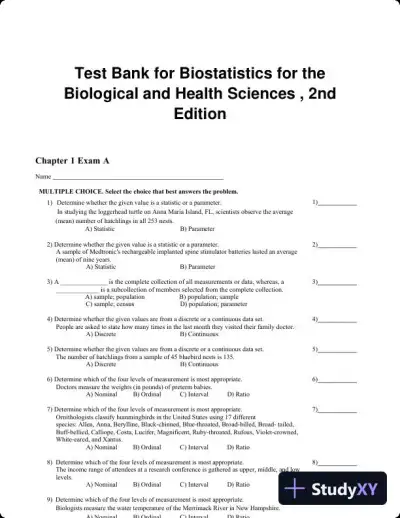 Exam Guides
Test Bank for Biostatistics for the Biological and Health Sciences , 2nd Edition
Statistics
182 pages161downloadsFeb 2025 Exam Guides
Elementary Statistics, 13th Edition Test Bank
Statistics
239 pages160downloadsFeb 2025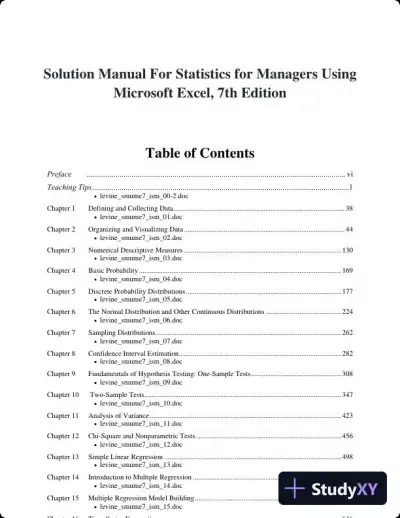 Textbook Guides
Solution Manual For Statistics for Managers Using Microsoft Excel, 7th Edition
Statistics
1418 pages158downloadsFeb 2025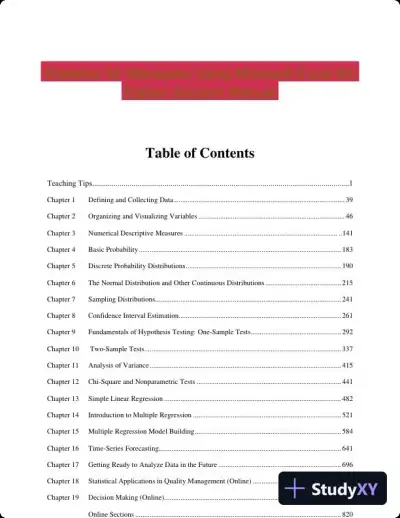 Textbook Guides
Statistics for Managers Using Microsoft Excel 8th Edition Solution Manual
Statistics
1343 pages156downloadsFeb 2025 Textbook Guides
Essentials of Social Statistics for a Diverse Society Second Edition Solution Manual
Statistics
137 pages135downloadsFeb 2025 Exam Guides
Test Bank For Elementary Statistics, 3rd Edition
Statistics
969 pages126downloadsFeb 2025 Textbook Guides
Solution Manual for Business Statistics, 4th Edition
Statistics
582 pages125downloadsFeb 2025 Exam Guides
Test Bank for Business Statistics: A Decision-Making Approach, 10th Edition
Statistics
881 pages110downloadsFeb 2025
Study this document with CramX
Once it is in your library, every tool can work from it.