
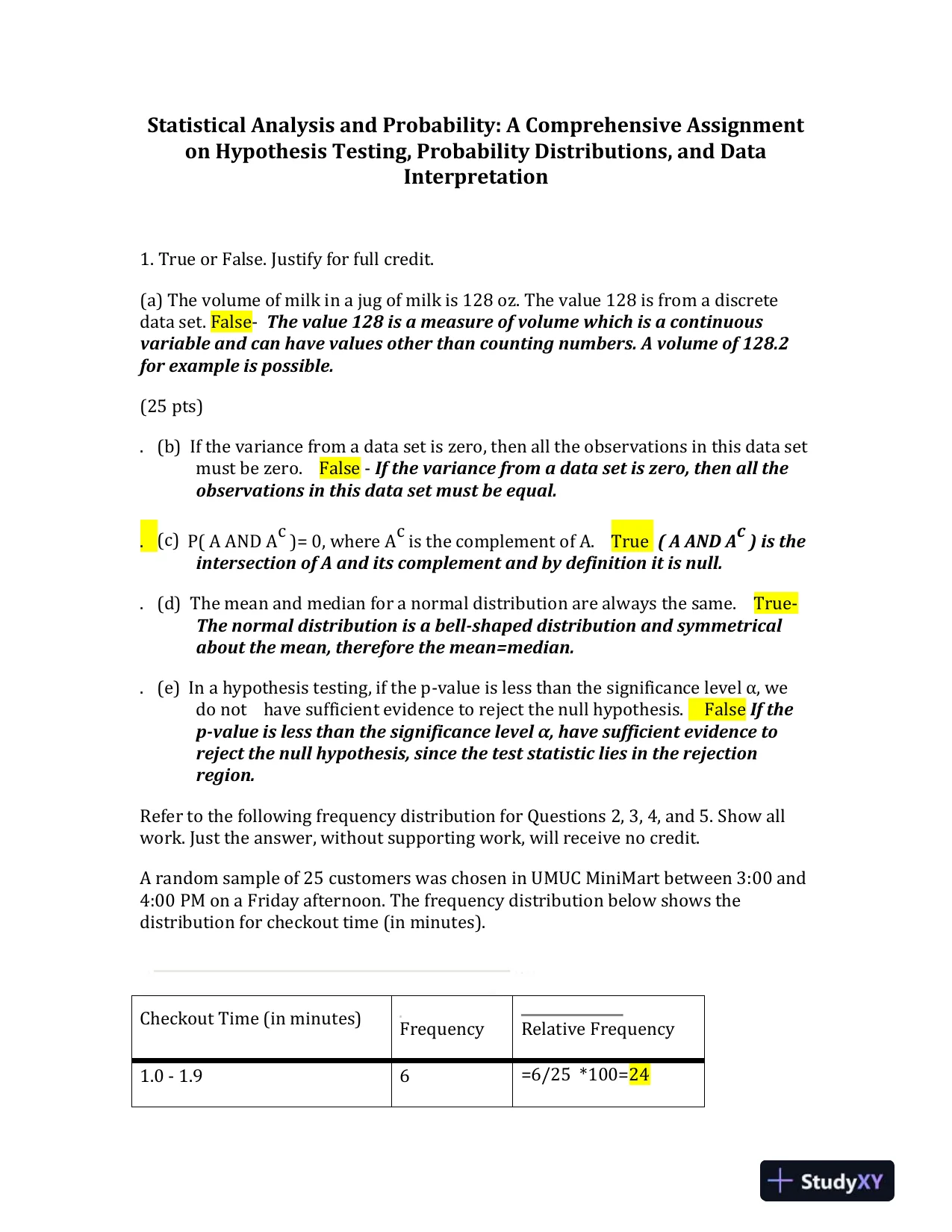
 Statistical Analysis and Probability: A Comprehensive Assignmenton Hypothesis Testing, Probability Distributions, and DataInterpretation1.True or False.Justify for full credit.(a) The volume of milk in a jug of milk is 128 oz. The value 128 is from a discretedata set.False-The value 128 is a measure of volume which is a continuousvariable and can have values other than counting numbers. A volume of 128.2for example is possible.(25 pts).(b)If the variance from a data set is zero, then all the observations in this data setmust be zero.False-Ifthe variance from a data set is zero, then all theobservations in this data set must be equal..(c)P(AANDAc)=0, whereAcis the complement ofA.True(AANDAc) is theintersectionof A and its complement and by definition it is null..(d)The mean and median for a normal distribution are always the same.True-The normal distribution isa bell-shaped distribution and symmetricalabout the mean, therefore the mean=median..(e)In a hypothesis testing, if the p-value is less than the significance level α, wedo nothave sufficient evidence to reject the null hypothesis.FalseIf thep-value is less than the significance level α, have sufficient evidence toreject the null hypothesis, since the test statistic lies in the rejectionregion.Refer to the following frequency distribution for Questions 2, 3, 4, and 5.Show allwork. Just the answer, without supporting work, will receive no credit.A random sample of 25 customers was chosen in UMUC MiniMart between 3:00 and4:00 PM on a Friday afternoon. The frequency distribution below shows thedistribution for checkout time (in minutes).Checkout Time (in minutes)FrequencyRelative Frequency1.0-1.96=6/25 *100=24
Preview Mode
This document has 7 pages. Sign in to access the full document!