

Statistical Analysis of Experimental Results
- Statistics
- 21 pages
- Shared May 2025
This solved assignment presents statistical methods for analyzing experimental research results with step-by-step interpretations.
Preview 7 of 21 pages
See the first 7 pages exactly as they appear in the document.
Page 1 Read page 1 as text
Statistical Analysis of Experimental Results Chapter 4, Section 3, Exercise 075 SS Match the p - values with the appropriate conclusion: (a) The evidence against the null hypothesis is significant, but only at the 10% level. 0.0883 (b) The evidence against the null and in favor of the alternative is very strong. 0.00013 (c) There is not enough evidence to reject the null hypothesis, even at the 10% level. 0.6251 (d) The result is significant at a 5% level but not at a 1% level. 0.0219 Chapter 4, Section 3, Exercise 082 Sleep or Caffeine for Memory? The consumption of caffeine to benefit alertness is a common activity practiced by 90% of adults in North America. Often caffeine is used in order to replace the need for sleep. One recent study 1 compares students' ability to recall memorized information after either the consumption of caffeine or a brief sleep. A random sample of 35 adults (between the ages of 18 - 39 ) were randomly divided into three groups and verbally given a list of 24 words to memorize. During a break, one of the groups takes a nap for an hour and a half, another group is kept awake and then given a caffeine pill an hour prior to testing, and the third group is given a placebo. The response variable of interest is the number of words participants are able to recall following the break. The summary statistics for the three groups are in the table below. We are interested in testing whether there is evidence of a difference in average recall ability between any two of the treatments. Thus we have three possible tests between different pair s of groups: Sleep vs Caffeine, Sleep vs Placebo, and Caffeine vs Placebo. Group Sample size Mean Standard
Page 2 Page 3 Read page 3 as text
Deviation Sleep 12 15.25 3.3 Caffeine 12 12.25 3.5 Placebo 11 13.70 3.0 1 Mednick, Cai, Kanady, and Drummond, "Comparing the benefits of caffeine, naps and placebo on verbal, motor and perceptual memory", Behavioural Brain Research , 193 (2008), 79 - 86. Don't show me this message again for the assignment (a) In the test comparing the sleep group to the caffeine group, the p - value is 0.003 . What is the conclusion of the test? Reject H0 . In the sample , which group had better recall ability? Sleep According to the test results, do you think sleep is really better than caffeine for recall ability? Yes Don't show me this message again for the assignment (b) In the test comparing the sleep group to the placebo group, the p - value is 0.06 . What is the conclusion of the test, using a 5% significance level? Do not reject H0 .
Page 4 Read page 4 as text
What is the conclusion of the test, if we use a 10% significance level? Reject H0 . How strong is the evidence of a difference in mean recall ability between these two treatments? No evidence at all Don't show me this message again for the assignment (c) In the test comparing the caffeine group to the placebo group, the p - value is 0.22 . What is the conclusion of the test? Do not reject H0 . In the sample , which group had better recall ability? Placebo According to the test results, would we be justified in concluding that caffeine impairs recall ability? No Don't show me this message again for the assignment (d) According to this study, what should you do before an exam that asks you to recall information?
Page 5 Read page 5 as text
Take a nap. Have a placebo. Have some coffee. Don't show me this message again for the assignment Chapter 4, Section 4, Exercise 128 Arsenic in Chicken A restaurant chain is measuring the levels of arsenic in chicken from its suppliers. The question is whether there is evidence that the mean level of arsenic is greater than 80 ppb, so we are testing H0: =80 vs Ha: >80 , where represents the average level of arsenic in all chicken from a certain supplier. It takes money and time to test for arsenic so samples are often small. Suppose n=6 chickens from one supplier are tested, and the level of arsenic (in ppb) are 63,71,82,92,93,139 . Don't show me this message again for the assignment (a) What is the sample mean for the data? Round your answer to the nearest integer. x= 90
Page 6 Read page 6 as text
Don't show me this message again for the assignment the tolerance is +/ - 2% (b) Translate the original sample data by the appropriate amount to create a new data set in which the null hypothesis is true. How do the sample size and standard deviation of this new data set compare to the sample size and standard deviation of the original data set? They are different. The sample size is the same but the standard deviation is different. The standard deviation is the same but the sample size is different. They are the same . Don't show me this message again for the assignment (c) Write the six new data values from part (b) on six cards. Sample from these cards with replacement to generate one randomization sample. (Select a card at random, record the value, put it back, select another at random, until you have a sample size of 6 , to match the original sample size.) Give the sample mean. x = 73.833 Don't show me this message again for the assignment the tolerance is +/ - 2%
Page 7 Read page 7 as text
Chapter 4, Section 5, Exercise 149 Hypotheses for a statistical test are given, followed by several possible confidence intervals for different samples. In each case, use the confidence interval to state a conclusion of the test for that sample, and give the significance level used. In addition, in each case for which the results are significant, state which group ( 1 or 2 ) has the larger mean. Hypotheses: H0: 1= 2 vs Ha: 1 ≠ 2 (a) 95% confidence interval for : 1 - 2: 0.16 to 0.58 Conclusion: Reject H0 Significance level: 5% Group with the larger mean: Group 1 (b) 99% confidence interval for 1 - 2 : - 2.5 to 5.5 Conclusion: Do not reject H0 Significance level: 1% Group with the larger mean: Cannot determine (c) 90% confidence interval for 1 - 2 : - 10.8 to - 3.3 Conclusion: Reject H0 Significance level: 10% Group with the larger mean: Group 2 Chapter 4, Section 5, Exercise 156
14 more pages in the full document
Unlock it once and it stays in your library, ready to chat with or turn into flashcards.
Unlock the full documentMore Statistics study materials
See all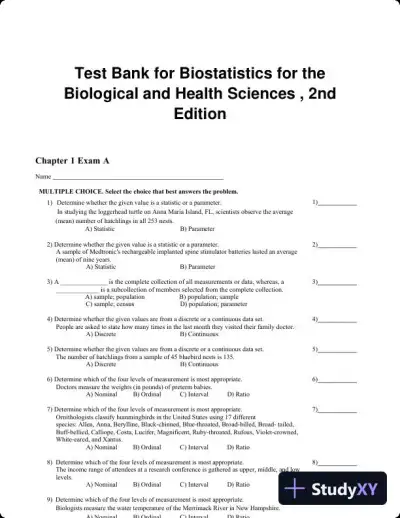 Exam Guides
Test Bank for Biostatistics for the Biological and Health Sciences , 2nd Edition
Statistics
182 pages161downloadsFeb 2025 Exam Guides
Elementary Statistics, 13th Edition Test Bank
Statistics
239 pages160downloadsFeb 2025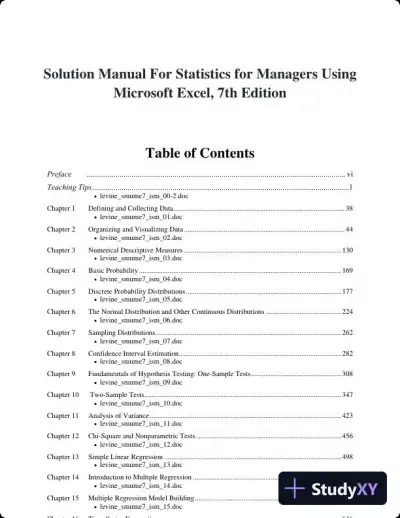 Textbook Guides
Solution Manual For Statistics for Managers Using Microsoft Excel, 7th Edition
Statistics
1418 pages158downloadsFeb 2025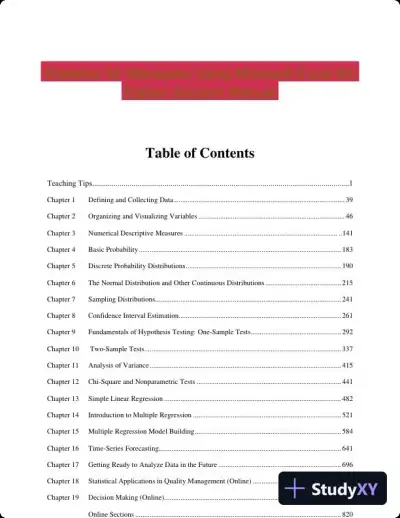 Textbook Guides
Statistics for Managers Using Microsoft Excel 8th Edition Solution Manual
Statistics
1343 pages156downloadsFeb 2025 Textbook Guides
Essentials of Social Statistics for a Diverse Society Second Edition Solution Manual
Statistics
137 pages135downloadsFeb 2025 Exam Guides
Test Bank For Elementary Statistics, 3rd Edition
Statistics
969 pages126downloadsFeb 2025 Textbook Guides
Solution Manual for Business Statistics, 4th Edition
Statistics
582 pages125downloadsFeb 2025 Exam Guides
Test Bank for Business Statistics: A Decision-Making Approach, 10th Edition
Statistics
881 pages110downloadsFeb 2025
Study this document with CramX
Once it is in your library, every tool can work from it.