

Test Bank for Business Statistics, 3rd Edition
- Statistics
- 1360 pages
- Shared May 2025
Get ahead with Test Bank for Business Statistics, 3rd Edition, filled with multiple-choice questions and answers to boost your study routine.
Preview 16 of 1360 pages
See the first 16 pages exactly as they appear in the document.
Page 1 Read page 1 as text
T EST B ANK S ERINA A L H ADDAD Rollins College B USINESS S TATISTICS T HIRD E DITION Robert A. Donnelly
Page 2 Page 3 Read page 3 as text
Table of Contents Chapter 1: An Introduction to Business Statistics………………………………………………1 - 1 Chapter 2: Displaying Descriptive Statistics……………………………………………………2 - 1 Chapter 3: Calculating Descriptive Statistics………………………………………...…………3 - 1 Chapter 4: Introduction to Probabilities…………………………………………...……………4 - 1 Chapter 5: Discrete Probability Distributions…………………………………………..………5 - 1 Chapter 6: Continuous Probability Distributions……………………………………………….6 - 1 Chapter 7: S ampling and Sampling Distributions………………………………………………7 - 1 Chapter 8: Confidence Intervals………………………………………………………………...8 - 1 Chapter 9: Hypothesis Testing for a Single Population………………………………………...9 - 1 Chapter 10: Hypothesis Tests Comparing Two Populations……………………… …………..10 - 1 Chapter 11: Analysis of Variance (ANOVA) Procedures……………………………………..11 - 1 Chapter 12: Chi - Square Tests………………………………………………………………….12 - 1 Chapter 13: Hypothesis Tests for the Population Variance……………………………………13 - 1 Chapter 14: Correlati on and Simple Line ar Regression …………………… … ……………….14 - 1 Chapter 15: Multiple Regression and Model Building………………………………………...15 - 1 Chapter 16: Forecasting………………………………………………………………………..16 - 1 Chapter 17: Decision Analysis………………………………………………………………...17 - 1 Chapter 18: Nonparametric Stati stics………………………………………………………….18 - 1
Page 4 Page 5 Read page 5 as text
1-1 Business Statistics (Donnelly) Chapter 1 An Introduction to Business Statistics 1) Statistics is the mathematical science that deals with the collection, analysis, and presentation of data–data that can then be used as a basis for inference and induction. Answer: TRUE Diff: 1 Keywords: introduction to statistics Objective: 1.1.1 2) Business statistics are statistics applied to the business world in an effort to improve people's decision making in fields such as marketing research, operations, finance, and advertising. Answer: TRUE Diff: 1 Keywords: introduction to statistics Objective: 1.1.1 3) Information is the basic foundation for the field of statistics and can be defined as the value assigned to a specific observation or measurement. Answer: FALSE Diff: 1 Keywords: data Objective: 1.2.1 4) One of the major reasons to use statistics is to transform data into information. Answer: TRUE Diff: 1 Keywords: introduction to statistics Objective: 1.2.1 5) An employee records the number of customers that arrive at a retail store today. This is an example of collecting information. Answer: FALSE Diff: 2 Keywords: data Objective: 1.2.1 6) Primary data is data collected by the person or organization that eventually uses the data. Answer: TRUE Diff: 1 Keywords: primary data Objective: 1.2.1
Page 6 Read page 6 as text
1-2 Chapter 1 7) Asking customers at the shopping mall about their voting intentions in the upcoming political election is an example of secondary data. Answer: FALSE Diff: 1 Keywords: primary data Objective: 1.2.1 8) Analyzing unemployment data from the Bureau of Labor Statistics is an example of using secondary data. Answer: TRUE Diff: 1 Keywords: secondary data Objective: 1.2.1 9) A hotel employee asks customers who are checking out to rate their satisfaction on a scale of 1-10. This is an example of collecting primary data. Answer: TRUE Diff: 1 Keywords: primary data Objective: 1.2.1 10) Analyzing snowfall amounts in New York over the past 100 years to help predict future weather patterns is an example of using primary data. Answer: FALSE Diff: 1 Keywords: secondary data Objective: 1.2.1 11) Bias can occur in a survey when a question is stated in a way that encourages or leads a respondent to a particular answer. Answer: TRUE Diff: 1 Keywords: survey, bias Objective: 1.2.1 12) A restaurant manager randomly selects tables at which customers have just been seated and records the amount of time it takes for the wait staff to greet these customers. This is an example of an experiment being used to collect data. Answer: FALSE Diff: 1 Keywords: direct observation Objective: 1.2.1
Page 7 Read page 7 as text
An Introduction to Business Statistics 1-3 13) A marketing research employee randomly selects adults in a shopping mall and asks them what type of car that they drive. This is an example of using direct observation to collect data. Answer: FALSE Diff: 1 Keywords: surveys Objective: 1.2.1 14) A manager of an electronics store would like to investigate the impact that price has on the demand for laptop computers. Each week, the price of a Dell laptop is adjusted and the demand for each week is recorded. This is an example of an experiment being used to collect data. Answer: TRUE Diff: 1 Keywords: experiments Objective: 1.2.1 15) To help ensure good questionnaire design, it is recommended that a survey is tested on a small group of respondents before releasing it to the actual participants. Answer: TRUE Diff: 1 Keywords: surveys Objective: 1.2.1 16) It is recommended that personal demographic questions be placed at the beginning of the questionnaire because respondents find these questions easy to answer. Answer: FALSE Diff: 2 Keywords: surveys Objective: 1.2.1 17) Interval data deals strictly with qualitative data assigned to predetermined categories. Answer: FALSE Diff: 1 Keywords: nominal data Objective: 1.2.1 18) Education level is an example of nominal data. Answer: TRUE Diff: 1 Keywords: nominal data Objective: 1.2.1
Page 8 Read page 8 as text
1-4 Chapter 1 19) Nominal data has all the features of interval data with the added benefit of having a true zero point. Answer: FALSE Diff: 1 Keywords: ratio data Objective: 1.2.1 20) The interval measurement level is considered quantitative data. Answer: TRUE Diff: 1 Keywords: interval data Objective: 1.2.1 21) The ratio measurement level is considered qualitative data. Answer: FALSE Diff: 1 Keywords: ratio data Objective: 1.2.1 22) The number of pages in your business statistics textbook is an example of quantitative data. Answer: TRUE Diff: 1 Keywords: quantitative data Objective: 1.2.1 23) Your cell phone number is an example of quantitative data. Answer: FALSE Diff: 2 Keywords: qualitative data Objective: 1.2.1 24) A respondent to a survey indicates that she drives a Ford Taurus. This is an example of qualitative data. Answer: TRUE Diff: 1 Keywords: qualitative data Objective: 1.2.1 25) A respondent to a survey indicates that he has lived in his current residence for three years. This is an example of qualitative data. Answer: FALSE Diff: 1 Keywords: qualitative data Objective: 1.2.1
Page 9 Read page 9 as text
An Introduction to Business Statistics 1-5 26) The mathematical operation of addition can be performed on nominal data. Answer: FALSE Diff: 2 Keywords: nominal data Objective: 1.2.1 27) The mathematical operation of multiplication can be performed on interval data. Answer: FALSE Diff: 2 Keywords: interval data Objective: 1.2.1 28) All mathematical operations can be performed on ratio data. Answer: TRUE Diff: 2 Keywords: ratio data Objective: 1.2.1 29) The purpose of inferential statistics is to summarize or display data. Answer: FALSE Diff: 1 Keywords: descriptive statistics Objective: 1.3.1 30) The purpose of inferential statistics is to make claims or conclusions about a population based on a sample. Answer: TRUE Diff: 1 Keywords: inferential statistics Objective: 1.3.1 31) A limitation of descriptive statistics is that, by summarizing large quantities of data, you lose information. Answer: TRUE Diff: 1 Keywords: descriptive statistics Objective: 1.3.1 32) Predicting election results by asking voters their intentions is an example of descriptive statistics. Answer: FALSE Diff: 1 Keywords: inferential statistics Objective: 1.3.1
Page 10 Read page 10 as text
1-6 Chapter 1 33) Deciding that a process that fills bottles with soda is functioning properly by checking the weights for a sample of bottles is an example of inferential statistics. Answer: TRUE Diff: 1 Keywords: inferential statistics Objective: 1.3.1 34) Calculating the average time callers wait on the phone for technical support is an example of inferential statistics. Answer: FALSE Diff: 1 Keywords: descriptive statistics Objective: 1.3.1 35) Determining the proportion of customers who have credit scores greater than 700 is an example of descriptive statistics. Answer: TRUE Diff: 1 Keywords: descriptive statistics Objective: 1.3.1 36) An unbiased sample is a sample that does not represent the intended population and can lead to distorted findings. Unbiased sampling can occur either intentionally or unintentionally. Answer: FALSE Diff: 2 Keywords: biased sample Objective: 1.4.1 37) Statistics can be misused by making differences seem greater or lesser by adjusting the scale on graphs. Answer: TRUE Diff: 1 Keywords: misusing statistics Objective: 1.4.1 38) Collecting data about the number of television viewers for the Summer Olympics is an example of using statistics in the field of ________. A) human resources B) advertising C) operations D) finance Answer: B Diff: 1 Keywords: uses of business statistics Objective: 1.1.1
Page 11 Read page 11 as text
An Introduction to Business Statistics 1-7 39) Using income data to determine the credit worthiness of a consumer who wishes to purchase a new car is an example of using statistics in the field of ________. A) marketing research B) advertising C) operations D) finance Answer: D Diff: 1 Keywords: uses of business statistics Objective: 1.1.1 40) Gathering information from potential customers in an effort to determine their preferences is an example of using statistics in the field of ________. A) marketing research B) advertising C) operations D) finance Answer: A Diff: 1 Keywords: uses of business statistics Objective: 1.1.1 41) Using quality control techniques to test the salt content of pretzels before they are packaged for the consumer is an example of using statistics in the field of ________. A) marketing research B) advertising C) operations D) finance Answer: C Diff: 1 Keywords: uses of business statistics Objective: 1.1.1 42) ________ is (are) derived from facts for the purpose of making decisions. A) Data B) Information C) Statistics D) Samples Answer: B Diff: 1 Keywords: uses of business statistics Objective: 1.1.1
Page 12 Read page 12 as text
1-8 Chapter 1 43) The main drawback to using secondary data is that _______________________. A) it may be expensive to obtain the data B) the subjects of interest need to be directly observed to collect the data C) the subjects of interest are paid to provide the data D) you have no control over how the data were collected Answer: D Diff: 1 Keywords: sources of data Objective: 1.2.1 44) A method of gathering data when subjects are exposed to certain treatments and the data of interest is recorded is known as ____________. A) direct observation B) focus groups C) experiments D) surveys Answer: C Diff: 1 Keywords: experiments Objective: 1.2.1 45) A method of gathering data when people are asked a series of questions that can be administered by email, via the web, face-to-face or over the telephone, is known as _________. A) direct observation B) focus groups C) experiments D) surveys Answer: D Diff: 1 Keywords: surveys Objective: 1.2.1 46) A method of gathering data while the subjects of interest are in their natural environment, often unaware they are being watched, is known as ____________. A) direct observation B) focus groups C) experiments D) surveys Answer: A Diff: 1 Keywords: direct observation Objective: 1.2.1
Page 13 Read page 13 as text
An Introduction to Business Statistics 1-9 47) A method of gathering data when individuals are paid to discuss their attitudes towards products or services in a group setting controlled by a moderator is known as ____________. A) direct observation B) focus groups C) experiments D) surveys Answer: B Diff: 1 Keywords: focus groups Objective: 1.2.1 48) A telemarketer calls individuals at home over the phone and ask them the likelihood that they will purchase a timeshare property over the next 12 months. This method of gathering data is known as ____________. A) direct observation B) focus groups C) experiments D) surveys Answer: D Diff: 1 Keywords: surveys Objective: 1.2.1 49) A Bank of America employee records the amount of time that customers spend using the ATM machine at her branch. This method of gathering data is known as _______________. A) direct observation B) focus groups C) experiments D) surveys Answer: A Diff: 1 Keywords: direct observation Objective: 1.2.1 50) The manager at the local Ruby Tuesday's restaurant wanted to investigate the effect of music on the average revenue per customer. Each night for one month, fast-paced music was played. The following month, slow-paced music was played every night. The average revenue per customer for each month was compared. This method of gathering data is known as __________. A) direct observation B) focus groups C) experiments D) surveys Answer: C Diff: 1 Keywords: experiments Objective: 1.2.1
Page 14 Read page 14 as text
1-10 Chapter 1 51) A marketing manager for a textbook publisher meets with a group of several students who are paid to discuss what they like and dislike about their textbooks. This method of gathering data is known as _____________. A) direct observation B) focus groups C) experiments D) surveys Answer: B Diff: 1 Keywords: focus groups Objective: 1.2.1 52) ________ data use numerical values to describe something of interest either by measuring it or counting it. A) Primary B) Secondary C) Quantitative D) Qualitative Answer: C Diff: 1 Keywords: quantitative data Objective: 1.2.1 53) ________ data use descriptive terms to measure or classify something of interest. A) Primary B) Secondary C) Quantitative D) Qualitative Answer: D Diff: 1 Keywords: qualitative data Objective: 1.2.1 54) Which of the following is an example of quantitative data? A) the zip code of your home address B) Apple's closing stock price today C) your gender D) your telephone number Answer: B Diff: 1 Keywords: qualitative data Objective: 1.2.1
Page 15 Read page 15 as text
An Introduction to Business Statistics 1-11 55) Which of the following is an example of qualitative data? A) today's high temperature B) the class average of your last statistics exam C) the amount of time that you studied for your last statistics exam D) your last name Answer: D Diff: 1 Keywords: quantitative data Objective: 1.2.1 56) Which levels of measurement are considered quantitative data? A) interval and ratio B) nominal and interval C) nominal and ratio D) nominal and ordinal Answer: A Diff: 1 Keywords: quantitative data Objective: 1.2.1 57) Which levels of measurement are considered qualitative data? A) interval and ratio B) nominal and interval C) ordinal and ratio D) nominal and ordinal Answer: D Diff: 1 Keywords: qualitative data Objective: 1.2.1 58) The number of iPhones sold today at an Apple store is an example of ________ data. A) nominal B) ordinal C) interval D) ratio Answer: D Diff: 1 Keywords: ratio data Objective: 1.2.1
Page 16 Read page 16 as text
1-12 Chapter 1 59) A respondent of a survey indicates that he is a resident in the state of Ohio. This is an example of _________ data. A) nominal B) ordinal C) interval D) ratio Answer: A Diff: 1 Keywords: nominal data Objective: 1.2.1 60) The Graduate Management Admission Test (GMAT) is a standardized test used by schools to determine the aptitude of individuals who are applying for MBA programs. The range of the GMAT score is 200-800. Brian has recently taken the exam and scored 720. This is an example of __________ data. A) nominal B) ordinal C) interval D) ratio Answer: C Diff: 1 Keywords: interval data Objective: 1.2.1 61) In a Major League Baseball game today, the Philadelphia Phillies scored six runs against the New York Mets. This is an example of _________ data. A) nominal B) ordinal C) interval D) ratio Answer: D Diff: 1 Keywords: ratio data Objective: 1.2.1 62) A respondent of a survey indicates that she is currently in her junior year at the University of Texas. This is an example of _________ data. A) nominal B) ordinal C) interval D) ratio Answer: B Diff: 1 Keywords: ordinal data Objective: 1.2.1
1344 more pages in the full document
Unlock it once and it stays in your library, ready to chat with or turn into flashcards.
Unlock the full documentMore Statistics study materials
See all Exam Guides
Test Bank for Biostatistics for the Biological and Health Sciences , 2nd Edition
Statistics
182 pages161downloadsFeb 2025 Exam Guides
Elementary Statistics, 13th Edition Test Bank
Statistics
239 pages160downloadsFeb 2025 Textbook Guides
Solution Manual For Statistics for Managers Using Microsoft Excel, 7th Edition
Statistics
1418 pages158downloadsFeb 2025 Textbook Guides
Statistics for Managers Using Microsoft Excel 8th Edition Solution Manual
Statistics
1343 pages156downloadsFeb 2025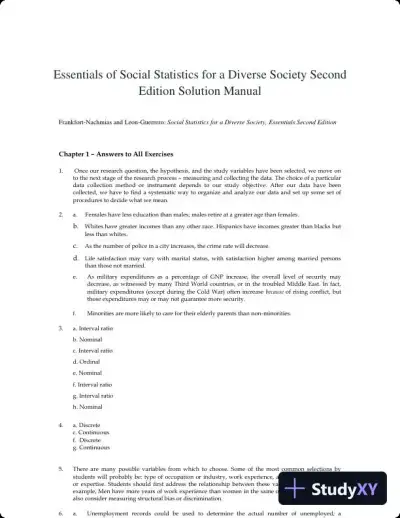 Textbook Guides
Essentials of Social Statistics for a Diverse Society Second Edition Solution Manual
Statistics
137 pages135downloadsFeb 2025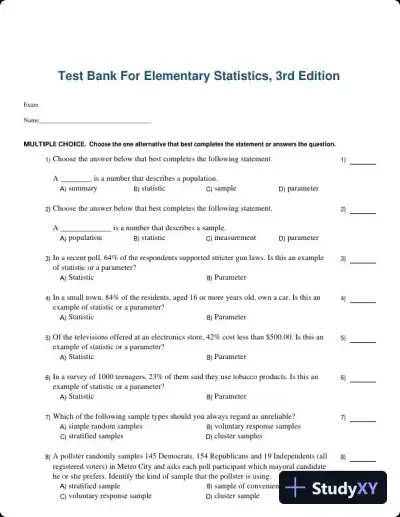 Exam Guides
Test Bank For Elementary Statistics, 3rd Edition
Statistics
969 pages126downloadsFeb 2025 Textbook Guides
Solution Manual for Business Statistics, 4th Edition
Statistics
582 pages125downloadsFeb 2025 Exam Guides
Test Bank for Business Statistics: A Decision-Making Approach, 10th Edition
Statistics
881 pages110downloadsFeb 2025
Study this document with CramX
Once it is in your library, every tool can work from it.