
CramX Logo
Understanding Statistical Methods: Analyzing Inferential Statistics, NHST, F-Ratios, and Experimental Designs - Document preview page 1

Understanding Statistical Methods: Analyzing Inferential Statistics, NHST, F-Ratios, and Experimental Designs - Page 1

Document preview content for Understanding Statistical Methods: Analyzing Inferential Statistics, NHST, F-Ratios, and Experimental Designs

Understanding Statistical Methods: Analyzing Inferential Statistics, NHST, F-Ratios, and Experimental Designs

Analysis of statistical methods including NHST, F-ratios, and experimental design.

Andrew Taylor
Contributor
4.1
0
12 months ago
Preview (7 of 20 Pages)
100%
Log in to unlock
Page 1 of 7
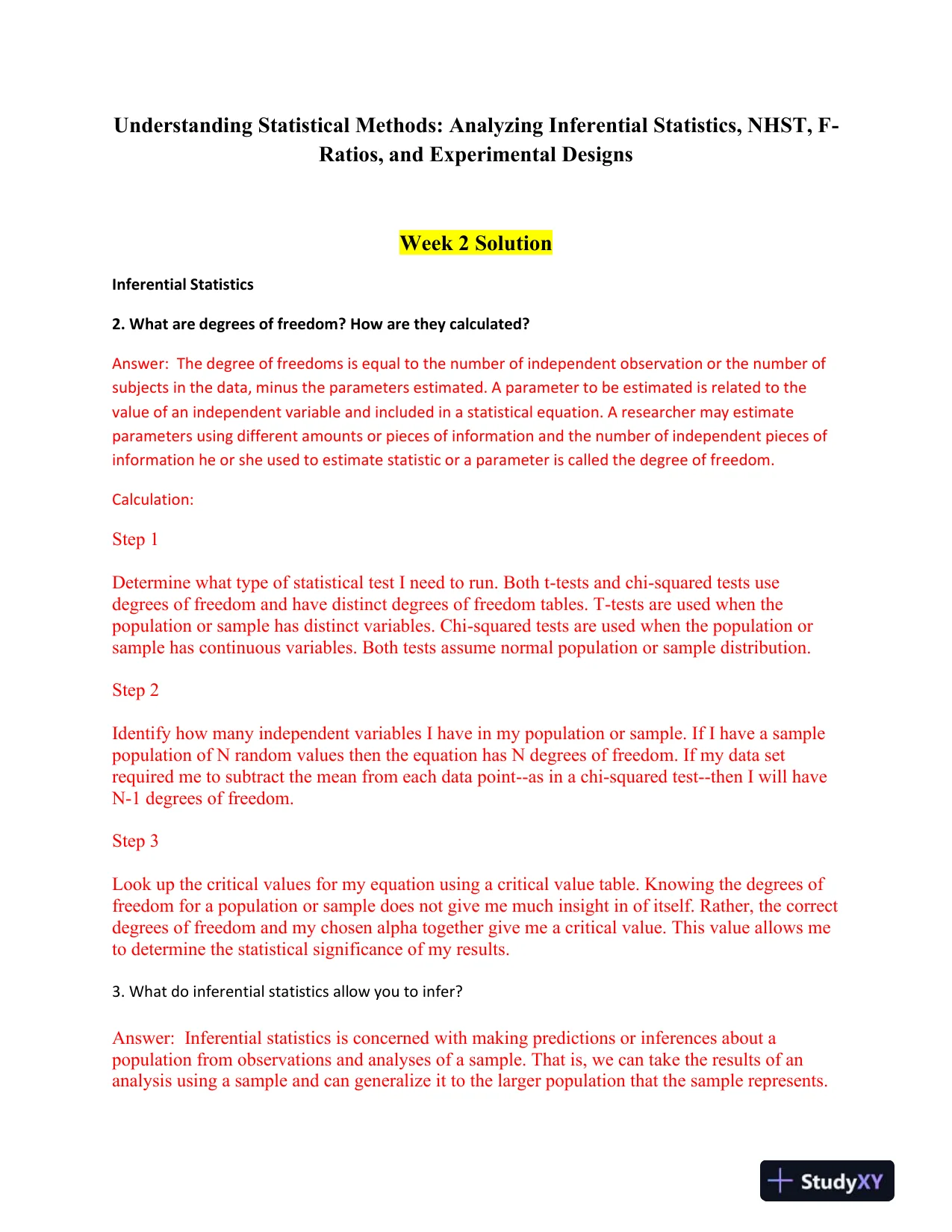
Understanding Statistical Methods: Analyzing Inferential Statistics, NHST, F-Ratios, and Experimental Designs - Page 1 preview imageUnderstanding Statistical Methods: Analyzing Inferential Statistics, NHST, F-Ratios, and Experimental DesignsWeek 2 SolutionInferential Statistics2. Whatare degrees of freedom? How are they calculated?Answer: The degree of freedoms is equal to the number of independent observation or the number ofsubjects in the data, minus the parameters estimated. A parameter to be estimated is related to thevalue of an independent variableand included in a statistical equation. A researcher may estimateparameters using different amounts or pieces of information and the number of independent pieces ofinformation he or she used to estimate statistic or a parameter is called the degree of freedom.Calculation:Step 1Determine what type of statistical test I need to run. Both t-tests and chi-squared tests usedegrees of freedom and have distinct degrees of freedom tables. T-tests are used when thepopulation or sample has distinct variables. Chi-squared tests are usedwhen the population orsample has continuous variables. Both tests assume normal population or sample distribution.Step 2Identify how many independent variables I have in my population or sample. If I have a samplepopulation of N random valuesthen the equation has N degrees of freedom. If my data setrequired me to subtract the mean from each data point--as in a chi-squared test--then I will haveN-1 degrees of freedom.Step 3Look up the critical values for my equation using a critical value table. Knowing the degrees offreedom for a population or sample does not give me much insight in of itself. Rather, the correctdegrees of freedom and my chosen alpha together give me a critical value. This value allows meto determine the statistical significance of my results.3. Whatdo inferential statistics allow you to infer?Answer:Inferential statistics is concerned with making predictions or inferences about apopulation from observations and analyses of a sample. That is, we can take the results of ananalysis using a sample and can generalize it to the larger population that the sample represents.
Page 2 of 7
Understanding Statistical Methods: Analyzing Inferential Statistics, NHST, F-Ratios, and Experimental Designs - Page 2 preview image
Page 3 of 7
Understanding Statistical Methods: Analyzing Inferential Statistics, NHST, F-Ratios, and Experimental Designs - Page 3 preview imageIn order to do this, however, it is imperative that the sample is representative of the group towhich it is being generalized.To address this issue of generalization, we have tests of significance. A Chi-square or T-test, forexample, can tell us the probability that the results of our analysis on the sample arerepresentative of the population that the sample represents. In other words, these tests ofsignificance tell us the probability that the results of the analysis could have occurred by chancewhen there is no relationship at all between the variables we studied in the population westudied.4. Whatis the General Linear Model (GLM)? Why does it matter?Answer:The General Linear Model (GLM) underlies most of the statistical analyses that are used in applied andsocial research. It is the foundation for thet-test, Analysis of Variance (ANOVA),Analysis of Covariance(ANCOVA),regression analysis, and many of the multivariate methods including factor analysis, clusteranalysis, multidimensional scaling, discriminant function analysis, canonical correlation, and others.Because of its generality, the model is important for students of social research. Although a deepunderstanding of the GLM requires some advanced statistics training, I will attempt here to introducethe concept and provide a non-statistical description.When there is a relationship among the variables and then they can expressedby the general linearmodels.5. Compareand contrast parametric and nonparametric statistics. Why and in what types of cases wouldyou use one over the other?Answer:Nonparametric statistics (also called “distribution free statistics”) are those that can describesome attribute of a population, test hypotheses about that attribute, its relationship with some otherattribute, or differences on that attribute across populations, across time or across related constructs,that require no assumptions about the form of the population data distribution(s) nor require intervallevel measurement.In the literal meaning of the terms, aparametricstatistical test is one that makes assumptions about theparameters (defining properties) of the population distribution(s) from which one's data are drawn,while anon-parametrictest is one that makes no such assumptions. In this strict sense, "non-parametric" is essentially a null category, since virtually all statistical tests assume one thing or anotherabout the properties of the source population(s).We will use parametric statistics and non-parametric statistics in the following situation:
Page 4 of 7
Understanding Statistical Methods: Analyzing Inferential Statistics, NHST, F-Ratios, and Experimental Designs - Page 4 preview image6. Whyis it important to pay attention to the assumptions of the statistical test? What are your optionsif your dependent variable scores are not normally distributed?When you do a statistical test, you are, in essence, testing if the assumptions are valid.We are typicallyonly interested in one, the null hypothesis.That is, the assumption that the difference is zero (actually itcould test if the difference were any amount).But the null hypothesis is only one of many assumptions.A second assumption is that the data are normally distributed.One unusual thing about the ‘real’ worldis that data are often normally distributed.Height, IQ and many, many other parameters are.Ingeneral, if a variable is affected by many, many different factors, it will be normally distributed. We evenhave tests to determine if the data are normal.Unfortunately, almost all variables have a slightdeparture from normality.When the dependent variables score are not normally distributedthen we have to standardized thedependent variable such that it can follows normal distributions.NHST1.What does p = .05 mean? What are some misconceptions about the meaning of p =.05? Why arethey wrong? Should all research adhere to the p = .05 standard for significance? Why or whynot?
Page 5 of 7
Understanding Statistical Methods: Analyzing Inferential Statistics, NHST, F-Ratios, and Experimental Designs - Page 5 preview imageAnswer:p = 0.05 means signifance level of the given sample size. P= 0.05 is a threshold given by fisherused to check the significance or non-significance of a sample size. Fisher does not explain the0.05 clearly like from where it came what arethe concepts behind the value of p. So people willremain in confusion about the choice of the value of 0.05. But it was assumed that 0.05 is just anarbitrary number fisher assumed which is used to check the significance level. No it is notnecessary to adhere all research to the value 0.05 as it is not proved its origin hence we can makesome other arbitrary constant for the same with proper reasoning..2.Compare and contrast the concepts of effect size and statistical significance.Answer:Effect size is a simple way of quantifying the difference between two groups that has manyadvantages over the use of tests of statistical significance alone. Effect size emphasizes the sizeof the difference rather than confounding this with sample size.If effect size comes under thepurview of 0.05 then it is said to be significant and acceptable but it is goes beyond the purviewof 0.05 then the effect size or the sample size is said to be non-significant.3.What is the difference between a statistically significant result and a clinically or “real world”significant result? Give examples of both.Answer:Statistically significant results are based on various assumptions while the clinicallysignificant results are due to a logical conclusion. For example in financial sector performance ofthe company is analyzed in advance on the basis of statistical calculation of previous years while
Page 6 of 7
Understanding Statistical Methods: Analyzing Inferential Statistics, NHST, F-Ratios, and Experimental Designs - Page 6 preview imagein reality check it could differ from the statistical result. Like GDP growth of US is-2.3predicted in advance but in real calculation it was found to be +1.0.4.What is NHST? Describe the assumptions of the model.Answer:Null Hypothesis Significance Testing (NHST) is a type of statistical techniques or methodswhich are used to check or calculate the effect of certain factor on our observation.Assumptions used in NHSTIn the null hypotheses involves the absence of factors such as selection and drift etc.These null hypotheses does not based on reality.Null hypotheses is formulated on a well-informed hypotheses based on testeda prioriassumptions.Hypotheses allow the analysis and reconstruction of models.5.Describe and explain three criticisms of NHST.Answer:For NHST, the two independent dimensions of measurement are (1) the strength of an effect,measured using the distance of a point estimate from zero; and (2) the uncertainty we have aboutthe effect’s true strength, measured using something like the expected variance of ourmeasurement device. These two dimensions are reduced into a single p-value in a way thatdiscards much of the meaning of the original data. In addition to that nobody knows the origin
Page 7 of 7
Understanding Statistical Methods: Analyzing Inferential Statistics, NHST, F-Ratios, and Experimental Designs - Page 7 preview imageof 0.05 in NHST and why only 0.05 is assumed so it is like an assumption assumed to checkresult.6.Describe and explain two alternatives to NHST. What do their proponents consider to be theiradvantages?Answer:Today there is need toreplace the NHST with real life statistical calculations. There arevarious alternatives available to NHST;Two alternatives to NHSTPower AnalysisIn statistical power analysis it gives you a long-term probability but given that the populationeffect size, alpha, and sample size, of rejecting the null hypothesis, given that the null hypothesisis false. The influence of sample size on significance has long been understood. It is better thanNHST as their results and probability are for long term.Plot-Plus-Error-Bar ProcedureIn this method a bar graph is used to predict results. This method is reliable as it tracks the datafrom the various no of years. This procedure is also known as PPE.7.Which type of analysis would best answer the research question you stated in Activity 1? Justify youranswer.Answer:You are a researcher interested in addressing the question: does smiling cause mood rise (i.e.become more positive)? Sketch between-participants, within-participants, and matched-
Preview Mode

This document has 20 pages. Sign in to access the full document!