

French II – Adjectives Adverbs Prepositions
- World Languages
- Texas A&M University
- 28 pages
- Shared March 2026
Preview 9 of 28 pages
See the first 9 pages exactly as they appear in the document.
Page 1 Read page 1 as text
Study Guide French II – Adjectives Adverbs Prepositions 1. Adjectives, Adverbs, and Prepositions In French, adjectives, adverbs, and prepositions help make sentences clearer, more detailed, and more interesting. Without these words, we would only know what actions happen , but not how , where , or in what way they happen. These parts of speech add important information and help us describe people, places, things, and actions more precisely. 1. Adjectives Adjectives are words that describe nouns . They give more information about: • people • places • things • ideas For example, adjectives can describe size, color, shape, personality, or quality . Examples: • une maison grande — a big house • un livre intéressant — an interesting book • une ville moderne — a modern city Adjectives make sentences more informative by telling us what something is like . 2. Adverbs Adverbs describe how an action is performed . They usually modify: • verbs • adjectives • other adverbs
Page 2 Read page 2 as text
Study Guide In simple terms, adverbs explain how, when, where, or how much something happens. Examples: • Il parle lentement. He speaks slowly. • Elle travaille très bien. She works very well. Adverbs help add details about the manner or intensity of an action . 3. Comparisons Adjectives, adverbs, and even nouns can be used to make comparisons between people or things. These comparisons help show: • more • less • equality For example: • comparing two people • comparing two places • comparing the quality of two objects Comparisons help speakers express differences and similarities . 4. Prepositions Prepositions are words that connect elements in a sentence . They show relationships between words, especially between: • nouns and nouns • verbs and nouns Prepositions often describe location, direction, time, or relationships .
Page 3 Read page 3 as text
Study Guide Examples of common ideas expressed by prepositions include: • location • movement • possession • time Because they often indicate place or direction , prepositions are especially useful when: • traveling • giving directions • looking for places or objects For example, they help explain where something is located or where someone is going. Key Takeaway • Adjectives describe nouns such as people, places, things, or ideas. • Adverbs describe how actions happen and modify verbs, adjectives, or other adverbs. • Comparisons allow adjectives, adverbs, and nouns to show differences or similarities. • Prepositions connect parts of a sentence and often describe location, direction, or relationships. 2. Adjectives and Exclamations in French 1. Adjectives Must Agree with the Noun In French, adjectives must agree with the noun they describe . This means the adjective changes depending on the noun’s: • gender (masculine or feminine) • number (singular or plural) Because of this, it is important to know whether a noun is masculine or feminine and singular or plural .
Page 4 Read page 4 as text
Study Guide Example: • Il est intelligent. He is intelligent. • Elle est intelligente. She is intelligent. Forming Feminine Adjectives 1. Most Adjectives Add - e The most common rule is simple: Add - e to the masculine adjective to form the feminine form . Example: • intelligent → intelligente Sometimes a final consonant that was silent becomes pronounced in the feminine form. 2. Adjectives Ending in - e If a masculine adjective already ends in - e , the feminine form does not change . Example: • sincère → sincère Example sentences: • Il est sincère. • Elle est sincère. Both forms look and sound the same. 3. Adjectives Ending in - é If the masculine adjective ends in - é , the feminine form adds another - e . Example:
Page 5 Read page 5 as text
Study Guide • occupé → occupée Example: • Il est occupé. • Elle est occupée. 4. Adjectives Ending in - x Adjectives ending in - x usually change - x to - se in the feminine. Example: • curieux → curieuse 5. Adjectives Ending in - f Adjectives ending in - f change - f to - ve . Example: • actif → active 6. Adjectives Ending in - er Adjectives ending in - er change - er to - ère . Example: • fier → fière 7. Doubling the Final Consonant Some adjectives form the feminine by doubling the final consonant before adding - e . Examples:
Page 6 Read page 6 as text
Study Guide Irregular Feminine Adjectives Some adjectives do not follow regular patterns and must be memorized. Examples:
Page 7 Read page 7 as text
Study Guide
Page 8 Read page 8 as text
Study Guide Special Forms Before Vowels Some adjectives change form when placed before a masculine noun beginning with a vowel or silent h . Examples: • beau → bel • nouveau → nouvel • vieux → vieil • fou → fol • mou → mol Example: • un bel appartement a beautiful apartment But when the adjective comes after the noun , the normal masculine form is used.
Page 9 Read page 9 as text
Study Guide Example: • L'appartement est beau. Forming Plural Adjectives 1. Most Adjectives Add - s To make adjectives plural, simply add - s . Examples: • intelligent → intelligents • intelligente → intelligentes Example sentences: • Ils sont intelligents. • Elles sont intelligentes. 2. Mixed Gender Nouns When an adjective describes both masculine and feminine nouns , the masculine plural is used. Example: • Le garçon et la fille sont contents. The boy and the girl are happy. 3. Adjectives Ending in - s or - x If the masculine adjective ends in - s or - x , the singular and plural forms stay the same . Example: • Il est sérieux. • Ils sont sérieux. 4. Adjectives Ending in - al Most adjectives ending in - al change to - aux in the plural.
19 more pages in the full document
Unlock it once and it stays in your library, ready to chat with or turn into flashcards.
Unlock the full documentMore World Languages study materials
See all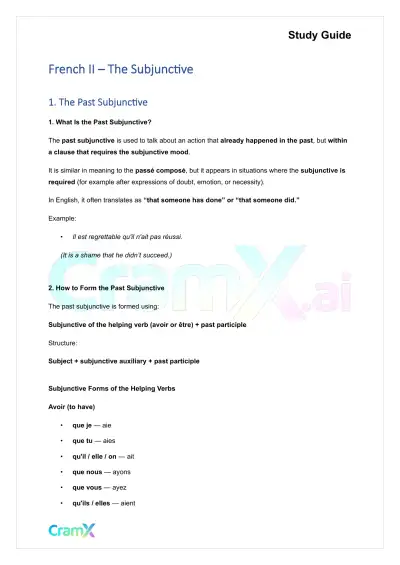 Quick Guides
French II – The Subjunctive
World Languages
26 pagesMar 2026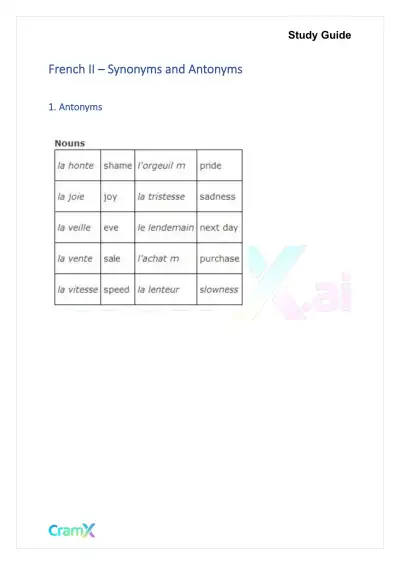 Quick Guides
French II – Synonyms and Antonyms
World Languages
9 pagesMar 2026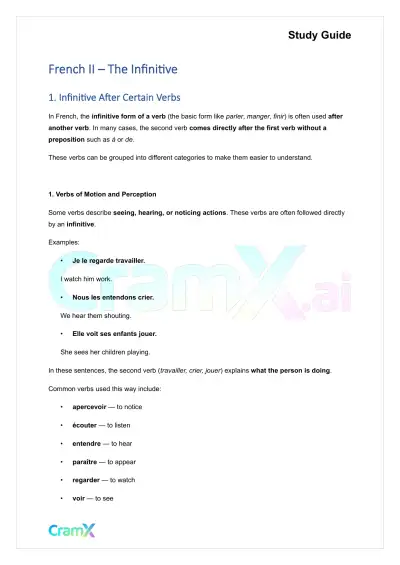 Quick Guides
French II – The Infinitive
World Languages
19 pagesMar 2026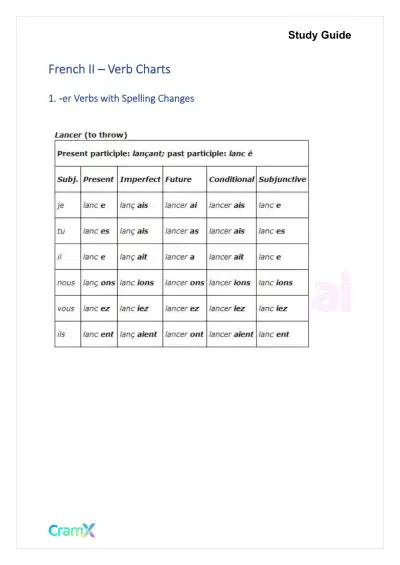 Quick Guides
French II – Verb Charts
World Languages
41 pagesMar 2026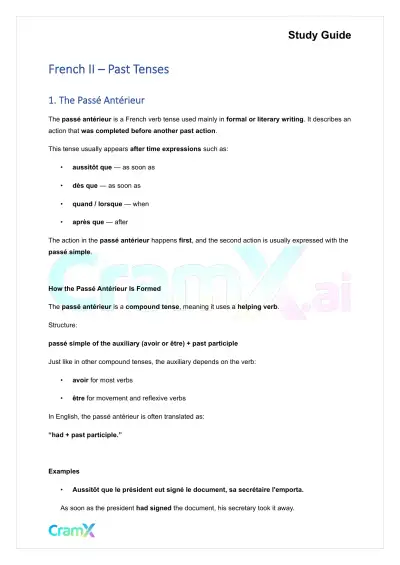 Quick Guides
French II – Past Tenses
World Languages
30 pagesMar 2026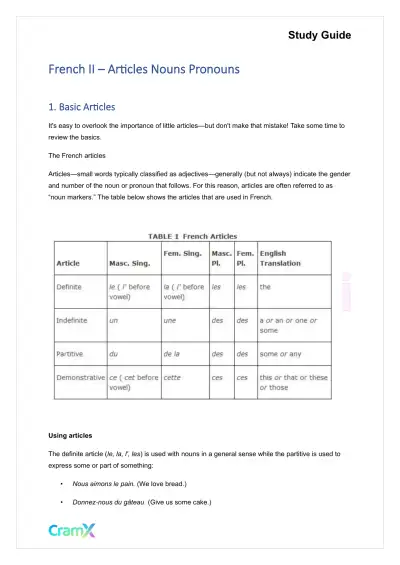 Quick Guides
French II – Articles Nouns Pronouns
World Languages
22 pagesMar 2026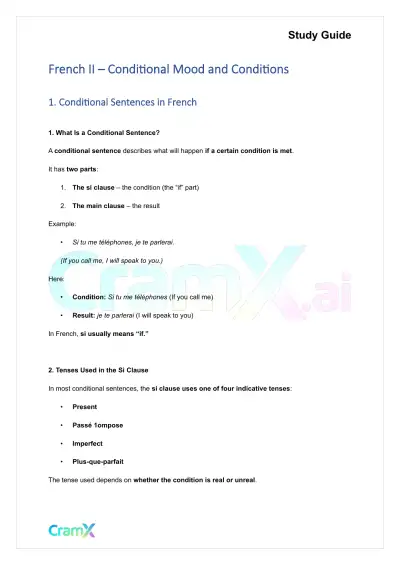 Quick Guides
French II – Conditional Mood and Conditions
World Languages
19 pagesMar 2026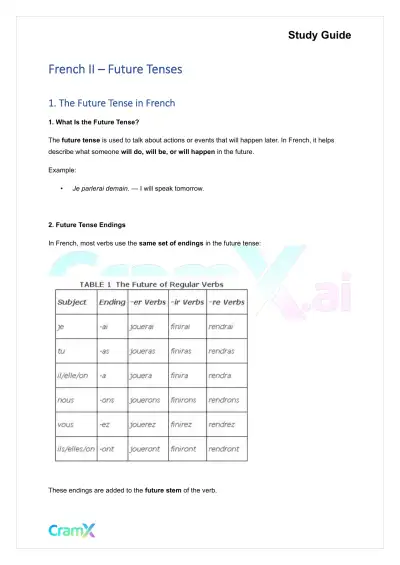 Quick Guides
French II – Future Tenses
World Languages
18 pagesMar 2026
Study this document with CramX
Once it is in your library, every tool can work from it.