

French II – Participles
- World Languages
- Texas A&M University
- 16 pages
- Shared March 2026
Preview 5 of 16 pages
See the first 5 pages exactly as they appear in the document.
Page 1 Read page 1 as text
Study Guide French II – Participles 1. Past Participles in French The past participle is an important verb form in French. It is mainly used to form compound tenses (such as the passé composé ), but it can also function as an adjective . When a past participle is used as an adjective (called an epithet or attribute ), it usually comes after the noun it describes and must agree in gender and number with that noun. Forming the Past Participle For regular verbs , the past participle follows simple patterns based on the verb family. • – er verbs → – é parler → parlé (spoken) • – ir verbs → – i finir → fini (finished) • – re verbs → – u vendre → vendu (sold)
Page 2 Read page 2 as text
Study Guide However, many French verbs have irregular past participles . These often fall into several common groups. Some verbs that are irregular in the present form have regular past participles:
Page 3 Read page 3 as text
Study Guide Common Groups of Irregular Past Participles Verbs Ending in – i • rire → ri (laughed) • suffire → suffi (sufficed) • suivre → suivi (followed) Verbs Ending in – is • acquérir → acquis (acquired) • asseoir → assis (seated) • conquérir → conquis (conquered) • mettre → mis (put) • prendre → pris (taken) Verbs Ending in – it • conduire → conduit (driven) • construire → construit (constructed) • cuire → cuit (cooked) • détruire → détruit (destroyed) • dire → dit (said) • écrire → écrit (written) • produire → produit (produced) • traduire → traduit (translated) Verbs Ending in – u • apercevoir → aperçu (noticed) • avoir → eu (had)
Page 4 Read page 4 as text
Study Guide • boire → bu (drunk) • connaître → connu (known) • courir → couru (run) • croire → cru (believed) • devoir → dû (had to) • lire → lu (read) • paraître → paru (appeared) • plaire → plu (pleased) • pouvoir → pu (been able) • recevoir → reçu (received) • savoir → su (known) • se taire → tu (kept quiet) • tenir → tenu (held) • valoir → valu (been worth) • venir → venu (come) • vivre → vécu (lived) • vouloir → voulu (wanted) Verbs Ending in – ert • ouvrir → ouvert (opened) • offrir → offert (offered) • souffrir → souffert (suffered) Verbs Ending in – int • atteindre → atteint (attained) • craindre → craint (feared)
Page 5 Read page 5 as text
Study Guide • éteindre → éteint (extinguished) • joindre → joint (joined) • peindre → peint (painted) • plaindre → plaint (pitied) Totally Irregular Past Participles Some verbs have completely unique forms : • être → été (been) • faire → fait (done / made) • mourir → mort (died) • naître → né (born) Related verbs usually follow the same pattern as their base verb. Any related infinitive forms its past participle according to the list above, for example:
11 more pages in the full document
Unlock it once and it stays in your library, ready to chat with or turn into flashcards.
Unlock the full documentMore World Languages study materials
See all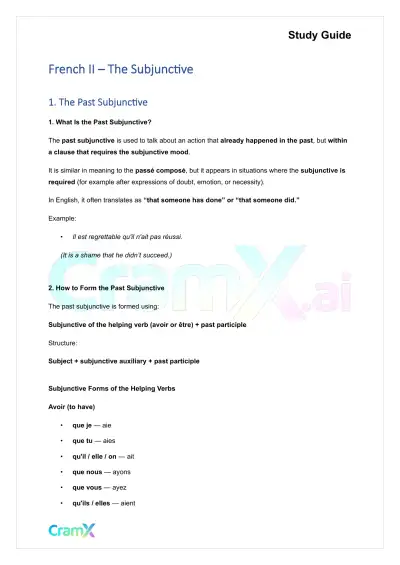 Quick Guides
French II – The Subjunctive
World Languages
26 pagesMar 2026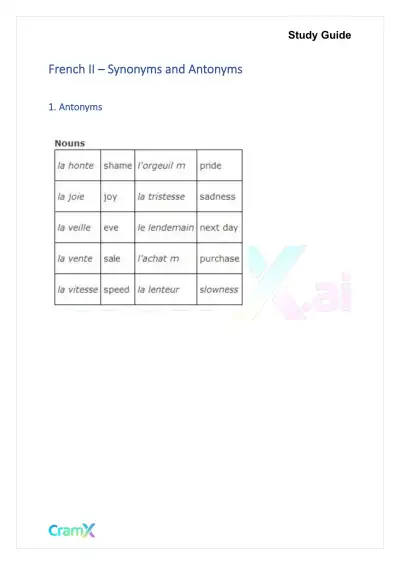 Quick Guides
French II – Synonyms and Antonyms
World Languages
9 pagesMar 2026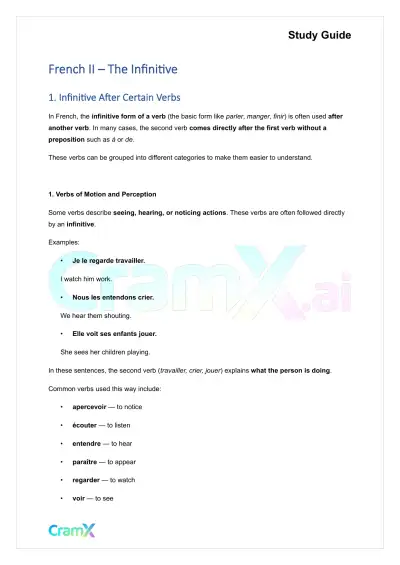 Quick Guides
French II – The Infinitive
World Languages
19 pagesMar 2026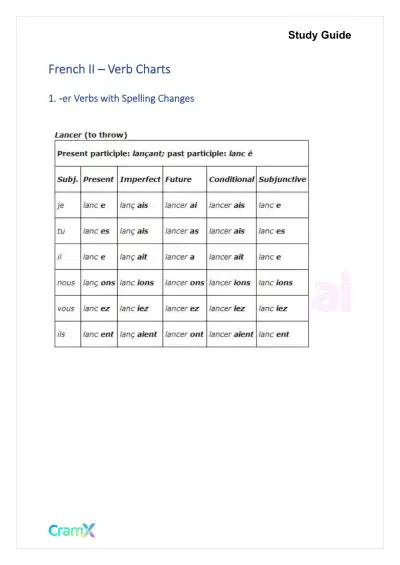 Quick Guides
French II – Verb Charts
World Languages
41 pagesMar 2026 Quick Guides
French II – Adjectives Adverbs Prepositions
World Languages
28 pagesMar 2026 Quick Guides
French II – Past Tenses
World Languages
30 pagesMar 2026 Quick Guides
French II – Articles Nouns Pronouns
World Languages
22 pagesMar 2026 Quick Guides
French II – Conditional Mood and Conditions
World Languages
19 pagesMar 2026
Study this document with CramX
Once it is in your library, every tool can work from it.