

French II – Indefinites Passive Voice
- World Languages
- Texas A&M University
- 26 pages
- Shared March 2026
Preview 8 of 26 pages
See the first 8 pages exactly as they appear in the document.
Page 1 Read page 1 as text
Study Guide French II – Indefinites Passive Voice 1. Indefinite Adjectives 1. What Are Indefinite Adjectives? Indefinite adjectives describe nouns in a general or non - specific way . They refer to things like some, several, any, each, or all rather than a specific number or identity. They are placed before or after nouns , depending on the word used. Examples of common indefinite adjectives include:
Page 2 Read page 2 as text
Study Guide
Page 3 Read page 3 as text
Study Guide 2. Aucun(e) Aucun(e) means “no” or “not any.” It is always used in the singular , even though the meaning may be plural. Examples: • Il a travaillé sans aucun effort. (He worked without any effort.) • Elle a accepté l'invitation sans aucune hésitation. (She accepted the invitation without any hesitation.) • Il n'y a aucun problème. (There is no problem.) 3. Autre(s) Autre means “other” or “another.” Important points: • It usually comes before the noun . • It may appear with or without an article . Examples: • Donnez - moi une autre tranche de gâteau. (Give me another piece of cake.) • Ça c'est autre chose. (That's another story.) Plural Form The plural of un autre is d'autres . Example: • Il a un problème. Moi, j'ai d'autres problèmes. (He has a problem. I have other problems.)
Page 4 Read page 4 as text
Study Guide Additional Expression Encore + un(e) can also mean “another.” Example: • Apportez - moi encore une tasse de café. (Please bring me another cup of coffee.) 4. Certain(e)(s) Certain(e)(s) means “certain” or “some.” • In the singular , it uses un/une . • In the plural , no article is used. Examples: • Elle a un certain sourire. (She has a certain smile.) • Une certaine Mme Dupont vous attend. (A certain Mrs. Dupont is waiting for you.) • Certains tableaux dans ce musée sont très beaux. (Certain paintings in this museum are very beautiful.) 5. Chaque Chaque means “each” or “every.” Important rule: • It is invariable • It is used only in the singular Example: • Chaque région française a sa propre spécialité. (Each French region has its own specialty.)
Page 5 Read page 5 as text
Study Guide 6. Différent(e)(s), Divers(e)(s), and Maint(e)(s) These adjectives generally mean “several” or “various.” Divers(e)(s) Used alone and mainly in the plural . Example: • Diverses personnes m'ont parlé du problème. (Various people told me about the problem.) Différent(e)(s) Often used with a preposition . Example: • Il s'est trompé à différentes reprises. (He made mistakes on several occasions.) Maint(e)(s) Usually found in formal or literary language . Example: • Je vous en ai parlé maintes fois. (I have spoken to you about it many times.) 7. Le / La / Les Même(s) Before a noun, même means “the same.” Example: • Nous portons les mêmes chaussures. (We are wearing the same shoes.) After a noun, même can mean “itself,” “even,” or “very.” Examples:
Page 6 Read page 6 as text
Study Guide • Il est la générosité même. (He is generosity itself.) • Ses parents mêmes ne la croient pas. (Even her parents do not believe her.) After a pronoun, même means “self.” Example: • J'ai fait le travail moi - même. (I did the work myself.) 8. N'importe N'importe means “no matter” or “any.” It is often used with quel(le)(s) . Examples: • Téléphone - moi à n'importe quelle heure. (Call me at any time.) • N'importe quel docteur te dira la même chose. (Any doctor will tell you the same thing.) 9. Plusieurs Plusieurs means “several.” Important rule: • It is invariable • It is always plural Example: • Il a plusieurs amis. (He has several friends.)
Page 7 Read page 7 as text
Study Guide 10. Quelconque(s) Quelconque means “any kind” or “any sort.” It usually comes after the noun . Example: • Choisis un stylo quelconque. (Choose any pen.) If placed before the noun , it may have a negative tone . Example: • Avez - vous une idée quelconque ? (Do you have any idea?) 11. Quelque(s) Singular Quelque means “some” or “a little.” Example: • J'habite à quelque distance d'ici. (I live some distance from here.) Plural Quelques means “a few.” Example: • Elle ne peut rester que quelques instants. (She can stay only a few minutes.) As an Adverb Quelque can mean “about” before numbers.
Page 8 Read page 8 as text
Study Guide Example: • Il est âgé de quelque vingt ans. (He is about twenty years old.) 12. Tel(le)(s) Tel(le)(s) means “such” or “like.” Examples: • Tel père, tel fils. (Like father, like son.) • Je n'ai jamais vu un tel film. (I have never seen such a film.) When followed by an adjective, si is often used instead. Example: • As - tu lu un si beau livre ? (Have you ever read such a beautiful book?) 13. Tout(e)(s) and Tous Singular Tout can mean: • each • every • any Example: • Nous cherchons tout indice utile. (We are looking for any useful clue.) When followed by an article, it means “the whole.”
18 more pages in the full document
Unlock it once and it stays in your library, ready to chat with or turn into flashcards.
Unlock the full documentMore World Languages study materials
See all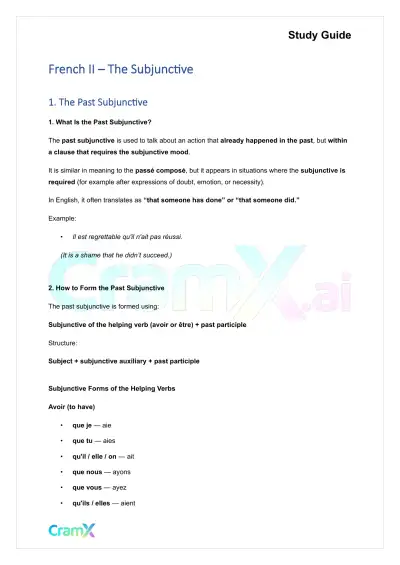 Quick Guides
French II – The Subjunctive
World Languages
26 pagesMar 2026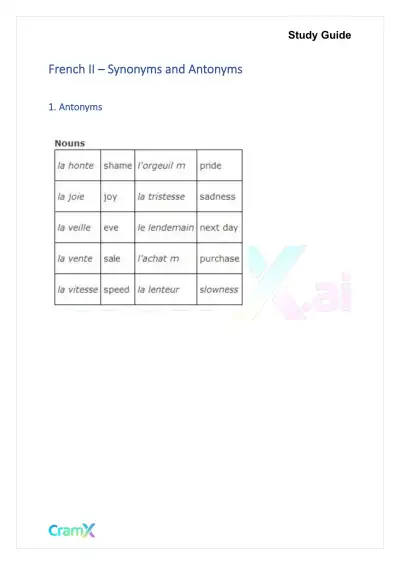 Quick Guides
French II – Synonyms and Antonyms
World Languages
9 pagesMar 2026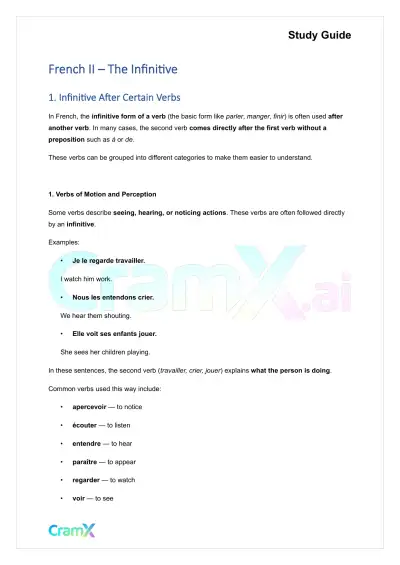 Quick Guides
French II – The Infinitive
World Languages
19 pagesMar 2026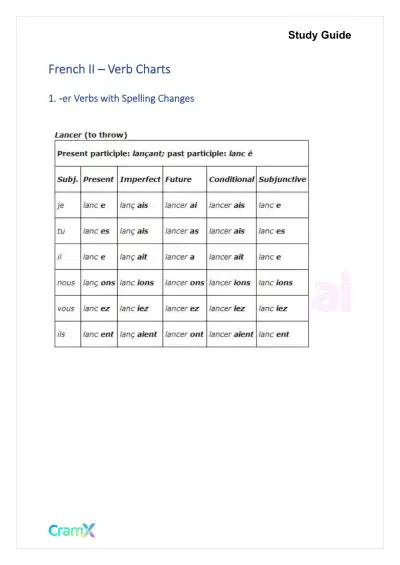 Quick Guides
French II – Verb Charts
World Languages
41 pagesMar 2026 Quick Guides
French II – Adjectives Adverbs Prepositions
World Languages
28 pagesMar 2026 Quick Guides
French II – Past Tenses
World Languages
30 pagesMar 2026 Quick Guides
French II – Articles Nouns Pronouns
World Languages
22 pagesMar 2026 Quick Guides
French II – Conditional Mood and Conditions
World Languages
19 pagesMar 2026
Study this document with CramX
Once it is in your library, every tool can work from it.