

French II – Past Tenses
- World Languages
- Texas A&M University
- 30 pages
- Shared March 2026
Preview 9 of 30 pages
See the first 9 pages exactly as they appear in the document.
Page 1 Read page 1 as text
Study Guide French II – Past Tenses 1. The Passé Antérieur The passé antérieur is a French verb tense used mainly in formal or literary writing . It describes an action that was completed before another past action . This tense usually appears after time expressions such as: • aussitôt que — as soon as • dès que — as soon as • quand / lorsque — when • après que — after The action in the passé antérieur happens first , and the second action is usually expressed with the passé simple . How the Passé Antérieur Is Formed The passé antérieur is a compound tense , meaning it uses a helping verb . Structure: passé simple of the auxiliary (avoir or être) + past participle Just like in other compound tenses, the auxiliary depends on the verb: • avoir for most verbs • être for movement and reflexive verbs In English, the passé antérieur is often translated as: “had + past participle.” Examples • Aussitôt que le président eut signé le document, sa secrétaire l'emporta. As soon as the president had signed the document, his secretary took it away.
Page 2 Read page 2 as text
Study Guide Here, the signing happened before the secretary took the document. • Dès que ses ennemis eurent envahi la France, Napoléon se retira à Elbe. As soon as his enemies had invaded France, Napoleon withdrew to Elba. In this example, the invasion happened before Napoleon’s withdrawal. When It Is Used The passé antérieur is mainly used in: • literary texts • historical writing • formal narration In everyday French conversation, speakers usually replace it with the plus - que - parfait . Key Takeaway • The passé antérieur describes an action that happened before another past action . • It is commonly used after time conjunctions like aussitôt que , dès que , quand , and après que . • It is formed with the passé simple of avoir or être + the past participle . • In English, it often translates as “had + past participle.” • This tense is mostly found in formal and literary French , not everyday speech. 2. The Imparfait (Imperfect Tense) The imparfait is a French past tense used to describe ongoing, repeated, or habitual actions in the past . It often explains what was happening , what used to happen , or the background of a past situation . In English, it is often translated as: • was / were + - ing • used to + verb • would + verb (when it means “used to”)
Page 3 Read page 3 as text
Study Guide The imparfait is a simple tense , which means it does not use a helping verb . When the Imparfait Is Used The imparfait describes: • habitual or repeated actions in the past • ongoing actions in the past • background descriptions or situations • actions that were not completed Examples: • Pendant mon enfance, je lisais beaucoup. During my childhood, I used to read a lot. • Je regardais la télé quand le téléphone a sonné. I was watching TV when the phone rang. In the second example, je regardais describes an action already in progress when another action happened. How to Form the Imparfait To form the imparfait , follow these steps: 1. Take the nous form of the present tense . 2. Remove the - ons ending. 3. Add the imparfait endings . Imparfait Endings
Page 4 Read page 4 as text
Study Guide Examples with Regular Verbs Verbs Already Ending in – ions Some verbs already end in – ions in the present tense, such as:
Page 5 Read page 5 as text
Study Guide • étudier (to study) • rire (to laugh) • sourire (to smile) • vérifier (to check) In the imparfait , these verbs keep the extra i in the nous and vous forms. Examples: • Nous étudiions pendant des heures. We were studying for hours. • Vous riiez trop. You were laughing too much. Spelling Changes in the Imparfait Verbs Ending in – cer The c changes to ç before a to keep the soft c sound. Example: • La voiture avançait lentement. The car was moving forward slowly. • Commenciez - vous à vous inquiéter ? Were you beginning to worry? Verbs Ending in – ger These verbs add a silent e before a to keep the soft g sound. Example: • Il mangeait si vite. He was eating so quickly. • Nous mangions toujours dans ce restaurant. We always ate in that restaurant.
Page 6 Read page 6 as text
Study Guide Irregular Verbs in the Imparfait Most irregular verbs still follow the same rule : use the nous form and drop – ons , then add the imparfait endings. Examples of common nous forms : • aller → nous allons • avoir → nous avons • boire → nous buvons • conduire → nous conduisons • connaître → nous connaissons • courir → nous courons • devoir → nous devons • dire → nous disons • dormir → nous dormons • écrire → nous écrivons • faire → nous faisons • lire → nous lisons • mettre → nous mettons • ouvrir → nous ouvrons • pouvoir → nous pouvons • prendre → nous prenons • recevoir → nous recevons • savoir → nous savons • venir → nous venons • voir → nous voyons • vouloir → nous voulons
Page 7 Read page 7 as text
Study Guide Special Verbs Used Only in the Il Form Some verbs are used only in the third - person singular . Examples: • falloir → il fallait (it was necessary) • pleuvoir → il pleuvait (it was raining) The Only True Irregular Verb The only verb that does not follow the usual imparfait formation rule is être (to be) . Its stem is ét - . • j’ – étais • tu – étais • il – était • nous – étions • vous – étiez • ils – étaient Example: • Quand j'étais enfant, je jouais souvent dehors. When I was a child, I often played outside. Key Takeaway • The imparfait describes ongoing, repeated, or habitual actions in the past . • It often translates as was/were + - ing , used to , or would (in the sense of “used to”). • To form it, use the nous present form minus – ons + imparfait endings . • Most verbs follow this rule, including irregular verbs. • The only verb with a different stem is être (ét - ) . • The imparfait is commonly used for background descriptions and past habits .
Page 8 Read page 8 as text
Study Guide 3. The Plus - Que - Parfait (Pluperfect) The plus - que - parfait is a French past tense used to describe an action that had already happened before another action in the past . In other words, it shows that one past event happened earlier than another past event . In English, this tense is usually translated as: “had + past participle.” How the Plus - Que - Parfait Is Formed The plus - que - parfait is a compound tense , which means it uses a helping verb. Structure: imperfect of the auxiliary (avoir or être) + past participle Just like in other compound tenses: • Most verbs use avoir • Some verbs (movement and reflexive verbs) use être Examples • J'avais mal à l'estomac parce que j'avais trop mangé. I had a stomachache because I had eaten too much. Here, having eaten too much happened before the stomachache. • Il marchait avec peine parce qu'il était tombé. He walked with difficulty because he had fallen. The fall happened before he was walking with difficulty. • Elle s'était préparée avant de donner sa présentation. She had prepared herself before giving her presentation. In this sentence, the preparation happened before the presentation.
Page 9 Read page 9 as text
Study Guide Agreement of the Past Participle Just like in other compound tenses, the past participle may need to agree with the object. When the auxiliary avoir is used, the past participle agrees only if the direct object appears before the verb . Examples: • Voici les livres que j'avais écrits il y a longtemps. Here are the books I had written a long time ago. • Cette robe ? Elle l'avait achetée quand elle était à Paris. That dress? She had bought it when she was in Paris. In these sentences, the participle agrees with livres and robe because they appear before the verb . Key Takeaway • The plus - que - parfait describes an action that happened before another past action . • It is formed with the imperfect of avoir or être + past participle . • In English, it usually translates as “had + past participle.” • With avoir , the past participle agrees with a preceding direct object . • This tense is commonly used to explain the cause or background of a past event . 4. Using the Correct Form of the Past Tense in French French has several past tenses, and each one is used in a different situation . Choosing the correct tense depends on what kind of action happened in the past and how it relates to other events . The main past tenses you will encounter are: • Passé composé • Imparfait • Passé simple
21 more pages in the full document
Unlock it once and it stays in your library, ready to chat with or turn into flashcards.
Unlock the full documentMore World Languages study materials
See all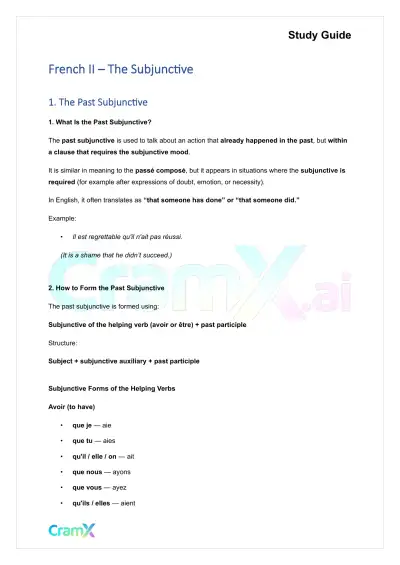 Quick Guides
French II – The Subjunctive
World Languages
26 pagesMar 2026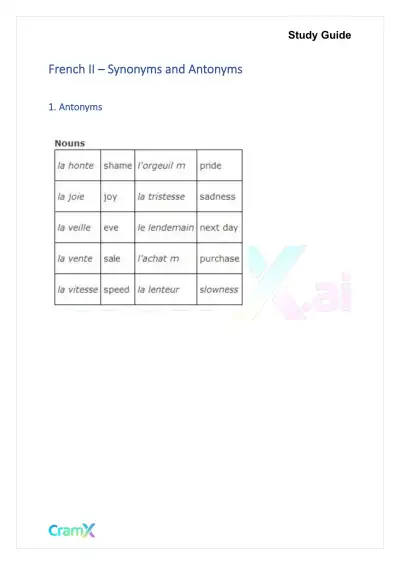 Quick Guides
French II – Synonyms and Antonyms
World Languages
9 pagesMar 2026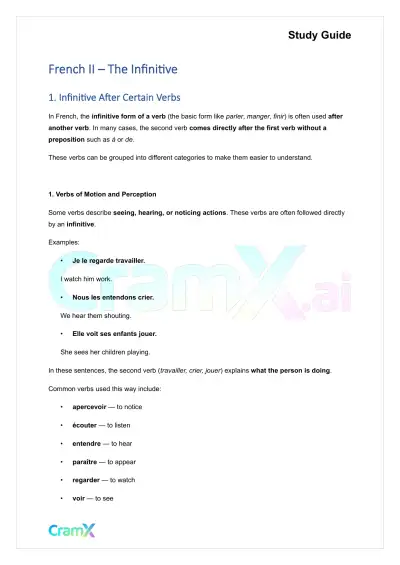 Quick Guides
French II – The Infinitive
World Languages
19 pagesMar 2026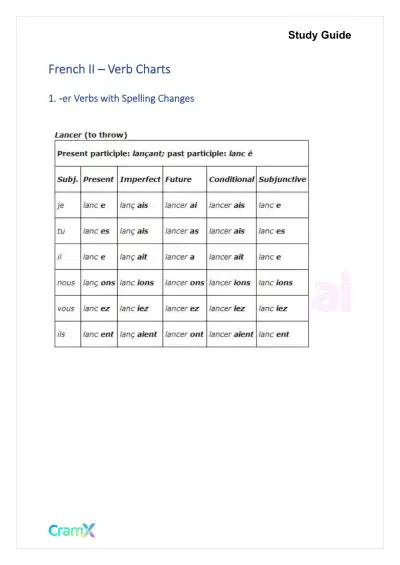 Quick Guides
French II – Verb Charts
World Languages
41 pagesMar 2026 Quick Guides
French II – Adjectives Adverbs Prepositions
World Languages
28 pagesMar 2026 Quick Guides
French II – Articles Nouns Pronouns
World Languages
22 pagesMar 2026 Quick Guides
French II – Conditional Mood and Conditions
World Languages
19 pagesMar 2026 Quick Guides
French II – Future Tenses
World Languages
18 pagesMar 2026
Study this document with CramX
Once it is in your library, every tool can work from it.