

French II – The Subjunctive
- World Languages
- Texas A&M University
- 26 pages
- Shared March 2026
Preview 8 of 26 pages
See the first 8 pages exactly as they appear in the document.
Page 1 Read page 1 as text
Study Guide French II – The Subjunctive 1. The Past Subjunctive 1. What Is the Past Subjunctive? The past subjunctive is used to talk about an action that already happened in the past , but within a clause that requires the subjunctive mood . It is similar in meaning to the passé composé , but it appears in situations where the subjunctive is required (for example after expressions of doubt, emotion, or necessity). In English, it often translates as “that someone has done” or “that someone did.” Example: • Il est regrettable qu'il n'ait pas réussi. (It is a shame that he didn’t succeed.) 2. How to Form the Past Subjunctive The past subjunctive is formed using: Subjunctive of the helping verb (avoir or être) + past participle Structure: Subject + subjunctive auxiliary + past participle Subjunctive Forms of the Helping Verbs Avoir (to have) • que je — aie • que tu — aies • qu'il / elle / on — ait • que nous — ayons • que vous — ayez • qu'ils / elles — aient
Page 2 Read page 2 as text
Study Guide This is the subjunctive present of the verb avoir . Être (to be) • que je — sois • que tu — sois • qu'il / elle / on — soit • que nous — soyons • que vous — soyez • qu'ils / elles — soient This is the present subjunctive of the verb être . Examples • Il est douteux qu'ils soient partis. (It is doubtful that they left.) • Il est important qu'elles se soient bien amusées. (It is important that they had a very good time.) These sentences show completed actions , but they appear in subjunctive clauses . 3. Agreement Rules The past subjunctive follows the same agreement rules as the passé composé . This means: • When être is the auxiliary, the past participle agrees with the subject . Example: • Elles se soient amusées. (They had a good time.)
Page 3 Read page 3 as text
Study Guide 4. When Is the Past Subjunctive Used? The past subjunctive is used when: 1. The subjunctive mood is required 2. The action already happened before the main verb It often appears after expressions showing: Emotion • Il est regrettable que… (It is regrettable that…) Example: • Il est regrettable qu'il n'ait pas réussi. (It is a shame that he didn't succeed.) Doubt or Uncertainty • Il est douteux que… (It is doubtful that…) Example: • Il est douteux qu'ils soient partis. (It is doubtful that they left.) Importance or Necessity • Il est important que… (It is important that…) Example: • Il est important qu'elles se soient bien amusées. (It is important that they had a very good time.) Key Takeaway ✔ The past subjunctive describes an action that already happened .
Page 4 Read page 4 as text
Study Guide ✔ Structure: Subjunctive of avoir/être + past participle ✔ Agreement rules follow the passé composé . ✔ Used when: • the subjunctive mood is required • the action happened before the main clause 2. Imperfect and Pluperfect Subjunctive 1. When Are These Tenses Used? The imperfect subjunctive and pluperfect subjunctive are rare in modern spoken French . Today, they are mainly found in formal writing and literature . In everyday conversation, French speakers usually replace them with the present subjunctive or past subjunctive . Even though they are uncommon, it is helpful to recognize them when reading literature or formal texts . 2. The Imperfect Subjunctive (Imparfait du Subjonctif) What It Is The imperfect subjunctive is a literary tense used to express a subjunctive action in the past , especially when the main verb is in the past. How It Is Formed The imperfect subjunctive is formed by:
Page 5 Read page 5 as text
Study Guide 1. Taking the je form of the passé simple 2. Dropping the final letter 3. Adding the following endings: Example sentence (literary style): • Je voulais qu'il parlât. (I wanted him to speak.) 3. The Pluperfect Subjunctive (Plus - que - parfait du Subjonctif) What It Is The pluperfect subjunctive is the compound form of the imperfect subjunctive. It describes an action that had already happened before another past action , within a clause that requires the subjunctive mood .
Page 6 Read page 6 as text
Study Guide This tense is almost exclusively used in literature . How It Is Formed The pluperfect subjunctive uses: Imperfect subjunctive of the auxiliary (avoir or être) + past participle Auxiliary forms: Avoir • je — eusse • tu — eusses • il — eût • nous — eussions • vous — eussiez • ils — eussent These are the imperfect subjunctive forms of the verb avoir (used mainly in literature). Être • je — fusse • tu — fusses • il — fût • nous — fussions • vous — fussiez • ils — fussent These are the imperfect subjunctive forms of the verb être (mostly used in formal writing or literature). Example • Je ne croyais pas qu'il fût revenu. (I didn’t think that he had come back.)
Page 7 Read page 7 as text
Study Guide Here: • fût revenu is the pluperfect subjunctive . 4. Important Usage Note These tenses appear mainly when the main clause is in a past tense . They are used only in formal or literary language . In modern spoken French, the sentence would usually be: • Je ne croyais pas qu'il soit revenu. Key Takeaway Imperfect Subjunctive • Rare in modern French • Used mainly in literature • Formed from the passé simple stem + special endings Pluperfect Subjunctive • Compound literary tense • Formed with imperfect subjunctive of avoir/être + past participle Modern Usage Most speakers replace these with: • Present subjunctive • Past subjunctive
Page 8 Read page 8 as text
Study Guide 3. Avoiding the Subjunctive Sometimes in French, it is possible to avoid using the subjunctive by changing the structure of the sentence. This usually happens when the same subject appears in both clauses or when the sentence can be simplified. Below are the main ways French speakers avoid the subjunctive. 1. Use an Infinitive When the Subject Is the Same If both parts of the sentence have the same subject , the word que is removed and the subjunctive is replaced with the infinitive . Structure Main verb + infinitive Example: • J'aimerais faire du shopping. (I would like to go shopping.) Here, the same person (I) is doing both actions. When the Subjects Are Different If the subjects are different , the subjunctive must be used . Example: • J'aimerais que nous fassions du shopping. (I would like for us to go shopping.) Here: • I would like • we go shopping Since the subjects are different, que + subjunctive is required .
18 more pages in the full document
Unlock it once and it stays in your library, ready to chat with or turn into flashcards.
Unlock the full documentMore World Languages study materials
See all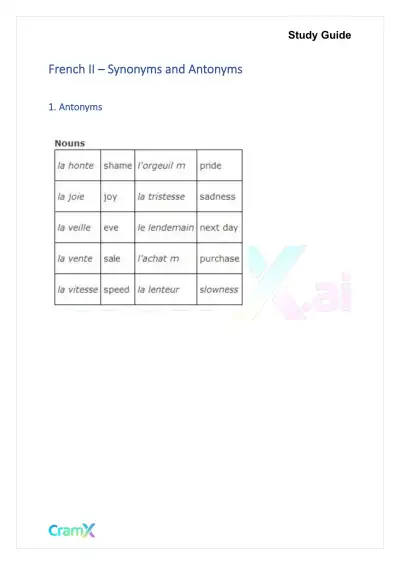 Quick Guides
French II – Synonyms and Antonyms
World Languages
9 pagesMar 2026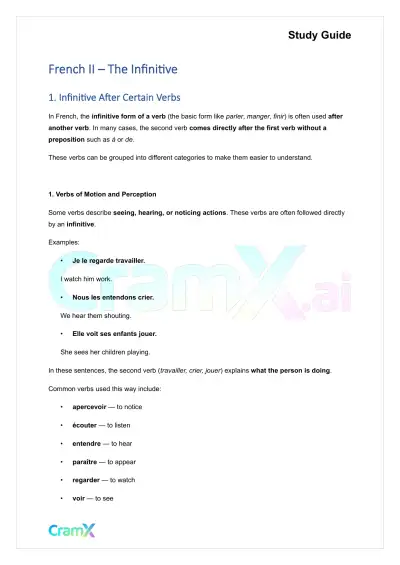 Quick Guides
French II – The Infinitive
World Languages
19 pagesMar 2026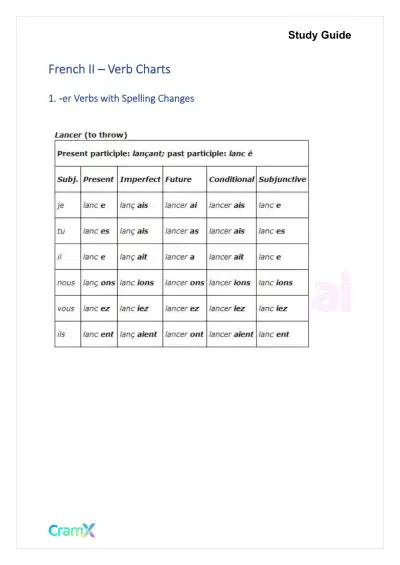 Quick Guides
French II – Verb Charts
World Languages
41 pagesMar 2026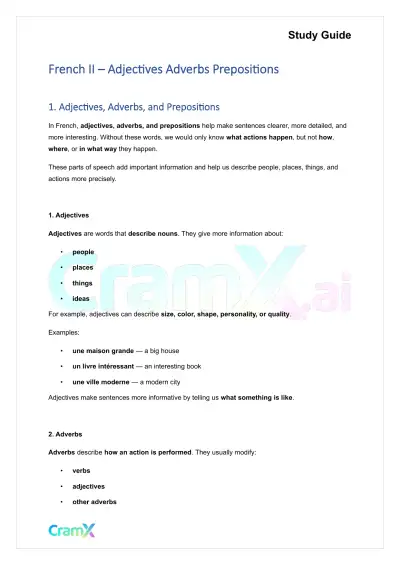 Quick Guides
French II – Adjectives Adverbs Prepositions
World Languages
28 pagesMar 2026 Quick Guides
French II – Past Tenses
World Languages
30 pagesMar 2026 Quick Guides
French II – Articles Nouns Pronouns
World Languages
22 pagesMar 2026 Quick Guides
French II – Conditional Mood and Conditions
World Languages
19 pagesMar 2026 Quick Guides
French II – Future Tenses
World Languages
18 pagesMar 2026
Study this document with CramX
Once it is in your library, every tool can work from it.