

French II – Special Uses of Certain Verbs
- World Languages
- Texas A&M University
- 22 pages
- Shared March 2026
Preview 7 of 22 pages
See the first 7 pages exactly as they appear in the document.
Page 1 Read page 1 as text
Study Guide French II – Special Uses of Certain Verbs 1. Other Important Irregularities in French Some French verbs have special meanings depending on how they are used or which preposition follows them . Understanding these differences helps you use the verbs more accurately in conversation. 1. Verbs Meaning “To Live” French has several verbs that translate as “to live,” but they are used in different situations. Habiter and Demeurer Both habiter and demeurer mean “to live” or “to dwell” in a particular place. • habiter may or may not use the preposition à . • demeurer usually uses à . Examples: • J'habite (à) Nice. I live in Nice. • Je demeure à Nice. I live in Nice. Vivre Vivre means “to live” or “to be alive.” It usually refers to a way of living or lifestyle , not simply a location. Example: • Je vis à cent à l'heure. I live in the fast lane.
Page 2 Read page 2 as text
Study Guide 2. Jouer (To Play) The verb jouer changes meaning depending on the preposition used. Jouer + à Used for sports or games . Example: • Nous jouons aux cartes. We are playing cards. Jouer + de Used for musical instruments . Example: • Il joue du piano. He plays the piano. 3. Penser The verb penser can have two slightly different meanings. Penser à Means “to think about someone or something.” Examples: • À qui penses - tu ? Who are you thinking about? • Je pense à mon fils. I am thinking about my son. • Je pense à lui. I am thinking about him.
Page 3 Read page 3 as text
Study Guide Penser de Used only when asking for someone’s opinion . Example: • Que penses - tu de lui ? What do you think of him? 4. Passer Passer Means “to spend time.” Example: • Je vais passer un mois en France. I am going to spend a month in France. Se passer When used reflexively, se passer means “to happen” or “to take place.” Example: • Qu'est - ce qui s'est passé ? What happened? Se passer de The expression se passer de means “to do without.” Example: • On ne peut pas se passer d'eau. One cannot do without water.
Page 4 Read page 4 as text
Study Guide 5. Servir Servir Means “to serve.” Se servir de The reflexive form se servir de means “to use.” Example: • On se sert d'une louche pour servir de la soupe. One uses a ladle to serve soup. 6. Venir + de + Infinitive The structure venir + de + infinitive expresses an action that has just happened . In the Present Tense It means “to have just.” Example: • Elle vient d'arriver. She has just arrived. In the Imperfect Tense It means “had just.” Example: • Elle venait d'arriver. She had just arrived. 7. Different Ways to Say “To Leave” French has several verbs that mean “to leave,” but they are used in different contexts.
Page 5 Read page 5 as text
Study Guide Partir Means “to go away.” Example: • Je pars. I am leaving / I am going away. Sortir Has several meanings: • to go out • to leave a place • to go out with someone • to take something out Examples: • Il sort souvent. He goes out often. • Il sort de la pièce. He leaves the room. • Il sort avec moi. He is going out with me. • Il sort son argent. He takes out his money. S'en aller Means “to go away.” Example:
Page 6 Read page 6 as text
Study Guide • Je m'en vais. I am going away. Quitter Means “to leave a person or place.” The person or place must always be mentioned. Examples: • Je te quitte. I am leaving you. • Je quitte la maison. I am leaving the house. Laisser Means “to leave something or someone behind.” Example: • J'ai laissé mes clefs à la maison. I left my keys at home. Key Takeaway • Some French verbs change meaning depending on the preposition used . • Reflexive forms often create new meanings (e.g., se passer , se servir de ). • French has several verbs for “to leave,” each with a different usage. • Structures like venir de + infinitive help express recent actions .
Page 7 Read page 7 as text
Study Guide 2. The Verb Devoir The French verb devoir is an irregular verb that means “must,” “to have to,” or “to owe.” In the present tense, it is a “shoe verb,” meaning the stem changes in the je, tu, il/elle/on, and ils/elles forms but not in nous and vous . Present Tense Conjugation 1. Expressing Obligation The most common use of devoir is to express obligation . It shows that someone must , has to , or is supposed to do something. Example: • Il doit travailler. He must work / He has to work. • Il devait travailler mais il était malade. He had to work, but he was sick. 2. Using Devoir in the Conditional When devoir is used in the conditional tense , it expresses advice or expectation. It usually means “should” or “ought to.” Examples: • Je devrais le faire.
15 more pages in the full document
Unlock it once and it stays in your library, ready to chat with or turn into flashcards.
Unlock the full documentMore World Languages study materials
See all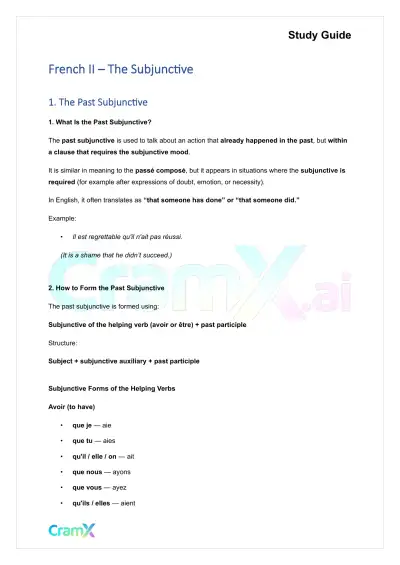 Quick Guides
French II – The Subjunctive
World Languages
26 pagesMar 2026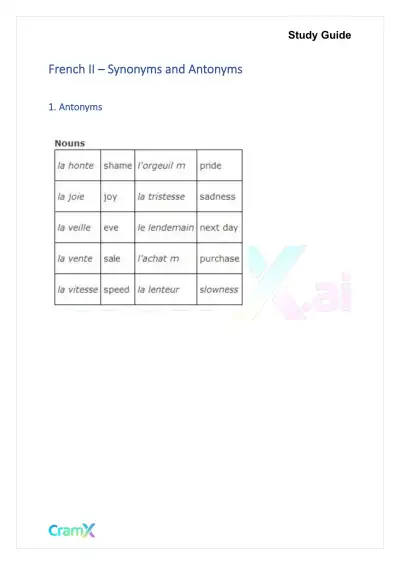 Quick Guides
French II – Synonyms and Antonyms
World Languages
9 pagesMar 2026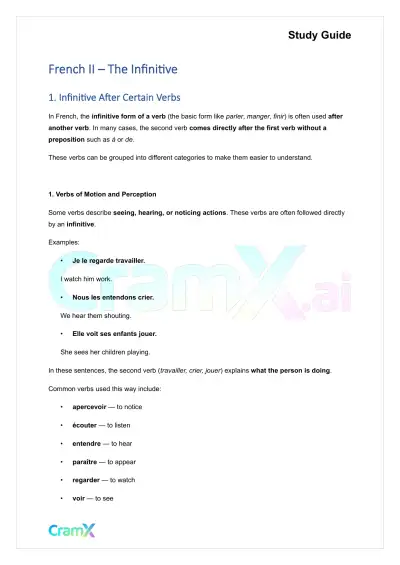 Quick Guides
French II – The Infinitive
World Languages
19 pagesMar 2026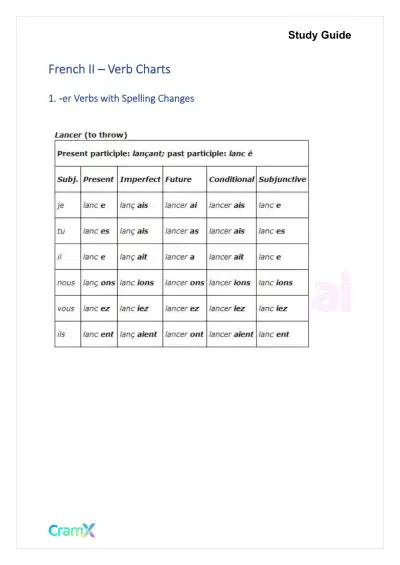 Quick Guides
French II – Verb Charts
World Languages
41 pagesMar 2026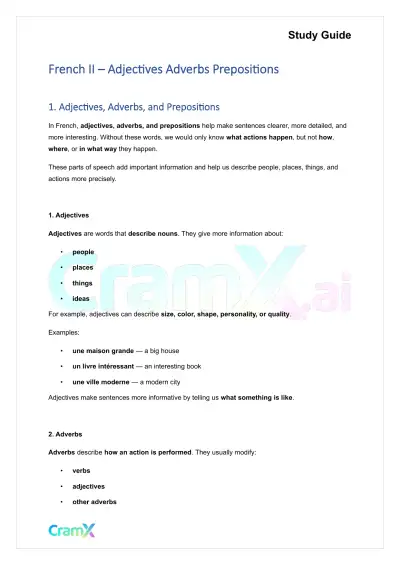 Quick Guides
French II – Adjectives Adverbs Prepositions
World Languages
28 pagesMar 2026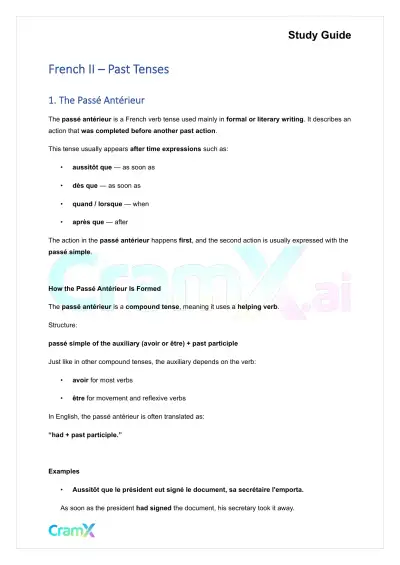 Quick Guides
French II – Past Tenses
World Languages
30 pagesMar 2026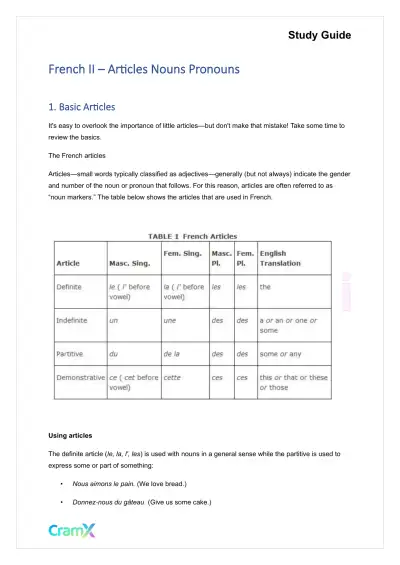 Quick Guides
French II – Articles Nouns Pronouns
World Languages
22 pagesMar 2026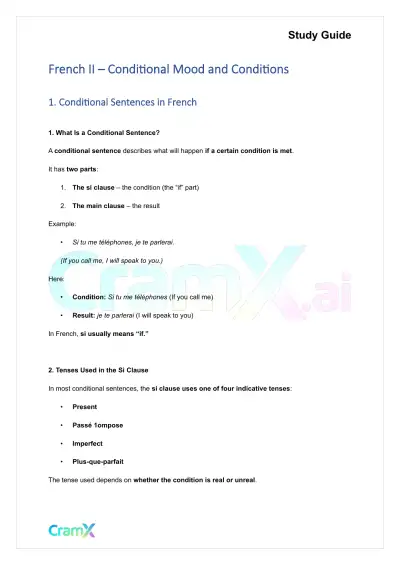 Quick Guides
French II – Conditional Mood and Conditions
World Languages
19 pagesMar 2026
Study this document with CramX
Once it is in your library, every tool can work from it.