

French II – The Infinitive
- World Languages
- Texas A&M University
- 19 pages
- Shared March 2026
Preview 6 of 19 pages
See the first 6 pages exactly as they appear in the document.
Page 1 Read page 1 as text
Study Guide French II – The Infinitive 1. Infinitive After Certain Verbs In French, the infinitive form of a verb (the basic form like parler , manger , finir ) is often used after another verb . In many cases, the second verb comes directly after the first verb without a preposition such as à or de . These verbs can be grouped into different categories to make them easier to understand. 1. Verbs of Motion and Perception Some verbs describe seeing, hearing, or noticing actions . These verbs are often followed directly by an infinitive . Examples: • Je le regarde travailler. I watch him work. • Nous les entendons crier. We hear them shouting. • Elle voit ses enfants jouer. She sees her children playing. In these sentences, the second verb ( travailler, crier, jouer ) explains what the person is doing . Common verbs used this way include: • apercevoir — to notice • écouter — to listen • entendre — to hear • paraître — to appear • regarder — to watch • voir — to see
Page 2 Read page 2 as text
Study Guide 2. Verbs of Thinking or Declaring Some verbs express thoughts, beliefs, or statements . These verbs are also followed directly by the infinitive . Examples: • Il espère pouvoir venir. He hopes to be able to come. • Elle nie connaître ce garçon. She denies knowing that boy. Common verbs used this way include: • affirmer — to affirm • croire — to believe • espérer — to hope • nier — to deny 3. Other Common Verbs Followed by the Infinitive Many everyday verbs are also followed directly by an infinitive . Examples: • Je préfère lire. I prefer reading. • Il faut écouter attentivement. It is necessary to listen carefully. Common verbs in this group include: • aimer mieux — to prefer • aller — to go • compter — to intend
Page 3 Read page 3 as text
Study Guide • désirer — to desire • devoir — to have to • envoyer — to send • faire — to make / to do • falloir — to be necessary • laisser — to allow / to let • oser — to dare • pouvoir — to be able to • préférer — to prefer • savoir — to know • sembler — to seem • souhaiter — to wish • valoir mieux — to be worth • vouloir — to want / to wish Key Takeaway • In French, an infinitive often follows another verb . • Many verbs do not require a preposition before the infinitive. • These verbs usually belong to three groups: o Verbs of perception (see, hear, watch) o Verbs of thinking or declaring (believe, hope, deny) o Common everyday verbs (want, prefer, be able to, have to) • Learning which verbs are followed directly by an infinitive will help you form more natural French sentences .
Page 4 Read page 4 as text
Study Guide 2. Infinitive After Certain Prepositions In French, the infinitive form of a verb (such as parler, finir, réussir ) is often used after prepositions . In most cases, the preposition is followed directly by the infinitive. However, there are a few important exceptions and patterns to remember. 1. Special Cases with Prepositions Most prepositions are followed by an infinitive , but two important exceptions exist: • en is followed by the present participle • après is followed by the past infinitive Two other common uses include: • par means “by” when used with verbs like commencer or finir • pour means “in order to” when followed by an infinitive Examples: • Il parle sans réfléchir. He speaks without thinking. • Elle commence par danser. She begins by dancing. • Ils finissent par rire. They end up laughing. • Il faut souffrir pour réussir. It is necessary to suffer to succeed. 2. Verbs Followed by à + Infinitive Some verbs require the preposition à before the infinitive. These verbs often express tendency, intention, effort, or purpose . Examples:
Page 5 Read page 5 as text
Study Guide • Je m'attends à gagner. I expect to win. • Elle tarde à arriver. She is late in arriving. Common verbs that take à + infinitive include: • s'accoutumer à — to become accustomed to • aider à — to help • s'amuser à — to have fun by • apprendre à — to teach • arriver à — to succeed in • s'attendre à — to expect • autoriser à — to authorize • avoir à — to have to • chercher à — to try or seek • commencer à — to begin • consentir à — to consent • continuer à — to continue • se décider à — to decide • se disposer à — to be disposed to • encourager à — to encourage • enseigner à — to teach • s'habituer à — to become accustomed to • hésiter à — to hesitate • inciter à — to encourage or incite • s'intéresser à — to be interested in • inviter à — to invite
Page 6 Read page 6 as text
Study Guide • se mettre à — to begin • persister à — to persist • renoncer à — to renounce • réussir à — to succeed in • songer à — to think about • tarder à — to delay / to be late in • tenir à — to be eager or anxious to 3. Verbs Followed by de + Infinitive Many verbs require the preposition de before the infinitive. These verbs often relate to asking, allowing, refusing, or completing an action . Examples: • Elle a oublié de me téléphoner. She forgot to call me. • Ils refusent de travailler. They refuse to work. Common verbs that take de + infinitive include: • accuser de — to accuse • s'agir de — to be a question of • s'arrêter de — to stop • blâmer de — to blame • cesser de — to stop • complimenter de — to compliment • convenir de — to agree • craindre de — to fear • décider de — to decide
13 more pages in the full document
Unlock it once and it stays in your library, ready to chat with or turn into flashcards.
Unlock the full documentMore World Languages study materials
See all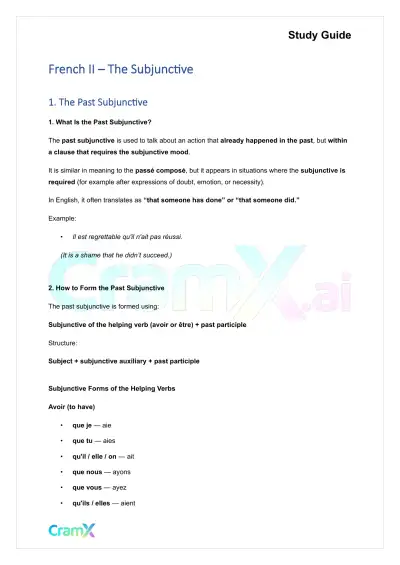 Quick Guides
French II – The Subjunctive
World Languages
26 pagesMar 2026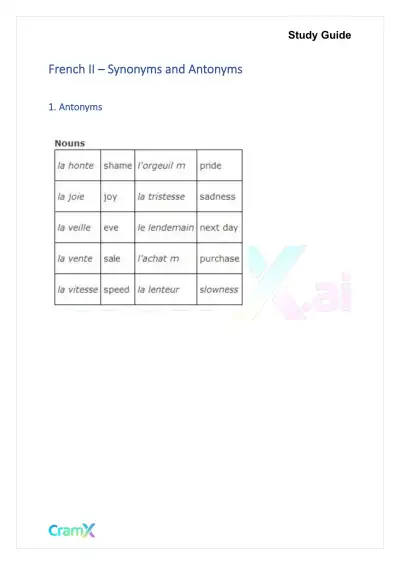 Quick Guides
French II – Synonyms and Antonyms
World Languages
9 pagesMar 2026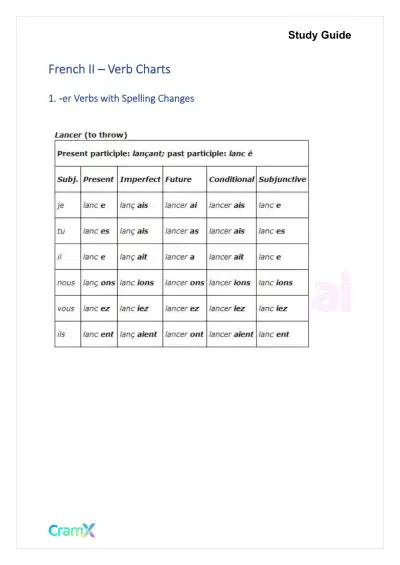 Quick Guides
French II – Verb Charts
World Languages
41 pagesMar 2026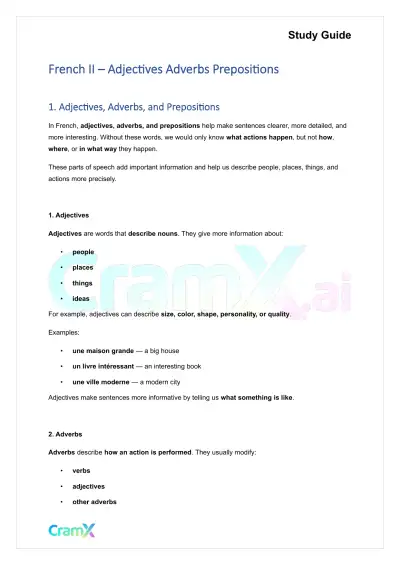 Quick Guides
French II – Adjectives Adverbs Prepositions
World Languages
28 pagesMar 2026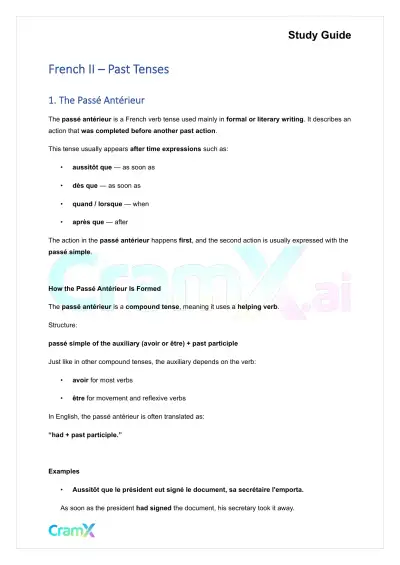 Quick Guides
French II – Past Tenses
World Languages
30 pagesMar 2026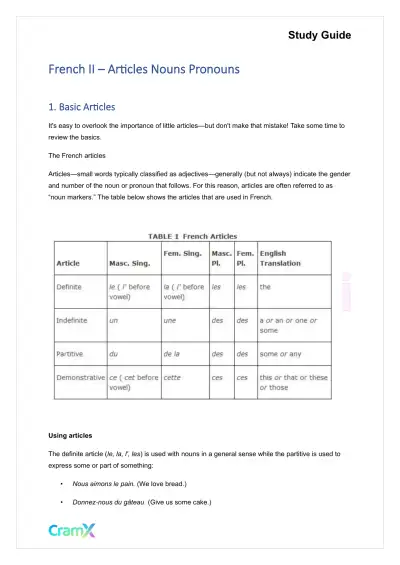 Quick Guides
French II – Articles Nouns Pronouns
World Languages
22 pagesMar 2026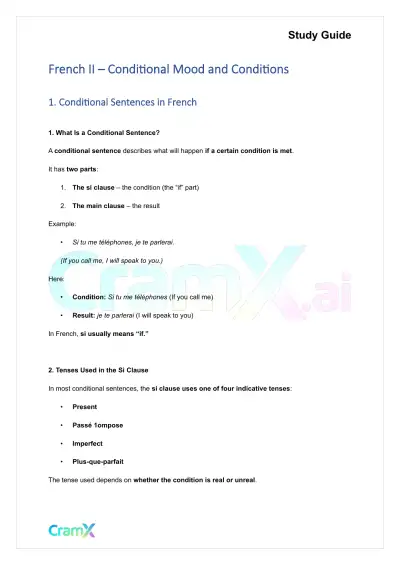 Quick Guides
French II – Conditional Mood and Conditions
World Languages
19 pagesMar 2026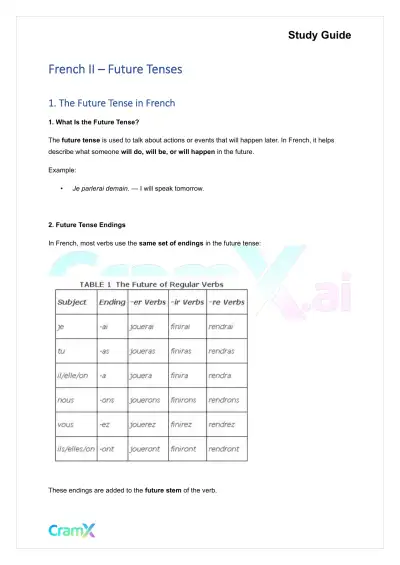 Quick Guides
French II – Future Tenses
World Languages
18 pagesMar 2026
Study this document with CramX
Once it is in your library, every tool can work from it.