

French II – Future Tenses
- World Languages
- Texas A&M University
- 18 pages
- Shared March 2026
Preview 6 of 18 pages
See the first 6 pages exactly as they appear in the document.
Page 1 Read page 1 as text
Study Guide French II – Future Tenses 1. The Future Tense in French 1. What Is the Future Tense? The future tense is used to talk about actions or events that will happen later. In French, it helps describe what someone will do, will be, or will happen in the future. Example: • Je parlerai demain. — I will speak tomorrow. 2. Future Tense Endings In French, most verbs use the same set of endings in the future tense: These endings are added to the future stem of the verb.
Page 2 Read page 2 as text
Study Guide 3. Regular Verbs in the Future - ER and - IR Verbs For - er and - ir verbs, simply add the future endings to the complete infinitive . Example: • jouer → je jouerai (I will play) • finir → tu finiras (you will finish) - RE Verbs For - re verbs , remove the final - e before adding the future endings. Example: • rendre → il rendra (he will return) 4. Pronunciation Note for - ER Verbs If there are two pronounced consonants before - er , the e is pronounced. Example: • parler → il parlera If there is one pronounced consonant , the e is silent . Example: • dîner → nous dînerons 5. Spelling Changes in Some Verbs Some verbs change spelling slightly in the future tense. Verbs Ending in - yer The y often changes to i . Examples: • nettoyer → je nettoierai • essayer → j’essaierai or j’essayerai
Page 3 Read page 3 as text
Study Guide Verbs with e + consonant + er The silent e becomes é . Example: • amener → tu amèneras Verbs like appeler and jeter These verbs double the consonant . Examples: • appeler → vous appellerez • jeter → vous jetterez 6. Irregular Future Stems Some common verbs have special future stems . You still add the same future endings.
Page 4 Read page 4 as text
Study Guide
Page 5 Read page 5 as text
Study Guide Example sentences: • J’irai en ville cet après - midi. — I will go downtown this afternoon. • Tu recevras une surprise. — You will receive a surprise. Irregular patterns also appear in related verbs . Example: • Je te reverrai demain. — I will see you again tomorrow. 7. Negatives in the Future Tense To make a sentence negative, place ne before the verb and the negative word after it. Examples: • Nous ne saurons pas tout de suite les résultats. (We will not know the results immediately.) • Il ne fera rien demain. (He will do nothing tomorrow.)
Page 6 Read page 6 as text
Study Guide Remember: pronouns stay before the verb . Example: • Elle ne t’enverra pas le paquet avant mercredi. (She will not send you the package before Wednesday.) 8. Asking Questions in the Future You can form questions by inverting the subject pronoun and verb and connecting them with a hyphen. Examples: • Fera - t - il une partie de tennis ce matin ? (Will he play tennis this morning?) • Travaillerez - vous pendant le week - end ? (Will you work during the weekend?) For negative questions , place ne and the negative expression around the verb. Examples: • Ne lui direz - vous pas la vérité ? (Won’t you tell him the truth?) • N’y iront - elles pas ? (Won’t they go there?) 9. Special Uses of the Future 1. Be Careful with “Will” The French future tense expresses future action , but vouloir is used when “will” means willingness or desire . Examples: • Je t’aiderai. — I will help you. • Veux - tu m’aider ? — Do you want to help me?
12 more pages in the full document
Unlock it once and it stays in your library, ready to chat with or turn into flashcards.
Unlock the full documentMore World Languages study materials
See all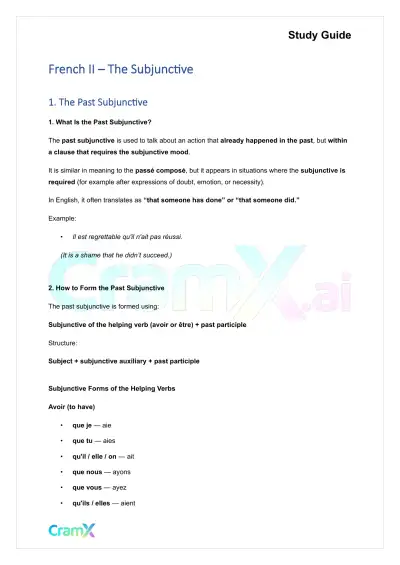 Quick Guides
French II – The Subjunctive
World Languages
26 pagesMar 2026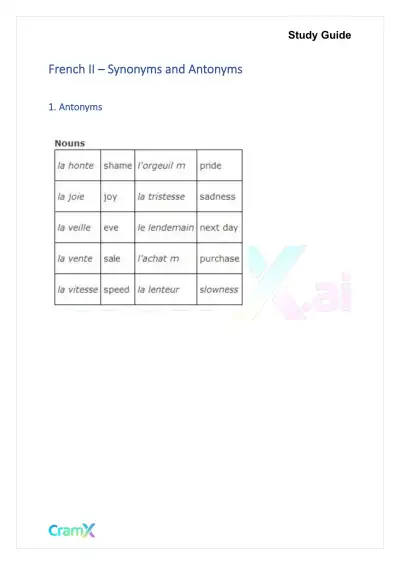 Quick Guides
French II – Synonyms and Antonyms
World Languages
9 pagesMar 2026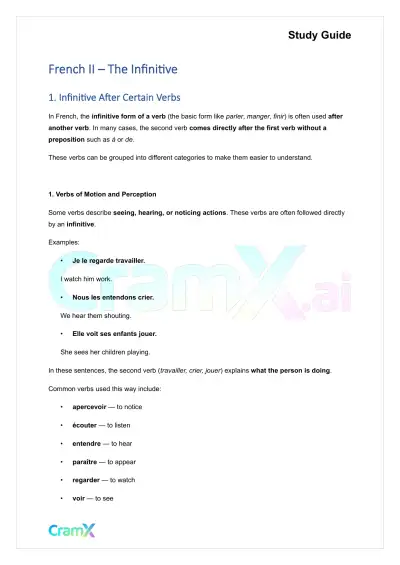 Quick Guides
French II – The Infinitive
World Languages
19 pagesMar 2026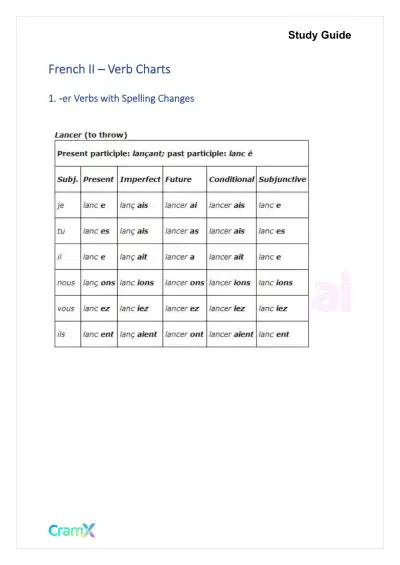 Quick Guides
French II – Verb Charts
World Languages
41 pagesMar 2026 Quick Guides
French II – Adjectives Adverbs Prepositions
World Languages
28 pagesMar 2026 Quick Guides
French II – Past Tenses
World Languages
30 pagesMar 2026 Quick Guides
French II – Articles Nouns Pronouns
World Languages
22 pagesMar 2026 Quick Guides
French II – Conditional Mood and Conditions
World Languages
19 pagesMar 2026
Study this document with CramX
Once it is in your library, every tool can work from it.