

French II – Articles Nouns Pronouns
- World Languages
- Texas A&M University
- 22 pages
- Shared March 2026
Preview 7 of 22 pages
See the first 7 pages exactly as they appear in the document.
Page 1 Read page 1 as text
Study Guide French II – Articles Nouns Pronouns 1. Basic Articles It's easy to overlook the importance of little articles — but don't make that mistake! Take some time to review the basics. The French articles Articles — small words typically classified as adjectives — generally (but not always) indicate the gender and number of the noun or pronoun that follows. For this reason, articles are often referred to as “noun markers.” The table below shows the articles tha t are used in French. Using articles The definite article ( le, la, l', les ) is used with nouns in a general sense while the partitive is used to express some or part of something: • Nous aimons le pain. (We love bread.) • Donnez ‐ nous du gâteau. (Give us some cake.)
Page 2 Read page 2 as text
Study Guide Use un or une when speaking about one portion or serving and use an adverb or noun of quantity or the partitive ( de, du, de la, de l', des ) to express amounts: • Un pain, s'il vous plaît. (A bread, please.) • Une tranche de pain, s'il vous plaît. (A slice of bread, please.) • Du pain, s'il vous plaît. (Some bread, please.) Use ce ( cet ) or cette to express “this” or “that” item and use ces to express “these” or “those.” Use the tags ‐ ci (here) or ‐ là (there) to be even more specific: • Je préfère ce pain ‐ ci. (I prefer this bread.) • Donnez ‐ moi ces pains ‐ là. (Give me those breads.) Contractions with articles The following prepositions contract with articles in French: Key Takeaway • Articles are small words used before nouns to indicate gender and number .
Page 3 Read page 3 as text
Study Guide • Definite articles (le, la, l’, les) mean “the.” • Indefinite articles (un, une, des) mean “a, an, or some.” • Partitive articles (du, de la, de l’, des) express “some” or an unspecified amount . • Demonstrative articles (ce, cet, cette, ces) mean “this, that, these, those.” • L’ is used instead of le or la before a vowel . • Ce becomes cet before a vowel sound. • Articles help indicate whether a noun is masculine, feminine, singular, or plural . • Some prepositions combine with articles to form contractions. • Common contractions include à + le = au , à + les = aux , de + le = du , de + les = des . 2. Basic Nouns and Nouns of Quantity All French nouns have a number (singular or plural) and a gender (masculine or feminine). Singular articles help you to identify the gender of nouns and should be learned with the nouns they modify. Although the gender of some nouns is quite obvious (those that refer to males are masculine, while those that refer to females are feminine), the gender of other nouns can be tricky and must be memorized. The following list goes into more detail about the number and gender of nouns: Some noun endings give you a hint as to gender: • Masculine endings include ‐ acle, ‐ age, ‐ al, ‐ eau, ‐ et, ‐ ier, ‐ isme, and ‐ ment. • Feminine endings include ‐ ade, ‐ ale, ‐ ance, ‐ ence, ‐ ette, ‐ ie, ‐ ique, ‐ oire, ‐ sion, and ‐ tion. Some nouns can be either masculine or feminine: • artiste • camarade • collègue • concierge
Page 4 Read page 4 as text
Study Guide • élève • enfant • malade • secrétaire • touriste Some nouns can be changed to the feminine by simply adding an ‐ e: • un cousin → une cousine • un ami → une amie Some masculine nouns (usually referring to professions) have a corresponding feminine ending:
Page 5 Read page 5 as text
Study Guide Some words are always masculine or feminine no matter to whom they are referring: Most French nouns are made plural by adding an unpronounced ‐ s to the singular form. The letters s, x, and z are all used to make plurals in French. If a singular noun ends in any of these letters, its plural form remains unchanged: • le fils → les fils • la voix → les voix • le nez → les nez Nouns ending in ‐ eau add ‐ x to form the plural: • le château → les châteaux Nouns ending in ‐ eu add ‐ x to form the plural, except that le pneu (tire) becomes les pneus (tires): • le cheveu → les cheveux Nouns ending in ‐ al change ‐ al to ‐ aux, except for le bal (which becomes les bals ), le festival (which becomes les festivals ), and le récital (which becomes les récitals):
Page 6 Read page 6 as text
Study Guide • l'animal → les animaux Some nouns ending in ‐ ou add ‐ x to form the plural: • le bijou → les bijoux Most compound nouns (nouns made up of two nouns that are usually joined by a hyphen) do not change in the plural. Remember, however, to change their respective articles: • les hors ‐ d'oeuvre Note the following irregularities: • les grands ‐ mères • les grands ‐ pères • les grands ‐ parents Some French words are always plural: • les ciseaux (scissors) • les gens (people) • les lunettes (glasses) • les vacances (vacation) • les mathématiques French last names do not add an ‐ s in the plural: • Les Dupont Nouns that express quantity are followed by the preposition de ( d' before a vowel) before the noun that follows. For example: • Je vais acheter une douzaine d' oeufs. (I'm going to buy a dozen eggs.) • Donnez ‐ moi un verre de lait. (Give me a glass of milk.) High ‐ frequency nouns of quantity include:
Page 7 Read page 7 as text
Study Guide • une boûte (a box, a can) • une bouteille (a bottle) • une douzaine • une livre (a pound) • un morceau (a piece) • une paire • un panier (a basket) • un paquet (a package) • un sac (a bag) • une tasse (a cup) • une tranche (a slice) • un verre (a glass) Key Takeaway • French nouns have gender (masculine or feminine) and number (singular or plural) . • The article before a noun helps identify its gender (un, une, le, la). • Some masculine nouns form feminine by adding – e (ex: ami → amie ). • Certain masculine endings change to feminine forms (ex: - teur → - trice , - eur → - euse ). • Some nouns are always masculine or always feminine regardless of the person (ex: un médecin , une victime ). • Certain nouns can be either masculine or feminine (ex: artiste, élève, secrétaire ). • Most French nouns form plurals by adding – s , which is usually not pronounced. • Nouns ending in - eau or - eu often add – x in the plural (ex: château → châteaux ). • Nouns expressing quantity are followed by de (or d’ before a vowel) . • Common quantity nouns include une bouteille (bottle), une douzaine (dozen), un verre (glass), une tranche (slice) .
15 more pages in the full document
Unlock it once and it stays in your library, ready to chat with or turn into flashcards.
Unlock the full documentMore World Languages study materials
See all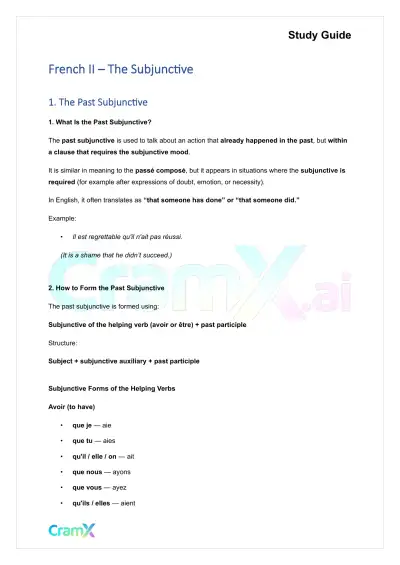 Quick Guides
French II – The Subjunctive
World Languages
26 pagesMar 2026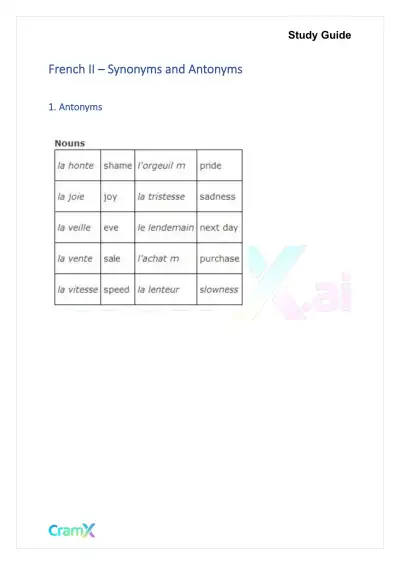 Quick Guides
French II – Synonyms and Antonyms
World Languages
9 pagesMar 2026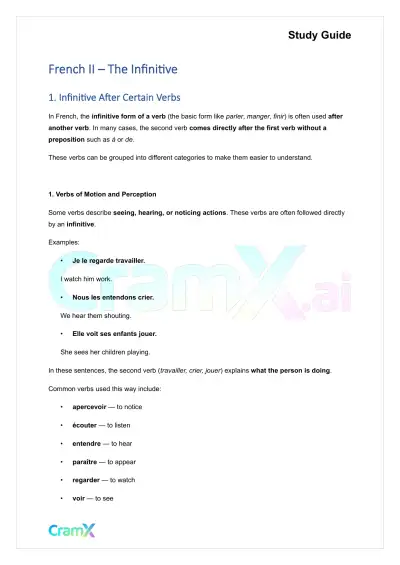 Quick Guides
French II – The Infinitive
World Languages
19 pagesMar 2026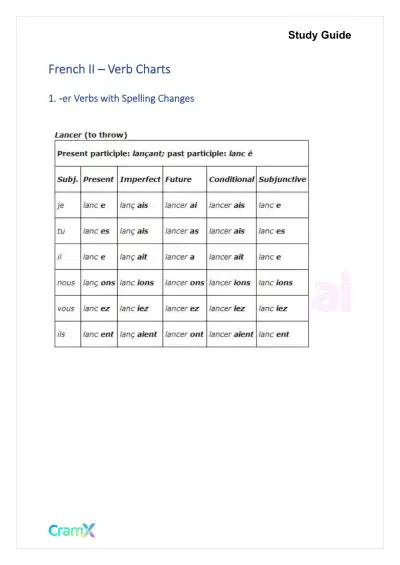 Quick Guides
French II – Verb Charts
World Languages
41 pagesMar 2026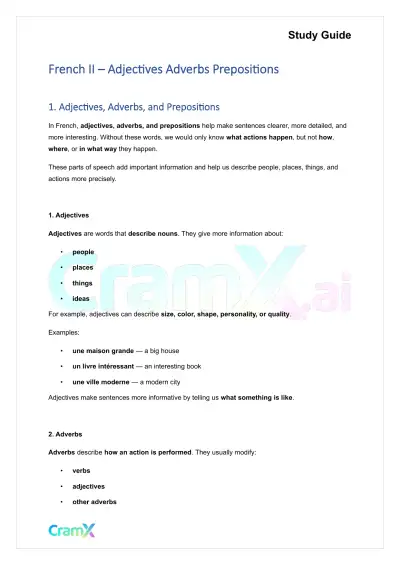 Quick Guides
French II – Adjectives Adverbs Prepositions
World Languages
28 pagesMar 2026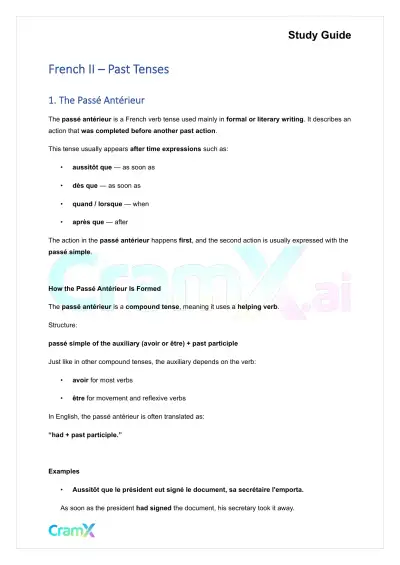 Quick Guides
French II – Past Tenses
World Languages
30 pagesMar 2026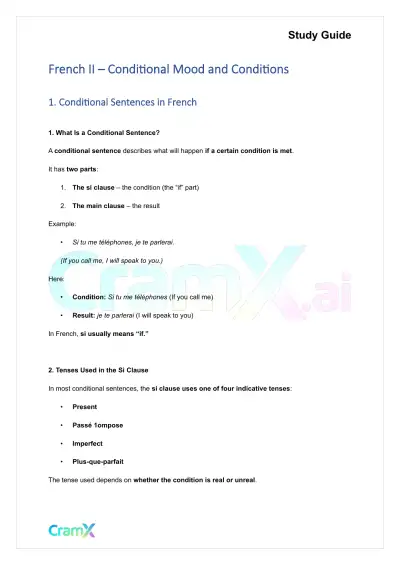 Quick Guides
French II – Conditional Mood and Conditions
World Languages
19 pagesMar 2026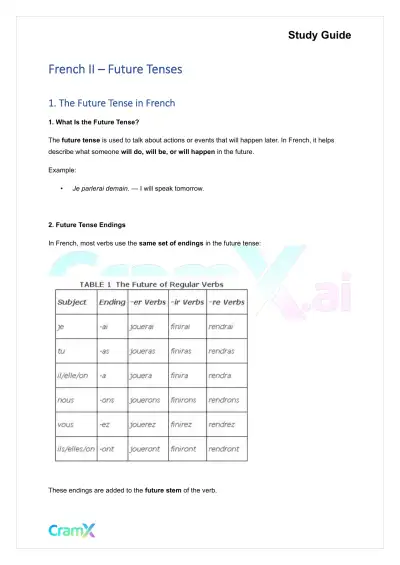 Quick Guides
French II – Future Tenses
World Languages
18 pagesMar 2026
Study this document with CramX
Once it is in your library, every tool can work from it.