

French II – Basic Verbs
- World Languages
- Texas A&M University
- 44 pages
- Shared March 2026
Preview 10 of 44 pages
See the first 10 pages exactly as they appear in the document.
Page 1 Read page 1 as text
Study Guide French II – Basic Verbs 1. Regular Verbs in French In French, most verbs follow predictable patterns when they are conjugated. These are called regular verbs . Learning these patterns makes conjugation much easier because once you know the rule, you can apply it to many verbs. French regular verbs belong to three main infinitive families : • - er verbs • - ir verbs • - re verbs The infinitive is the basic form of the verb (for example: danser , choisir , rendre ). To conjugate a regular verb in the present tense , follow these simple steps: 1. Remove the infinitive ending ( - er, - ir, or - re). 2. Add the correct ending for the subject pronoun. Once you memorize the endings for each family, you can conjugate most regular verbs easily. Present Tense Endings for Regular Verbs Here are examples of how verbs from each family are conjugated.
Page 2 Read page 2 as text
Study Guide - ER Verb Example: danser (to dance) Common - er endings: - e, - es, - e, - ons, - ez, - ent - IR Verb Example: choisir (to choose) Common - ir endings: - is, - is, - it, - issons, - issez, - issent - RE Verb Example: rendre (to return) Common - re endings: - s, - s, — , - ons, - ez, - ent Notice that in the third person singular (il/elle/on) form, - re verbs do not add an ending after removing - re .
Page 3 Read page 3 as text
Study Guide Special Note: Verbs Like rompre Some - re verbs have a small spelling change in one form. The verb rompre (to break) and related verbs add a “t” in the third person singular form. Examples: • il rompt (he breaks) • il corrompt (he corrupts) • il interrompt (he interrupts) This change helps maintain correct pronunciation. Key Takeaway • French regular verbs follow predictable patterns . • Identify the verb family ( - er, - ir, - re ). • Remove the infinitive ending and add the correct present - tense ending . 2. Verbs with Spelling Changes What Are “Shoe Verbs”? Some regular French verbs change their spelling when they are conjugated in the present tense . These are often called “shoe verbs.”
Page 4 Read page 4 as text
Study Guide Why the name? If you look at the verb chart, the forms that change ( je, tu, il/elle/on, and ils/elles ) form a shape that looks like a shoe or boot . The forms nous and vous are outside the “shoe,” so they usually do not change . This spelling change helps keep the correct pronunciation of the verb. Verbs Ending in - cer For verbs that end in - cer , the letter c changes to ç before a or o . This keeps the soft “s” sound of the letter c . In the present tense , this change happens only in the nous form . Example: placer (to place) • je place • tu places • il/elle/on place • nous plaçons • vous placez • ils/elles placent Other common - cer verbs include: • annoncer (to announce) • avancer (to move forward) • commencer (to begin) • effacer (to erase) • lancer (to throw) • menacer (to threaten) • prononcer (to pronounce) • remplacer (to replace) • renoncer à (to give up)
Page 5 Read page 5 as text
Study Guide Verbs Ending in - ger For verbs ending in - ger , an extra silent “e” is added between g and a/o . This keeps the soft “j” sound of the letter g . In the present tense , this also happens only in the nous form . Example: nager (to swim) • je nage • tu nages • il/elle/on nage • nous nageons • vous nagez • ils/elles nagent Other common - ger verbs include: • arranger (to arrange) • changer (to change) • corriger (to correct) • déménager (to move house) • déranger (to disturb) • diriger (to direct) • manger (to eat) • obliger (to force) • partager (to share) • plonger (to dive) • ranger (to tidy) • songer à (to think about) • voyager (to travel)
Page 6 Read page 6 as text
Study Guide Verbs Ending in - yer For verbs ending in - yer , the y changes to i before a silent e in the “shoe forms.” This means the change happens in: • je • tu • il/elle/on • ils/elles But nous and vous keep the original y . Example: envoyer (to send) • j’envoie • tu envoies • il/elle/on envoie • nous envoyons • vous envoyez • ils/elles envoient Other - yer verbs include: • employer (to employ) • ennuyer (to bother) • essuyer (to wipe) • nettoyer (to clean) • renvoyer (to fire/send back) Special Note About - ayer Verbs Some verbs that end in - ayer can either change y to i or keep the y before a silent e . Both forms are often acceptable.
Page 7 Read page 7 as text
Study Guide Examples: • essayer (to try) • payer (to pay) Key Takeaway • Spelling changes help maintain correct pronunciation . • Many changes happen only in the “shoe” forms (je, tu, il/elle / on, ils/elles). • - cer verbs: c → ç in nous form. • - ger verbs: add e in nous form. • - yer verbs: y → i in the shoe forms . • - ayer verbs: may change or stay the same . 3. Irregular Verbs in French Unlike regular verbs, irregular verbs do not follow a single pattern . Their conjugations change in different ways, so they usually need to be memorized individually . Even though they are irregular, many of these verbs are very common in everyday French , so learning them is important for speaking and understanding the language. Below are some of the most frequently used irregular verbs in the present tense. Very Common Irregular Verbs aller (to go) • je vais • tu vas • il/elle/on va • nous allons • vous allez • ils/elles vont
Page 8 Read page 8 as text
Study Guide avoir (to have) • j’ai • tu as • il/elle/on a • nous avons • vous avez • ils/elles ont être (to be) • je suis • tu es • il/elle/on est • nous sommes • vous êtes • ils/elles sont These three verbs ( aller, avoir, être ) are among the most important verbs in French and are used very frequently. Other Common Irregular Verbs boire (to drink) • je bois • tu bois • il/elle/on boit • nous buvons • vous buvez • ils/elles boivent
Page 9 Read page 9 as text
Study Guide courir (to run) • je cours • tu cours • il/elle/on court • nous courons • vous courez • ils/elles courent dire (to say / to tell) • je dis • tu dis • il/elle/on dit • nous disons • vous dites • ils/elles disent dormir (to sleep) • je dors • tu dors • il/elle/on dort • nous dormons • vous dormez • ils/elles dorment Verbs similar to dormir keep the consonant before - ir in plural forms. Examples include: • endormir (to put to sleep)
Page 10 Read page 10 as text
Study Guide • mentir (to lie) • partir (to leave) • sentir (to feel or smell) • servir (to serve) • sortir (to go out) écrire (to write) • j’écris • tu écris • il/elle/on écrit • nous écrivons • vous écrivez • ils/elles écrivent faire (to make / to do) • je fais • tu fais • il/elle/on fait • nous faisons • vous faites • ils/elles font lire (to read) • je lis • tu lis • il/elle/on lit
34 more pages in the full document
Unlock it once and it stays in your library, ready to chat with or turn into flashcards.
Unlock the full documentMore World Languages study materials
See all Quick Guides
French II – The Subjunctive
World Languages
26 pagesMar 2026 Quick Guides
French II – Synonyms and Antonyms
World Languages
9 pagesMar 2026 Quick Guides
French II – The Infinitive
World Languages
19 pagesMar 2026 Quick Guides
French II – Verb Charts
World Languages
41 pagesMar 2026 Quick Guides
French II – Adjectives Adverbs Prepositions
World Languages
28 pagesMar 2026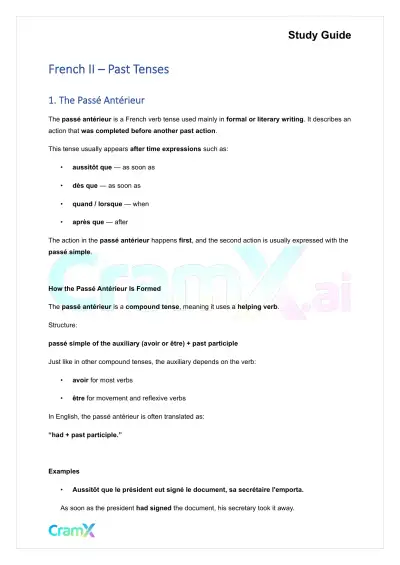 Quick Guides
French II – Past Tenses
World Languages
30 pagesMar 2026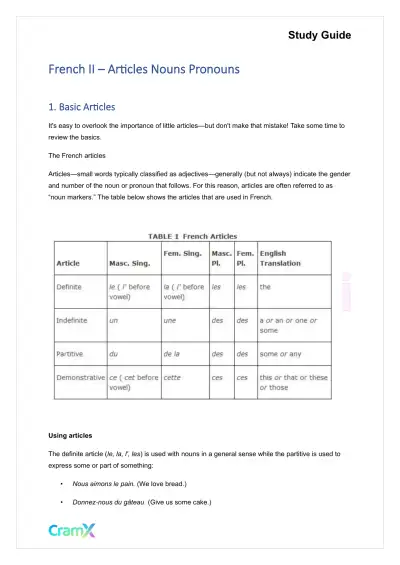 Quick Guides
French II – Articles Nouns Pronouns
World Languages
22 pagesMar 2026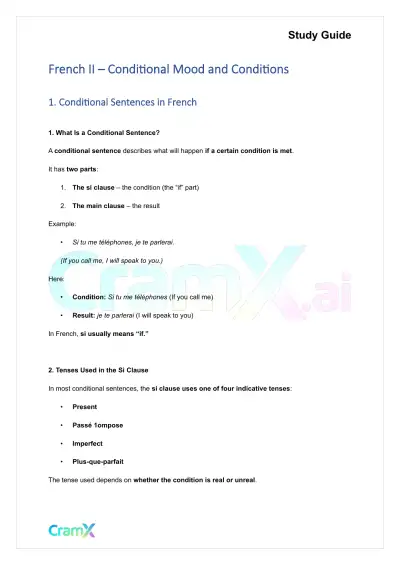 Quick Guides
French II – Conditional Mood and Conditions
World Languages
19 pagesMar 2026
Study this document with CramX
Once it is in your library, every tool can work from it.