

French II – Conditional Mood and Conditions
- World Languages
- Texas A&M University
- 19 pages
- Shared March 2026
Preview 6 of 19 pages
See the first 6 pages exactly as they appear in the document.
Page 1 Read page 1 as text
Study Guide French II – Conditional Mood and Conditions 1. Conditional Sentences in French 1. What Is a Conditional Sentence? A conditional sentence describes what will happen if a certain condition is met . It has two parts : 1. The si clause – the condition (the “if” part) 2. The main clause – the result Example: • Si tu me téléphones, je te parlerai. (If you call me, I will speak to you.) Here: • Condition: Si tu me téléphones (If you call me) • Result: je te parlerai (I will speak to you) In French, si usually means “if.” 2. Tenses Used in the Si Clause In most conditional sentences, the si clause uses one of four indicative tenses : • Present • Passé 1 ompose • Imperfect • Plus - que - parfait The tense used depends on whether the condition is real or unreal .
Page 2 Read page 2 as text
Study Guide 3. Real Conditions A real condition describes something possible or likely in the present or past. Example: • Si tu me téléphones, je te parlerai. (If you call me, I will speak to you.) Tense Pattern for Real Conditions Si clause: Present Main clause: Present / Future / Imperative Examples: • Si j ’ ai soif, je bois de l ’ eau. (If I am thirsty, I drink water.) • Tu réussiras 2 ompo étudies beaucoup. (You will succeed if you study a lot.) • Si je suis en retard, attends - moi. (If I am late, wait for me.) Here the condition is possible and realistic .
Page 3 Read page 3 as text
Study Guide Real Conditions About the Past Sometimes the si clause uses the passé 3 ompose to talk about a past condition. Example: • Si j ’ ai bien compris, elle a 3 ompos d ’ avis. (If I understood correctly, she changed her mind.) Other examples: • Le vol n ’ est pas encore 3 ompos , si j ’ ai bien entendu. (The flight hasn ’ t arrived yet, if I heard correctly.) • S ’ il s ’ est trompé, il perdra beaucoup d ’ argent. (If he made a mistake, he will lose a lot of money.) • Si tu l ’ as appris, n ’ en dis rien. (If you heard about it, don ’ t say anything.) 4. Word Order in Conditional Sentences Either clause can come first . Example: • Si tu étudies, tu réussiras. • Tu réussiras 3 ompo étudies. Both sentences mean the same thing. Special Rule with si When si is followed by il or ils , it becomes s ’ il or s ’ ils . Examples: • s ’ il commence • s ’ ils arrivent
Page 4 Read page 4 as text
Study Guide But it does not change with elle or elles : • si elle • si elles 5. Contrary - to - Fact (Unreal) Conditions A contrary - to - fact condition describes a situation that is unlikely, imaginary, or impossible . Example: • S ’ il neigeait, je ne sortirais pas. (If it snowed, I wouldn ’ t go out.) Here the speaker does not expect snow . Tense Pattern for Unreal Conditions (Present/Future) Si clause: Imperfect Main clause: Conditional Examples:
Page 5 Read page 5 as text
Study Guide • Si j ’ étais riche, je m ’ achèterais un château. (If I were rich, I would buy myself a castle.) • Je t ’ enverrais de l ’ argent, 5 ompo en avais besoin. (I would send you money if you needed some.) These describe imaginary or unlikely situations . Unreal Conditions About the Past For conditions that did not happen in the past , French uses: Si clause: Plus - que - parfait Main clause: Past conditional Examples: • S ’ il avait eu le temps, il t ’ aurait 5 omp . (If he had had the time, he would have helped you.) • J ’ aurais fait un gâteau, si j ’ avais su que tu venais. (I would have baked a cake if I had known you were coming.) These sentences describe something that did not happen . 6. When si Means “Whether” Sometimes si does not mean “if.” It can also mean “whether.” When this happens, any tense can follow si , just like in English. Examples: • Savez - vous si elle travaillera demain ? (Do you know if she will work tomorrow?) • Je ne savais pas s ’ il le ferait. (I didn’t know whether he would do it.)
Page 6 Read page 6 as text
Study Guide Key Takeaway Structure of Conditional Sentences A conditional sentence has: Si clause (condition) + main clause (result) Real Conditions • Present (Si clause): Present / Future / Imperative in the main clause. • Passé 6 ompose (Si clause): Same tense as in English in the main clause. Unreal Conditions • Imperfect (Si clause): Conditional in the main clause. • Plus - que - parfait (Si clause): Past conditional in the main clause. 2. The Conditional in French 1. What Is the Conditional? The conditional is used to describe what would happen if certain conditions were met . In English, it often corresponds to words like “would,” “could,” or “should.” Example: • J'irais à Paris. (I would go to Paris.) The conditional is commonly used when talking about: • hypothetical situations
13 more pages in the full document
Unlock it once and it stays in your library, ready to chat with or turn into flashcards.
Unlock the full documentMore World Languages study materials
See all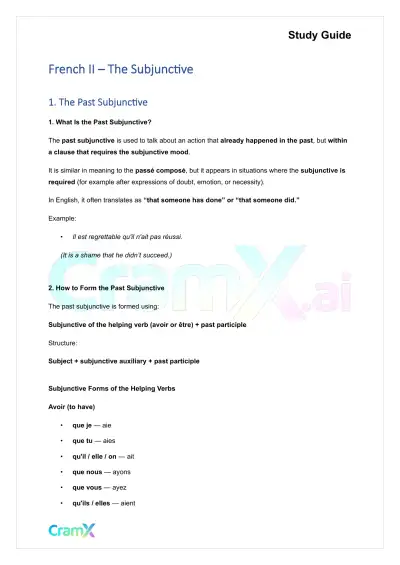 Quick Guides
French II – The Subjunctive
World Languages
26 pagesMar 2026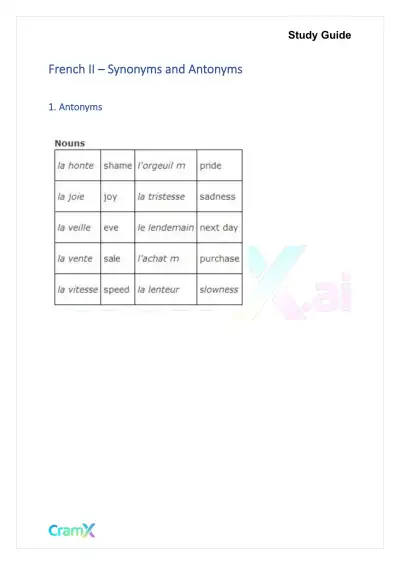 Quick Guides
French II – Synonyms and Antonyms
World Languages
9 pagesMar 2026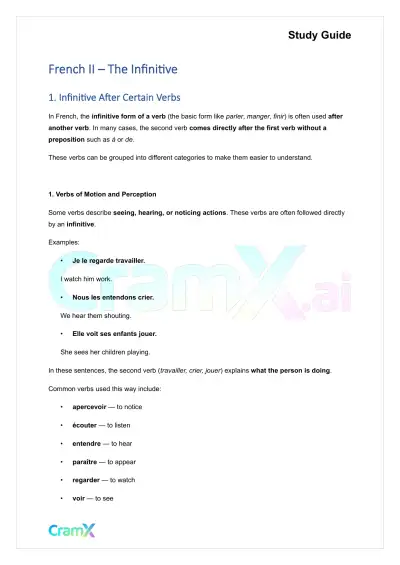 Quick Guides
French II – The Infinitive
World Languages
19 pagesMar 2026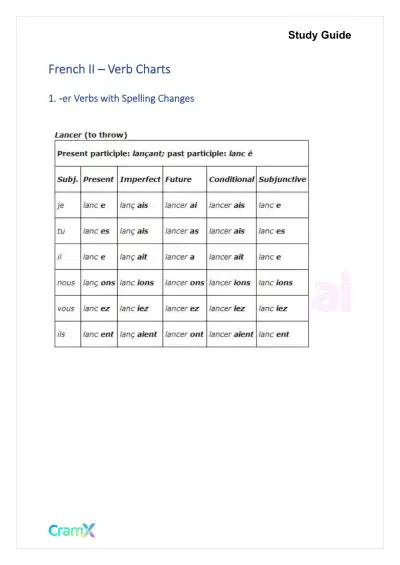 Quick Guides
French II – Verb Charts
World Languages
41 pagesMar 2026 Quick Guides
French II – Adjectives Adverbs Prepositions
World Languages
28 pagesMar 2026 Quick Guides
French II – Past Tenses
World Languages
30 pagesMar 2026 Quick Guides
French II – Articles Nouns Pronouns
World Languages
22 pagesMar 2026 Quick Guides
French II – Future Tenses
World Languages
18 pagesMar 2026
Study this document with CramX
Once it is in your library, every tool can work from it.