
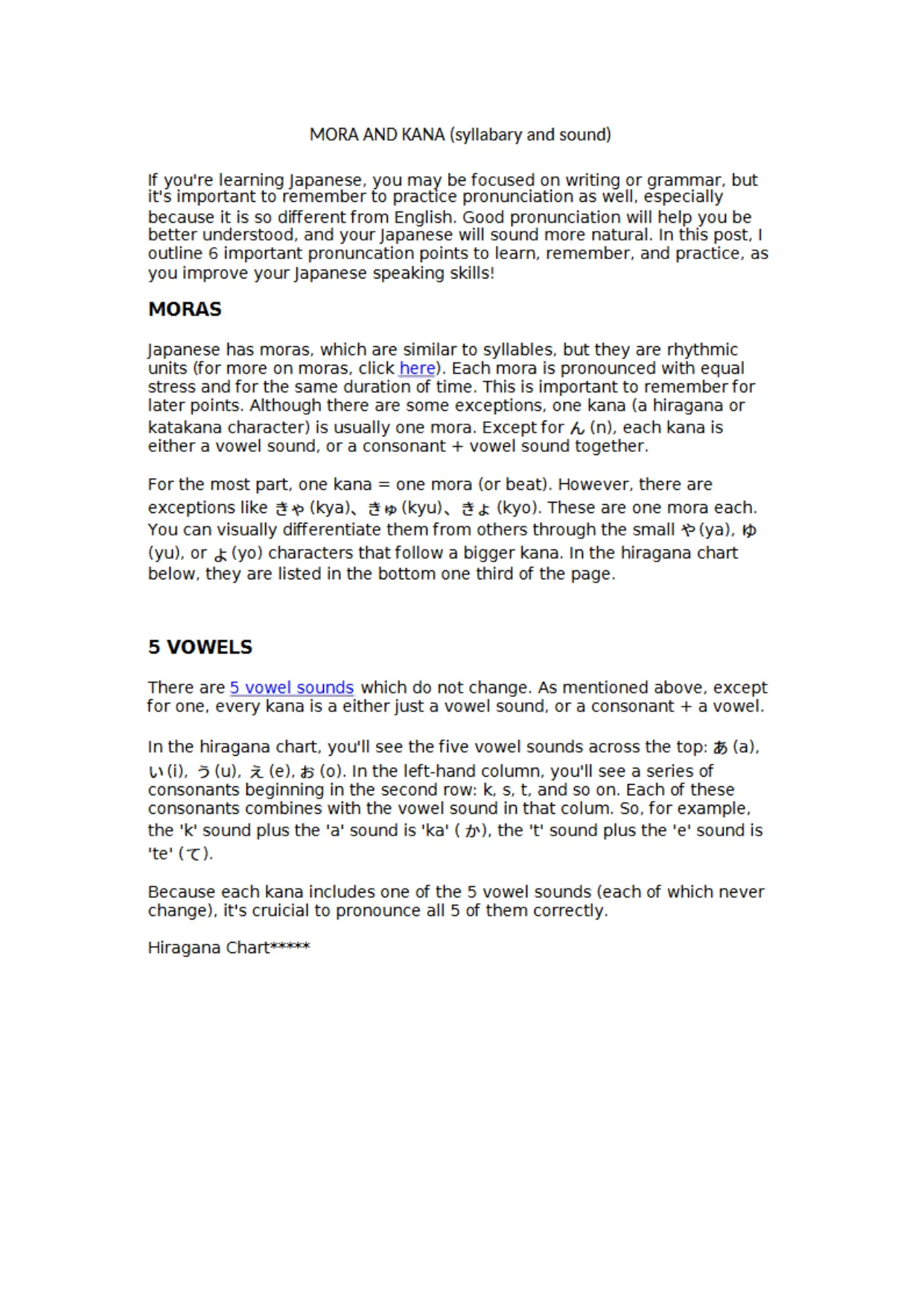
 MORA AN D KANA (syllabary and sound)If you're learning Japanese, you may be f o c u s e d on w r i t i n g or g r a m m a r , butit's i m p o r t a n t to r e m e m b e r to practice pronunciation as well, especiallybecause it is so different from English. Good pronunciation will help you bebetter understood, and your Japanese will sound more natural. In this post, Ioutline 6 i m p o r t a n t pronuncation points to learn, r e m e m b e r , and practice, asyou i m p r o v e your Japanese speaking skills!MORASJapanese has moras, which are similar to syllables, but they are r h y t h m i cunits (for more on moras, click here}. Each mora is pronounced with equalstress and for the same d u r a t i o n of time. This is i m p o r t a n t to r e m e m b e r f o rlater points. Although there are some exceptions, one kana (a hiragana orkatakana character) is usually one mora. Except for A (n), each kana iseither a vowel sound, or a consonant +vowel sound together.For the most part, one kana = one mora (or beat). However, there areexceptions like( k y a h(kyu),(kyo}. These are one mora each.You can visually differentiate them from others t h r o u g h the small(ya},(yu), orj; (yo) characters that follow a bigger kana. In the hiragana chartbelow, they are listed in the bottom one third of the page.5 VOWELSThere are 5 vowel_sounds which do not change. As m e n t i o n e d above, exceptfor one, every kana is a either just a vowel sound, or a consonant +a vowel.In the hiragana chart, you'll see the five vowel sounds across the top:(a),U (i),0 (u),X. (e), fc- (o) . In the left-hand column, you'll see a series ofconsonants beginning in the second row: k, s, t, and so on. Each of theseconsonants combines with the vowel sound in that colum. So, for example,the 'k' sound plus the 'a' sound is 'ka' ( fr), the 't' sound plus the 'e' sound is'te' ( X ) .Because each kana includes one of the 5 vowel sounds (each of which neverchange), it's cruicial to pronounce all 5 of them correctly.Hiragana Chart*****
Preview Mode
This document has 7 pages. Sign in to access the full document!