

Spanish I - Adjectives
- World Languages
- Texas A&M University
- 49 pages
- Shared March 2026
Preview 10 of 49 pages
See the first 10 pages exactly as they appear in the document.
Page 1 Read page 1 as text
Study Guide Spanish I – Adjectives 1. Adjective Types 1.1 Adjective Types: Possessive and Demonstrative Adjectives In Spanish, adjectives usually come before the noun . Two very important types of adjectives you’ll use all the time are: • Possessive adjectives (show ownership) • Demonstrative adjectives (show distance) Learning these two adjective types is essential for becoming confident in Spanish. The good news? They are logical, consistent, and easy to learn once you understand the patterns. 1.2 Possessive Adjectives (Before the Noun) They usually come before the noun , just like in English. Important rule: Possessive adjectives match the gender and number of the noun , NOT the gender or number of the person who owns it. Example: • mi libro → my book • mis libros → my books Even if many people own the book, the adjective only matches libro , not the owners.
Page 2 Read page 2 as text
Study Guide 1.3 How to Choose the Correct Possessive Adjective Use the adjective that matches who the owner is : • yo → mi / mis • tú → tu / tus • él, ella, usted → su / sus • nosotros/nosotras → nuestro/a/os/as • vosotros/vosotras → vuestro/a/os/as • ellos, ellas, ustedes → su / sus Then adjust singular or plural to match the noun being owned. Examples: • su libro → his book / her book / your (formal) book / their book • sus libros → his books / her books / your (formal) books / their books Tricky point: The word su can mean his, her, their, or your (formal) . Context tells you who owns it.
Page 3 Read page 3 as text
Study Guide Accent Reminder • tú (with accent) = you • tu (no accent) = your This difference is very important in writing. 1.4 Gender Changes: Nuestro and Vuestro Because nuestro and vuestro end in - o , they change for: • gender (masculine/feminine) • number (singular/plural) That’s why they have four forms each . 1.5 Possessive Adjectives (After the Noun – Long Form) Spanish also has long - form possessive adjectives that appear after the noun . These are commonly used: • After ser or estar • When the noun already has an article (el, la, los, las)
Page 4 Read page 4 as text
Study Guide Key Rule for Long Forms Long - form possessive adjectives must match the noun’s gender and number , just like other adjectives. Examples with Articles 1.6 Possessives with Ser or Estar In English, we say: • My book → The book is mine Spanish works the same way, but the possessive adjective stays after the noun .
Page 5 Read page 5 as text
Study Guide 1.7 Demonstrative Adjectives They answer the question: Is it here, there, or far away? In English: • this / these → close • that / those → farther away Spanish does the same thing, but also changes for gender and number . Distance 1: “This / These” (Here) Used for things close to you . • este (masculine singular) • esta (feminine singular) • estos (masculine plural) • estas (feminine plural)
Page 6 Read page 6 as text
Study Guide Distance 2: “That / Those” (There) Used for things farther away . • ese, esa, esos, esas Easy memory trick: “This and these have T’s. That and those don’t.” Distance 3: “Way Over There” (Far Away) Spanish has a third distance , which English does not. • aquel, aquella, aquellos, aquellas These mean: • that ___ way over there • those ___ far away 1.8 Demonstrative Adjectives + Distance Words Spanish often uses distance adverbs together with demonstrative adjectives: • aquí = here • ahí / allí = there • allá = far away
Page 7 Read page 7 as text
Study Guide Examples with Distance Words 1.9 Complete Demonstrative Adjective Chart To make things easier, all demonstrative adjectives can be organized by: • singular vs. plural • masculine vs. feminine Summary Most demonstrative adjective endings are predictable : • Feminine singular → - a • Masculine plural → - os • Feminine plural → - as
Page 8 Read page 8 as text
Study Guide The only forms that look unusual are: • este • ese 2. Quiz: Adjective Types 1. Question Their house = ? Answer Choices • Sus casa • Su casa Correct Answer Su casa Why This Is Correct In Spanish, “su” is used for his, her, your (formal), or their when referring to a singular noun . Since “casa” (house) is singular, the correct form is “su casa.” Important Note • Su casa = their house (one house) • Sus casas = their houses (more than one house) So even though “their” refers to more than one person, the Spanish possessive agrees with the thing owned , not the number of owners. 2. Question Your (familiar) pets =
Page 9 Read page 9 as text
Study Guide Answer Choices • Sus mascotas • Tus mascotas Correct Answer Tus mascotas Why This Is Correct In Spanish, “your” can be translated in different ways depending on the level of formality. • Tus mascotas is used in a familiar/informal context, when speaking to someone you know well (a friend, sibling, classmate). • Sus mascotas is used in a formal context or when referring to his/her/their pets. Because the question specifies (familiar) , the correct translation is “Tus mascotas.” 3. Question Her photos = ? Answer Choices • Sus fotos • Su fotos Correct Answer Sus fotos Why This Is Correct In Spanish, possessive adjectives must agree in number (singular or plural) with the noun they describe. • Fotos is plural , so the possessive adjective must also be plural → sus • Su is singular and is used only with singular nouns (e.g., su foto )
Page 10 Read page 10 as text
Study Guide Example: • Her photo → su foto • Her photos → sus fotos Therefore, “Her photos” = “Sus fotos” 4. Question Our vacation = Answer Choices • Nuestras vacaciones • Nuestro vacacion Correct Answer Nuestras vacaciones Why This Is Correct • “Vacation” in Spanish is “vacaciones” , which is plural , so it must agree with a plural possessive. • “Our” translates to “nuestras” (feminine plural) to match vacaciones . • “Nuestro vacacion” is incorrect because: o vacacion should be vacaciones (plural) o the gender agreement is wrong Correct Usage Example: Our vacation was fun. Nuestras vacaciones fueron divertidas.
39 more pages in the full document
Unlock it once and it stays in your library, ready to chat with or turn into flashcards.
Unlock the full documentMore World Languages study materials
See all Quick Guides
Spanish I - Infinitive and Regular Verb Use
World Languages
38 pagesMar 2026 Quick Guides
Spanish I - Negatives
World Languages
19 pagesMar 2026 Quick Guides
Spanish I - The Preterite Tense
World Languages
52 pagesMar 2026 Quick Guides
Spanish I - Irregular Verbs in the Present Tense
World Languages
43 pagesMar 2026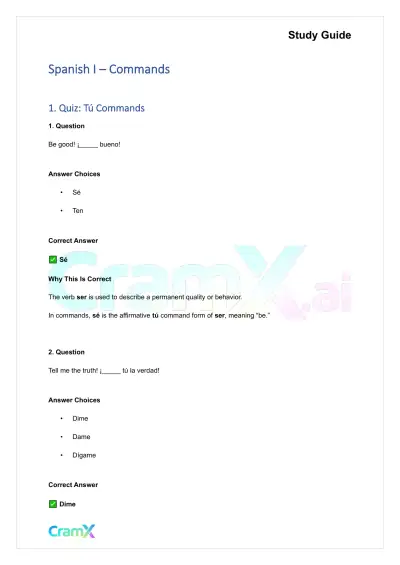 Quick Guides
Spanish I - Commands
World Languages
29 pagesMar 2026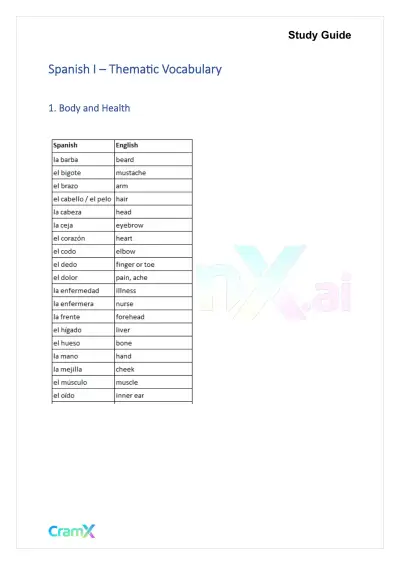 Quick Guides
Spanish I - Thematic Vocabulary
World Languages
27 pagesMar 2026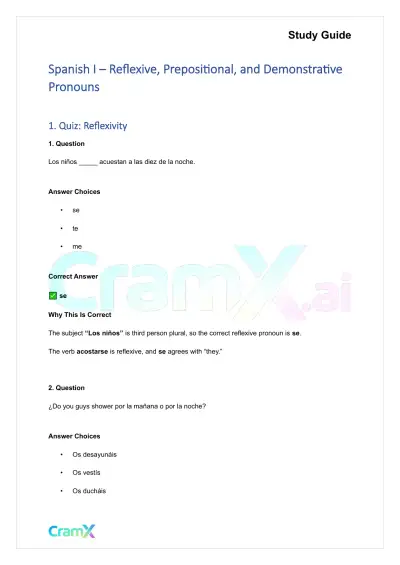 Quick Guides
Spanish I - Reflexive, Prepositional, and Demonstrative Pronouns
World Languages
20 pagesMar 2026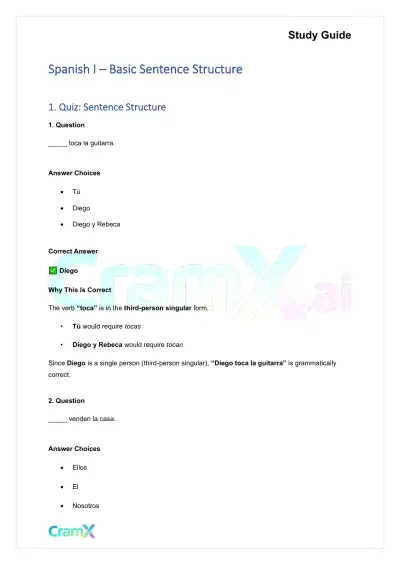 Quick Guides
Spanish I - Basic Sentence Structure
World Languages
14 pagesMar 2026
Study this document with CramX
Once it is in your library, every tool can work from it.