

Spanish I - Replacing Nouns with Pronouns
- World Languages
- Texas A&M University
- 20 pages
- Shared March 2026
Preview 6 of 20 pages
See the first 6 pages exactly as they appear in the document.
Page 1 Read page 1 as text
Study Guide Spanish I – Replacing Nouns with Pronouns 1. Pronoun Cases Pronouns don’t just replace nouns — they also change form depending on how they are used in a sentence . These different forms are called pronoun cases . 1.1 What Are Pronoun Cases? A pronoun case is a group of pronouns used for a specific job in a sentence. When a pronoun replaces a noun, you must choose the correct form based on the role that noun plays. Think of it like choosing the right tool for the job — each pronoun case has a specific purpose. 1.2 Subject Case Pronouns If a noun is the subject of a sentence (the one doing the action), you must replace it with a subject case pronoun . Example idea: If a noun is doing something, the pronoun replacing it should come from the subject case. 1.3 Object Case Pronouns If a noun is the direct object (the one receiving the action), you must use a pronoun from the object case . Example idea: If something is being acted upon, it needs an object case pronoun.
Page 2 Read page 2 as text
Study Guide 1.4 Different Roles a Noun Can Play A noun can have many different roles in a sentence. It might be: • the subject • the direct object • the indirect object • the object of a preposition • or something with a long name called a predicate nominative (don’t worry — it’s not as scary as it sounds!) Each role requires a different type of pronoun . 1.5 Choosing the Right Pronoun The key rule is simple: The pronoun you choose depends on the job the noun is doing in the sentence. So before picking a pronoun, pause and ask: • What role is this noun playing? • Is it doing the action, receiving it, or describing something else? Once you know the role, choosing the correct pronoun becomes much easier. Summary Pronoun cases help keep sentences clear and grammatically correct. When you understand what the noun is doing , you’ll always know which pronoun to use .
Page 3 Read page 3 as text
Study Guide 2 . Quiz: Pronoun Cases 1. Question Which pronoun would be used to address your friends “Juan y Diego” ? Answer Choices • vosotros • ustedes • ellos Correct Answer ustedes Why This Is Correct Ustedes is the Spanish subject pronoun used to address two or more people directly (you all). Since Juan and Diego are your friends and you are speaking to them, ustedes is correct. • Vosotros is also a “you all” form, but it is mainly used in Spain , not in most other Spanish - speaking regions. • Ellos means “they,” which is used to talk about people, not to address them directly. So, when speaking to Juan and Diego, the correct pronoun is ustedes . 2. Question Which pronoun would be used to refer to Marcos and his three sisters ? Answer Choices • ellas • ellos • nosotros
Page 4 Read page 4 as text
Study Guide Correct Answer ellos Why This Is Correct In Spanish, when referring to a group that includes at least one male , the masculine plural pronoun is used. Even though Marcos is with three sisters, the presence of one male means ellos is correct. For example: • Marcos y sus hermanas → ellos • Ana y María (all female) → ellas 3. Question Which pronoun would be used to refer to “Elena, Marta y Alicia” ? Answer Choices • ellos • ellas • nosotras Correct Answer ellas Why This Is Correct “Elena, Marta y Alicia” refers to a group made up entirely of females. In Spanish, the pronoun ellas is used for groups of women or girls. • ellos is used for groups that are all male or mixed gender • nosotras means “we” (female) and would only be used if the speaker were part of the group Therefore, ellas is the correct choice.
Page 5 Read page 5 as text
Study Guide 4. Question Which pronoun would be used to refer to yourself and a friend ? Answer Choices • ellos • ustedes • nosotros Correct Answer nosotros Why This Is Correct Nosotros is used when you are talking about yourself and one or more other people (“we”). Since the group includes you , Spanish requires the first - person plural pronoun. • Ellos = they (does not include you) • Ustedes = you all (used to address people, not to refer to yourself) • Nosotros = we ( includes you ) Example: Mi amigo y yo vamos al cine. → Nosotros vamos al cine. 5. Question Which pronoun would you use to answer a question about yourself? Answer Choices • yo • tú • ella
Page 6 Read page 6 as text
Study Guide Correct Answer yo Why This Is Correct In Spanish, yo is the subject pronoun used to refer to yourself (the speaker). It is used when you are talking about who you are or what you do . For example: • Yo soy estudiante . (I am a student.) The other options refer to different people: • tú = you (informal) • ella = she 6 . Question Which pronoun would you use to answer a question that was asked in the “ustedes” form? Answer Choices • ustedes • ellos • nosotros Correct Answer ustedes Why This Is Correct When a question is asked using “ustedes” (the formal or Latin American plural form of you all ), the correct way to respond is also with “ustedes.” Spanish keeps the same subject pronoun when answering questions to maintain clarity and agreement.
14 more pages in the full document
Unlock it once and it stays in your library, ready to chat with or turn into flashcards.
Unlock the full documentMore World Languages study materials
See all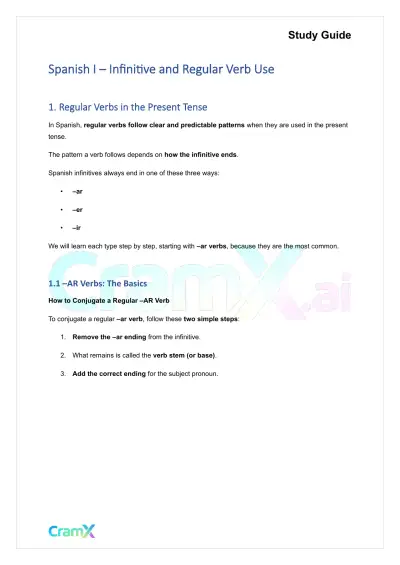 Quick Guides
Spanish I - Infinitive and Regular Verb Use
World Languages
38 pagesMar 2026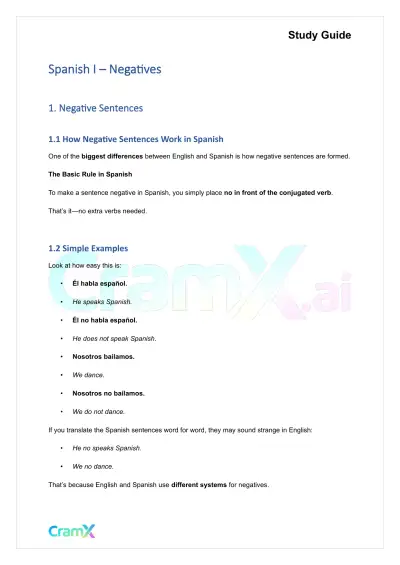 Quick Guides
Spanish I - Negatives
World Languages
19 pagesMar 2026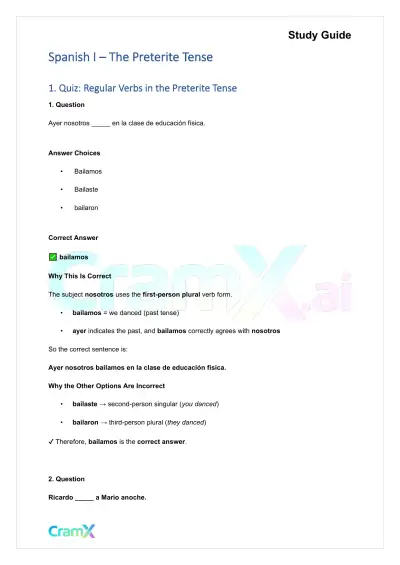 Quick Guides
Spanish I - The Preterite Tense
World Languages
52 pagesMar 2026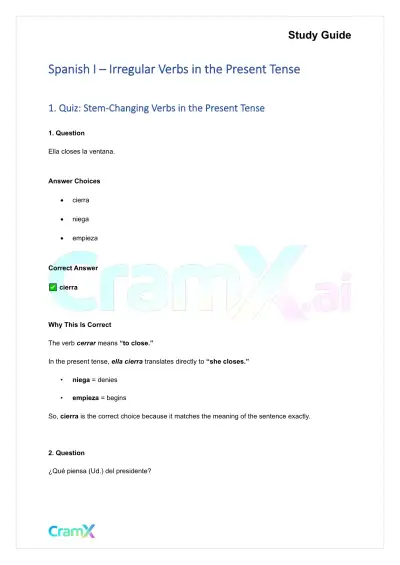 Quick Guides
Spanish I - Irregular Verbs in the Present Tense
World Languages
43 pagesMar 2026 Quick Guides
Spanish I - Commands
World Languages
29 pagesMar 2026 Quick Guides
Spanish I - Thematic Vocabulary
World Languages
27 pagesMar 2026 Quick Guides
Spanish I - Reflexive, Prepositional, and Demonstrative Pronouns
World Languages
20 pagesMar 2026 Quick Guides
Spanish I - Basic Sentence Structure
World Languages
14 pagesMar 2026
Study this document with CramX
Once it is in your library, every tool can work from it.