

Spanish I - Adverbs and Comparisons
- World Languages
- Texas A&M University
- 34 pages
- Shared March 2026
Preview 10 of 34 pages
See the first 10 pages exactly as they appear in the document.
Page 1 Read page 1 as text
Study Guide Spanish I – Adverbs and Comparisons 1. Adverb Placement in a Sentence When using adverbs in a sentence, there’s a simple rule for where to place them: 1. Adverbs after verbs: Usually, adverbs go right after verbs. o Example: o "El examen es horriblemente difícil." o The exam is horribly difficult. 2. Adverbs in front of adjectives or other adverbs: If the adverb is modifying an adjective or another adverb, it will come before the word it modifies. o Example: o "Mis abuelos hablan bien el castellano." o My grandparents speak Castilian well. 1.1 Adverbs of Time Adverbs of time tell us when an action happens. For example, "now," "tomorrow," or "yesterday." These adverbs can be placed before or after the verb, and the sentence still makes sense either way. • Example list of adverbs of time:
Page 2 Read page 2 as text
Study Guide 1.2 Adverbs of Manner Adverbs of manner tell us how an action is done. For example, "quickly," "sadly," "happily," etc. These adverbs usually come directly after the verb, unless there is a direct object. If there's a direct object, the adverb will come after the object. • Example: • "Ramon come rápidamente." • Ramón eats quickly. • "Adela canta tristemente." • Adela sings sadly.
Page 3 Read page 3 as text
Study Guide 1.3 Adverbs That Modify Adjectives or Other Adverbs When an adverb is used to change the meaning of an adjective or another adverb, it goes in front of the word it's modifying. These adverbs can intensify the meaning, like how "very" intensifies "intelligent" or "quickly." • Example: • "Él es muy inteligente." • He is very intelligent. • "Él habla muy inteligentemente." • He speaks very intelligently.
Page 4 Read page 4 as text
Study Guide 1.4 Common Adverbs to Intensify Words These adverbs can make adjectives or other adverbs stronger. Some of them are: • completamente = completely • extremadamente = extremely • muy = very • sumamente = extremely • totalmente = totally 2. Quiz: Adverb Placement in a Sentence 1. Question El camino es _____. Answer Choices • horriblemente rústico • horrible rústico • rústico horriblemente Correct Answer horriblemente rústico
Page 5 Read page 5 as text
Study Guide Why This Is Correct The phrase "horriblemente rústico" is correct because "horriblemente" (horribly) is an adverb modifying the adjective "rústico" (rustic). In Spanish, adverbs typically come before adjectives, not after them. Thus, the proper order is adverb + adjective : "horriblemente rústico" (horribly rustic). 2. Question Para una anciana de 95 años, _____. Answer Choices: • bien anda • anda bien Correct Answer : anda bien Why This Is Correct: In Spanish, the word order in sentences with adjectives or adverbs is important. In this case, "anda bien" is the correct option because "bien" (well) functions as an adverb modifying the verb "anda" (goes). The typical word order for adverb - verb construct ions is the adverb before the verb, making "anda bien" the correct phrasing. "Bien anda" sounds unnatural in this context. 3. Question Josue _____. Answer Choices • trabaja rápidamente • rápidamente trabaja
Page 6 Read page 6 as text
Study Guide Correct Answer trabaja rápidamente Why This Is Correct In Spanish, adverbs usually come after the verb. "Rápidamente" is an adverb modifying the verb "trabaja," so the correct word order is "trabaja rápidamente." This order makes the sentence grammatically correct and clear. 4. Question Las gitanas _____. Answer Choices • felices bailan • bailan felizmente Correct Answer bailan felizmente Why This Is Correct In Spanish, adverbs like "felizmente " (happily) typically modify the verb and describe how the action is performed. In this case, "bailan" (they dance) is the verb, so the adverb "felizmente" correctly modifies the action of dancing. The phrase "felices bailan" would be incorrect because "fe lices" is an adjective that describes a noun, but it doesn't fit properly with the verb "bailan." 5. Question El paciente _____. Answer Choices • se siente mal • mal se siente
Page 7 Read page 7 as text
Study Guide Correct Answer se siente mal Why This Is Correct In Spanish, the correct sentence structure places the verb before the adjective or adverb. "Se siente mal" follows the proper order: subject (el paciente), verb (se siente), and the adverb (mal). In contrast, "mal se siente" would sound unnatural and is no t the correct way to construct the sentence. 6. Question: Adela _____ está en la universidad. Answer Choices: • todavía • temprano • luego Correct Answer : todavía Why This Is Correct: The correct word to fill in the blank is "todavía," which means "still." The sentence translates to "Adela is still at the university." The other options don't fit grammatically in this context. • Temprano means "early" and wouldn't make sense here, as it would imply she is at the university early in the day, which is not the intended meaning. • Luego means "later," which changes the meaning of the sentence to "Adela is later at the university," making it grammatically incorrect in this context. 7. Question: Yo no ceno en casa _____.
Page 8 Read page 8 as text
Study Guide Answer Choices: • ayer • nunca • pronto Correct Answer : nunca Why This Is Correct: The correct word is "nunca ," which means "never" in English. The sentence is expressing that the speaker does not eat dinner at home ever, which fits with the word "nunca." For example: "Yo no ceno en casa nunca" means "I never have dinner at home." 8. Question Nosotras _____ llevamos nuestros pasaportes cuando viajamos. Answer Choices • siempre • anoche • tarde Correct Answer siempre
Page 9 Read page 9 as text
Study Guide Why This Is Correct The correct answer is "siempre " because it indicates a habitual action that occurs every time the subject (nosotras) travels. "Siempre" translates to "always," which fits the context of the sentence, meaning that they always take their passports when traveling. • "Anoche " means "last night," which doesn't fit the context of a habitual action. • "Tarde" means "late," which also doesn't convey the meaning of regularly taking the passports when traveling. 9. Question Jacobo es _____ diligente. Answer Choices • extremadamente • mucho • total Correct Answer extremadamente Why This Is Correct "Extremadamente" is the correct adverb to modify the adjective "diligente " (diligent), as it indicates a high degree of diligence. It emphasizes that Jacobo is extremely diligent. The other options, "mucho" and "total," do not fit grammatically or contextually to modify "diligente" in this case. For example: "Jacobo es extremadamente diligente" means "Jacobo is extremely diligent." 10. Question Yo chequeo mi Facebook _____ frecuentemente.
Page 10 Read page 10 as text
Study Guide Answer Choices • muy • totalmente • siempre Correct Answer siempre Why This Is Correct In this sentence, "siempre " means "always," which makes the most sense in the context of checking Facebook frequently. "Muy" means "very," and "totalmente" means "totally," but neither fits the sentence structure as well as "siempre." 3. Shortened Adverbs In Spanish, adverbs often end in - mente , which is similar to the English “ - ly.” But sometimes, these long words can make sentences sound too heavy. This is where shortened adverbs come in handy! 3.1 The Rule: When using two or more adverbs in a sentence that end with - mente , only the last adverb keeps the - mente . The other adverbs drop the - mente and stay in their feminine adjective form. Example 1: Original Sentence: • Marco trabaja rápida y diligentemente. • Marco works quickly and diligently.
24 more pages in the full document
Unlock it once and it stays in your library, ready to chat with or turn into flashcards.
Unlock the full documentMore World Languages study materials
See all Quick Guides
Spanish I - Infinitive and Regular Verb Use
World Languages
38 pagesMar 2026 Quick Guides
Spanish I - Negatives
World Languages
19 pagesMar 2026 Quick Guides
Spanish I - The Preterite Tense
World Languages
52 pagesMar 2026 Quick Guides
Spanish I - Irregular Verbs in the Present Tense
World Languages
43 pagesMar 2026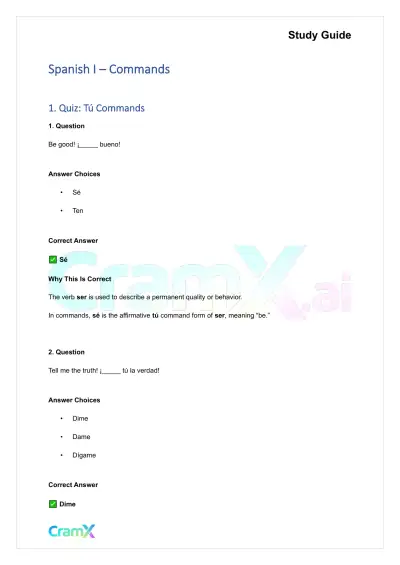 Quick Guides
Spanish I - Commands
World Languages
29 pagesMar 2026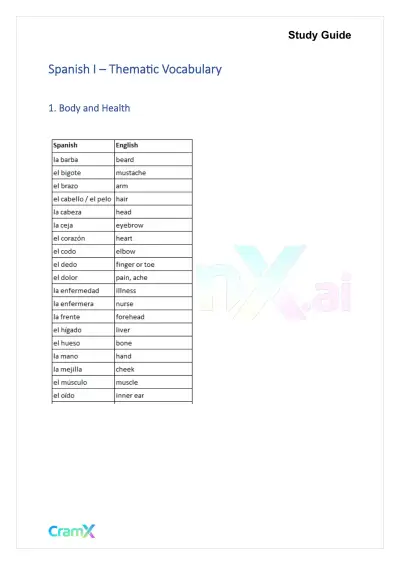 Quick Guides
Spanish I - Thematic Vocabulary
World Languages
27 pagesMar 2026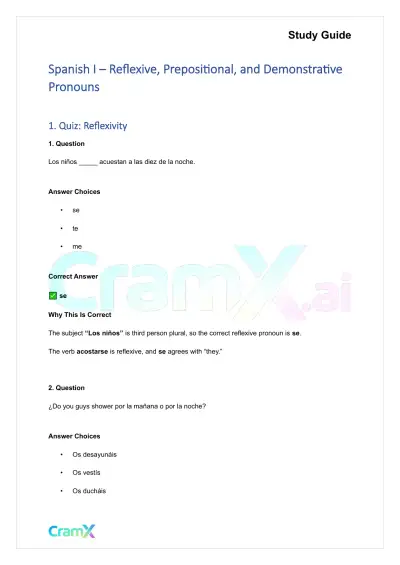 Quick Guides
Spanish I - Reflexive, Prepositional, and Demonstrative Pronouns
World Languages
20 pagesMar 2026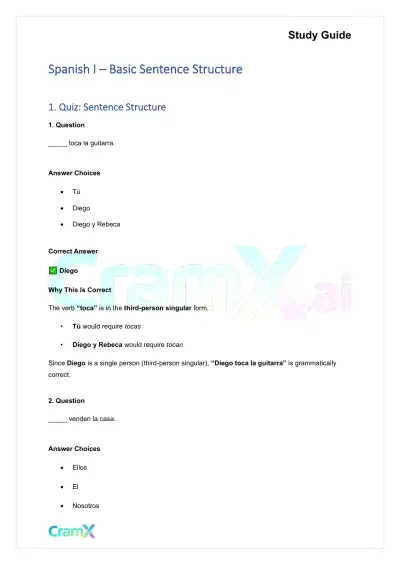 Quick Guides
Spanish I - Basic Sentence Structure
World Languages
14 pagesMar 2026
Study this document with CramX
Once it is in your library, every tool can work from it.