

Spanish I - Direct and Indirect Object Pronouns
- World Languages
- Texas A&M University
- 39 pages
- Shared March 2026
Preview 10 of 39 pages
See the first 10 pages exactly as they appear in the document.
Page 1 Read page 1 as text
Study Guide Spanish I – Direct and Indirect Object Pronouns 1. Direct Objects and Direct Object Pronouns In Spanish, a direct object is the person or thing that receives the action of the verb. To use a pronoun to replace a noun, we need to first identify what role that noun plays in the sentence. To find the direct object in a sentence, follow these three steps: 1. Identify the verb : Ask yourself, "What action is happening?" The answer is your verb. 2. Find the subject : Ask, "Who or what is doing the action?" The answer is the subject. 3. Find the direct object : Ask, "Who or what is being acted on?" This is the direct object. Example: Yolanda vende libros. (Yolanda sells books.) 1. What is the action? Vende (sells), so "vende" is the verb. 2. Who is doing the action? Yolanda is the subject. 3. Who is being sold? Libros (books) is the direct object. 1.1 The Personal "a" In Spanish, when the direct object is a person (or a word referring to a person), we add the word "a" before the direct object. This is called the personal "a" , and it disappears when the direct object is replaced by a pronoun. There is no direct translation for this "a" in English. 1.2 Direct Object Pronouns Once you know which noun is the direct object, you can replace it with a direct object pronoun . These pronouns are shown in the table below. To choose the correct one, match it to the subject pronoun you would use.
Page 2 Read page 2 as text
Study Guide Note: "Lo" and "la" also replace "usted" (formal "you"), depending on the gender of the person. Lo replaces masculine objects, and la replaces feminine ones. 1.3 Direct Object Pronoun Placement In English , the direct object always comes after the verb. But in Spanish , the pronoun must be placed before the conjugated verb. If the sentence is negative, the "no" (or any other negative word) will come before the pronoun. Example:
Page 3 Read page 3 as text
Study Guide • Yo veo la película. (I see the movie.) • Yo la veo. (I see it.) 1.4 Using Two Verbs When there are two verbs in a sentence (a conjugated verb and an infinitive), you can place the direct object pronoun in front of the conjugated verb or attach it to the infinitive verb. Example: • Yo quiero ver la película. (I want to see the movie.) • Yo quiero verla. (I want to see it.)
Page 4 Read page 4 as text
Study Guide 1.5 Present Progressive When using the present progressive (a form of "to be" + verb), you can either place the direct object pronoun before the verb "estar" or attach it to the end of the present participle (the verb ending in - ando or - iendo). Example: • Juan está llamando a María. (Juan is calling María.) • Juan la está llamando. (Juan is calling her.) If the pronoun is attached to the present participle, make sure to add an accent mark on the vowel just before - ando or - iendo. 1.6 Common Transitive Verbs Some verbs need a direct object to make sense. These are called transitive verbs . For example, you can’t just say "he brings." It sounds incomplete, because you need to know what he is bringing. Here are some common transitive verbs :
Page 5 Read page 5 as text
Study Guide • comprar – to buy • dar – to give • escribir – to write • invitar – to invite • llamar – to call • llevar – to carry, to take • mirar – to look at • querer – to want, to love • traer – to bring 2. Quiz: Direct Objects and Direct Object Pronouns 1. Question “Yo llevo los libros a clase.” = Answer Choices • Yo los llevo a clase. • Yo las llevo a clase. • Yo lo llevo a clase.
Page 6 Read page 6 as text
Study Guide Correct Answer Yo los llevo a clase. Why This Is Correct In Spanish, the pronoun "los " is used to replace a plural masculine object, such as "libros" (books). The sentence “Yo llevo los libros a clase” translates to "I carry the books to class." Replacing "los libros" with "los" gives us "Yo los llevo a clase," meaning "I carry them to cla ss." 2. Question “Ella invita a los chicos.” = Answer Choices: • Ella la invita. • Ella las invita. • Ella los invita. Correct Answer Ella los invita. Why This Is Correct In this sentence, "los chicos" refers to a plural masculine group (the boys). In Spanish, when replacing a masculine plural noun, we use the pronoun "los." So, “Ella invita a los chicos” becomes “Ella los invita,” meaning "She invites them." 3. Question “Mi madre llama a mi padre durante el día.” = Answer Choices: • Mi madre lo llama durante el día. • Mi madre las llama durante el día. • Mi madre los llama durante el día.
Page 7 Read page 7 as text
Study Guide Correct Answer Mi madre lo llama durante el día. Why This Is Correct In this sentence, “mi padre” refers to a singular masculine noun (my father). When replacing a singular masculine noun in Spanish, the correct pronoun is “lo.” So, “Mi madre llama a mi padre durante el día” becomes “Mi madre lo llama durante el día,” meani ng “My mother calls him during the day.” 4. Question “Amelia compra las salchichas en el supermercado.” = Answer Choices: • Amelia los compra en el supermercado. • Amelia la compra en el supermercado. • Amelia las compra en el supermercado. Correct Answer Amelia las compra en el supermercado. Why This Is Correct In this sentence, “las salchichas” refers to a plural feminine noun (the sausages). When replacing a plural feminine noun in Spanish, the correct pronoun is “las.” So, “Amelia compra las salchichas en el supermercado” becomes “Amelia las compra en el super mercado,” meaning “Amelia buys them at the supermarket.” 5. Question “La señora Lema enseña los verbos a los alumnos .” =
Page 8 Read page 8 as text
Study Guide Answer Choices: • La señora Lema las enseña a los alumnos . • La señora Lema los enseña a los alumnos . • La señora Lema lo enseña a los alumnos . Correct Answer La señora Lema los enseña a los alumnos . Why This Is Correct In this sentence, “los verbos ” refers to a plural masculine noun (the verbs). When replacing a plural masculine noun in Spanish, the correct pronoun is “los.” So, “La señora Lema enseña los verbos a los 8 nimals” becomes “La señora Lema los enseña a los 8 nimals,” meaning “Mrs. Lema teaches them to the students.” 6. Question “Este chico mira la tele todas las noches.” = Answer Choices: • Este chico lo mira todas las noches. • Este chico la mira todas las noches. • Este chico las mira todas las noches. Correct Answer Este chico la mira todas las noches. Why This Is Correct In this sentence, “la tele” refers to a singular feminine noun (the TV). When replacing a singular feminine noun in Spanish, the correct pronoun is “la.” So, “Este chico mira la tele todas las noches” becomes “Este chico la mira todas las noches,” meaning “This boy watches it every night.”
Page 9 Read page 9 as text
Study Guide 7. Question “Mario trae las 9 nimals a la fiesta.” = Answer Choices: • Mario las trae a la fiesta. • Mario lo trae a la fiesta. • Mario la trae a la fiesta. Correct Answer Mario las trae a la fiesta. Why This Is Correct In this sentence, “las 9 nimals” refers to a plural feminine noun (the drinks). When replacing a plural feminine noun in Spanish, the correct pronoun is “las.” So, “Mario trae las 9 nimals a la fiesta” becomes “Mario las trae a la fiesta,” meaning “Mario brings them to the party.” 8. Question “Elena y Ana tienen el dinero para el helado.” = Answer Choices: • Elena y Ana los tienen para el helado. • Elena y Ana la tienen para el helado. • Elena y Ana lo tienen para el helado. Correct Answer Elena y Ana lo tienen para el helado.
Page 10 Read page 10 as text
Study Guide Why This Is Correct In this sentence, “el dinero” refers to a singular masculine noun (the money). When replacing a singular masculine noun in Spanish, the correct pronoun is “lo.” So, “Elena y Ana tienen el dinero para el helado” becomes “Elena y Ana lo tienen para el helado ,” meaning “Elena and Ana have it for the ice cream.” 9. Question “Rosalita no vende las plantas en su tienda.” = Answer Choices: • Rosalita no las 10 nimals 10 su tienda. • Rosalita no la 10 nimals 10 su tienda. • Rosalita no los 10 nimals 10 su tienda. Correct Answer Rosalita no las 10 nimals 10 su tienda. Why This Is Correct In this sentence, “las plantas ” refers to a plural feminine noun (the plants). When replacing a plural feminine noun in Spanish, the correct pronoun is “las.” So, “Rosalita no vende las plantas en su tienda” becomes “Rosalita no las 10 nimals 10 su tienda,” meaning “Rosalita doesn’t sell them in her store.” 10. Question “Mariana ayuda los 10 nimals los fines de semana.” = Answer Choices: • Mariana la ayuda los fines de semana. • Mariana lo ayuda los fines de semana. • Mariana los ayuda los fines de semana.
29 more pages in the full document
Unlock it once and it stays in your library, ready to chat with or turn into flashcards.
Unlock the full documentMore World Languages study materials
See all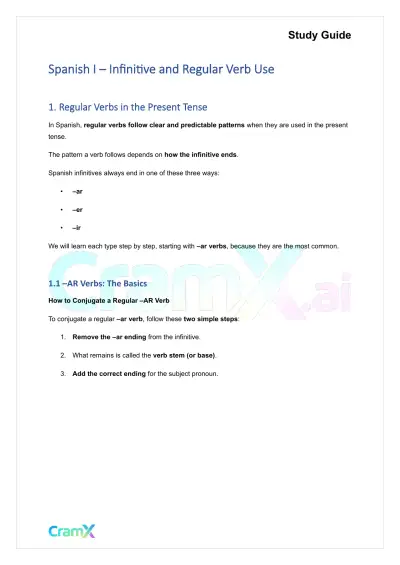 Quick Guides
Spanish I - Infinitive and Regular Verb Use
World Languages
38 pagesMar 2026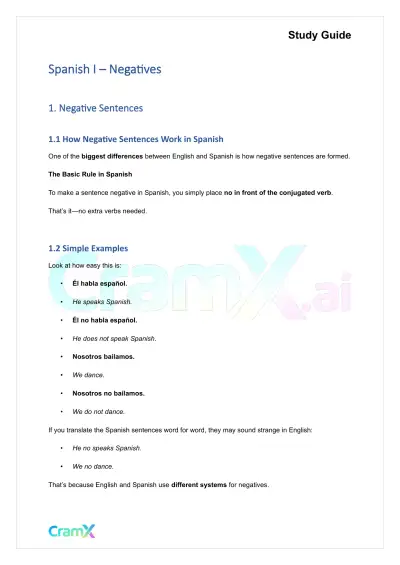 Quick Guides
Spanish I - Negatives
World Languages
19 pagesMar 2026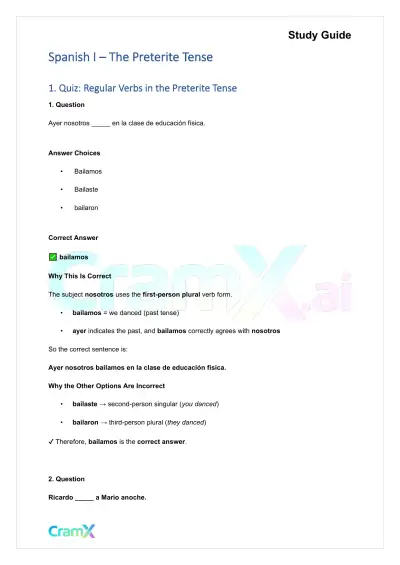 Quick Guides
Spanish I - The Preterite Tense
World Languages
52 pagesMar 2026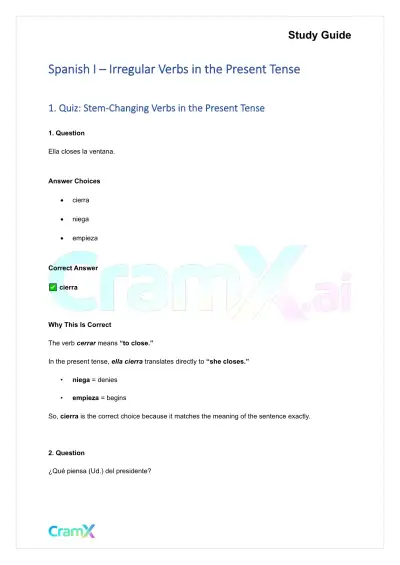 Quick Guides
Spanish I - Irregular Verbs in the Present Tense
World Languages
43 pagesMar 2026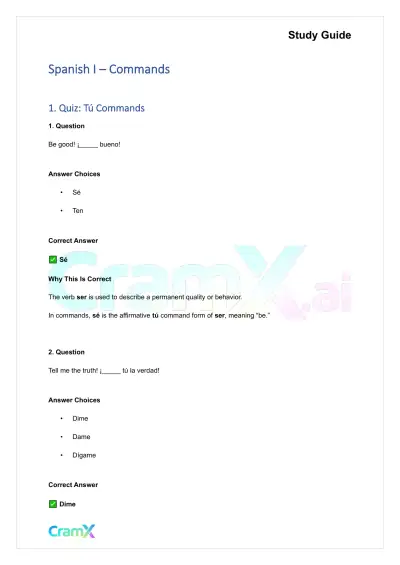 Quick Guides
Spanish I - Commands
World Languages
29 pagesMar 2026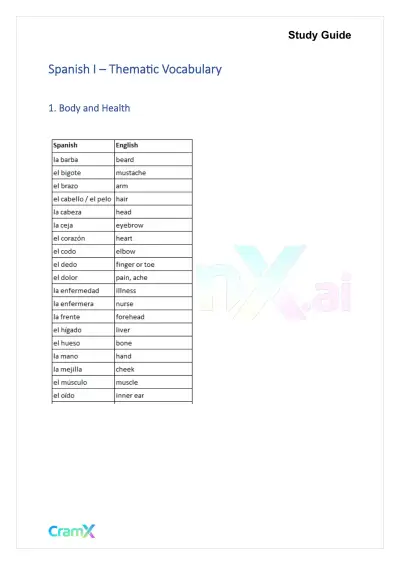 Quick Guides
Spanish I - Thematic Vocabulary
World Languages
27 pagesMar 2026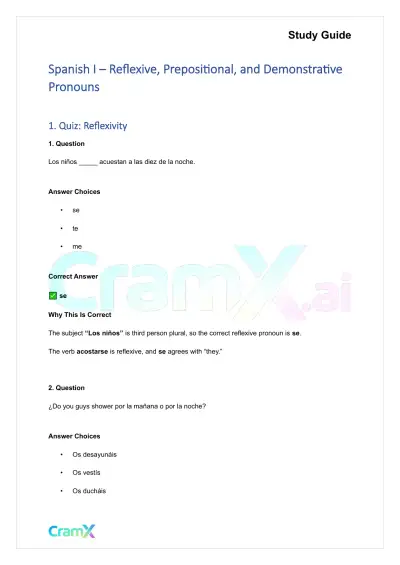 Quick Guides
Spanish I - Reflexive, Prepositional, and Demonstrative Pronouns
World Languages
20 pagesMar 2026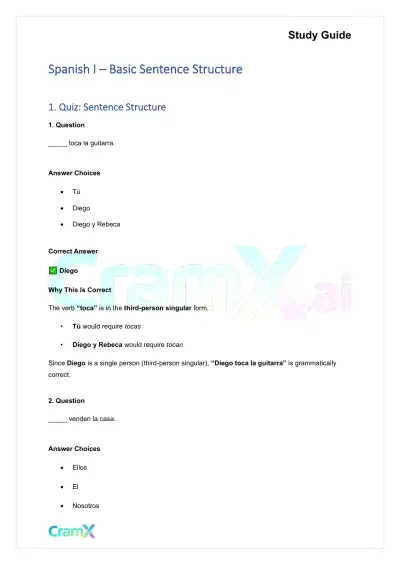 Quick Guides
Spanish I - Basic Sentence Structure
World Languages
14 pagesMar 2026
Study this document with CramX
Once it is in your library, every tool can work from it.