

Organic Chemistry I - Alkynes
- Chemistry
- Texas A&M University
- 16 pages
- Shared March 2026
Preview 5 of 16 pages
See the first 5 pages exactly as they appear in the document.
Page 1 Read page 1 as text
Study Guide Organic Chemistry I – Alkynes 1. Alkynes: Nomenclature What is Alkyne Nomenclature? The naming of alkynes follows rules from the International Union of Pure and Applied Chemistry (IUPAC) . These rules are similar to the naming rules for alkenes, except for the suffix used to indicate the presence of a triple bond . Steps for Naming Alkynes: 1. Identify the Longest Chain with the Triple Bond The parent name of the alkyne comes from the IUPAC name of the alkane with the same number of carbon atoms, but the - ane ending is replaced with - yne to show the presence of the triple bond. Example: If the longest chain with a triple bond has five carbon atoms, the compound is pentyne . 2. Number the Carbon Atoms in the Chain Number the carbon atoms starting from the end closest to the triple bond . This ensures that the triple bond is placed between the second and third carbon atoms. If you number from the wrong end, the triple bond would be placed incorrectly. Example: o The correct way to number is from right to left in 2 - pentyne . 3. Indicate the Position of the Triple Bond The position of the triple bond is shown by placing the lower of the two numbers assigned to the triple - bonded carbons in front of the name. Example: The compound shown is 2 - pentyne , with the triple bond located between the second and third carbon atoms.
Page 2 Read page 2 as text
Study Guide 4. Substituent Atoms or Groups If there are any substituent atoms or groups, their positions and names are indicated in the name. The position of the substituent is numbered based on the longest chain. Example: o For the compound shown with a chlorine atom, the name is 5 - chloro - 2 - hexyne . Key Takeaway • Identify the longest chain with the triple bond and replace the - ane ending with - yne . • Number the chain from the end closest to the triple bond. • The position of the triple bond is indicated by the numbers of the carbon atoms in the bond. • The location of any substituent atoms or groups is added to the name. 2. Alkynes: Physical Properties What Are the Physical Properties of Alkynes? Alkynes have physical properties similar to alkenes. Like alkenes, alkynes are generally nonpolar molecules , meaning they have little solubility in polar solvents , such as water. However, alkynes are soluble in nonpolar solvents like ether and acetone. • Alkynes with four or fewer carbon atoms tend to be gases, just like alkanes and alkenes. Substituted Alkynes and Dipole Moments What is a Dipole Moment?
Page 3 Read page 3 as text
Study Guide Substituted alkynes have small dipole moments . This is because the electronegativity difference between the triple - bonded carbon atoms and the single - bonded carbon atoms creates an unequal distribution of electrons. • The triple - bonded carbon atoms are sp hybridized (with a higher s character ), making them more electronegative. • The single - bonded carbon atoms are sp³ hybridized and less electronegative. This difference in electronegativity between the carbon atoms results in an asymmetrical electron distribution in the molecule. This asymmetry creates a dipole moment . Key Takeaway • Alkynes are nonpolar molecules with little solubility in polar solvents. • Alkynes with four or fewer carbon atoms are gases. • Substituted alkynes have small dipole moments due to differences in electronegativity between sp and sp³ hybridized carbon atoms. 3. Alkynes: Acidity What are Terminal Alkynes? Alkynes with the general structure of R - C≡C - H are referred to as terminal alkynes . These types of alkynes are weakly acidic . When exposed to a strong base, such as sodium amide (NaNH ₂ ) , they undergo an acid - base reaction. 3.1 Why Are Terminal Alkynes Acidic? The acidity of terminal alkynes is due to the high level of s character in the sp hybrid orbital . The carbon atom in the triple bond is sp hybridized , meaning it has more s character than the sp³ hybridized carbon in alkanes. This causes the electron cloud of the bond to shift closer to the carbon atom, making the hydrogen atom slightly positive . This slight positive charge on the hydrogen makes it a weak proton, which can be removed by a strong base.
Page 4 Read page 4 as text
Study Guide 3. 2 Comparison with Alkanes and Alkenes In alkanes and alkenes , the s character in the hybridized carbon bonds is less. This means there is a less electronegative shift in the overlap region of the σ bond, making the hydrogen atoms less electron - deficient and therefore less acidic . In these cases, much stronger bases are needed to remove the hydrogen atoms as protons. 3.3 Acetylide Ion Formation When a terminal alkyne reacts with a strong base, it forms an acetylide ion (R - C≡C ⁻ ) . The reaction is reversible , meaning the base may not form an acid stronger than the starting alkyne. The new acid could also reprotonate the acetylide ion. 3.4 Hydrolysis of the Acetylide Ion In the presence of water ( H ₂ O ), the acetylide ion can be reprotonated , resulting in the formation of a terminal alkyne and the hydroxide ion ( OH ⁻ ). Key Takeaway • Terminal alkynes are weakly acidic and can undergo acid - base reactions. • The acidity is due to the high s character in the sp hybridized carbon bond. • The acetylide ion forms in an acid - base reaction and can be reprotonated . • The process of hydrolysis of the acetylide ion can regenerate a terminal alkyne.
Page 5 Read page 5 as text
Study Guide 4. Alkynes: Preparations How Are Alkynes Prepared? The preparation of alkynes is very similar to that of alkenes. The main method of preparing alkynes involves the elimination of groups or ions from molecules, leading to the formation of π bonds . 4.1 Dehydrohalogenation Dehydrohalogenation is one common method. This involves the loss of a hydrogen atom and a halogen atom from adjacent carbon atoms in an alkane. This process first forms an alkene . Then, the loss of additional hydrogen and halogen atoms from the double - bonded carbon atoms leads to the formation of an alkyne. • The halogen atoms may be located on the same carbon (a geminal dihalide ) or on adjacent carbons (a vicinal dihalide ). 4.2 Second Step of Dehydrohalogenation In the second step of dehydrohalogenation, high temperatures and an extremely strong basic solution are required. Dehalogenation Dehalogenation is another method. Vicinal tetrahaloalkanes (compounds with halogens on adjacent carbons) can undergo dehalogenation with zinc metal in an organometallic reaction to form alkynes.
11 more pages in the full document
Unlock it once and it stays in your library, ready to chat with or turn into flashcards.
Unlock the full documentMore Chemistry study materials
See all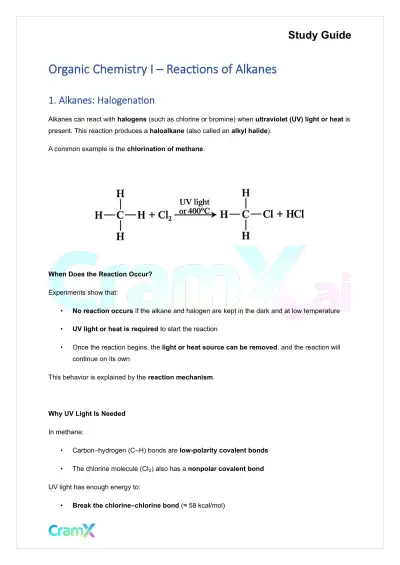 Quick Guides
Organic Chemistry I - Reactions of Alkanes
Chemistry
14 pagesMar 2026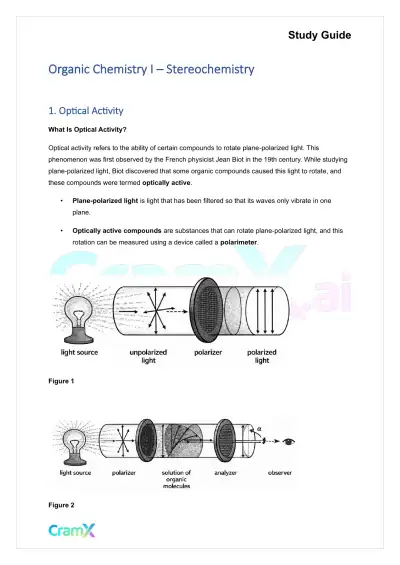 Quick Guides
Organic Chemistry I - Stereochemistry
Chemistry
25 pagesMar 2026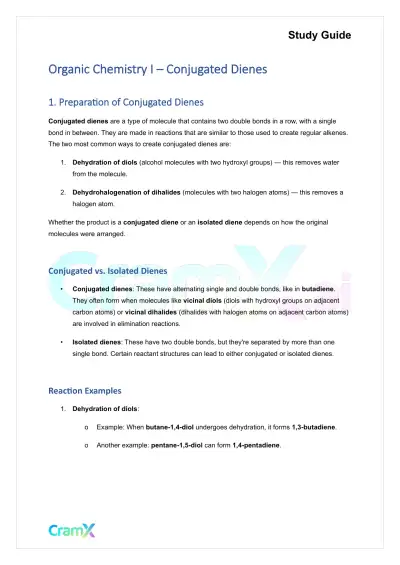 Quick Guides
Organic Chemistry I - Conjugated Dienes
Chemistry
17 pagesMar 2026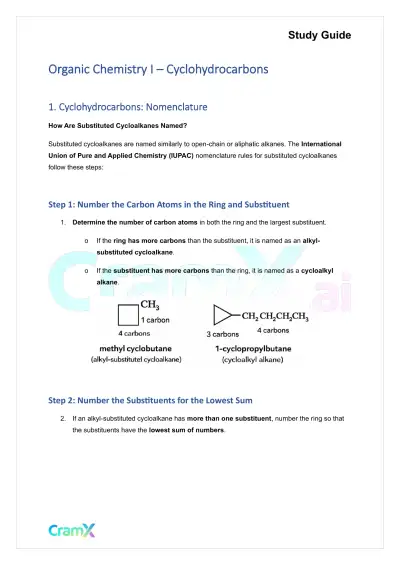 Quick Guides
Organic Chemistry I - Cyclohydrocarbons
Chemistry
11 pagesMar 2026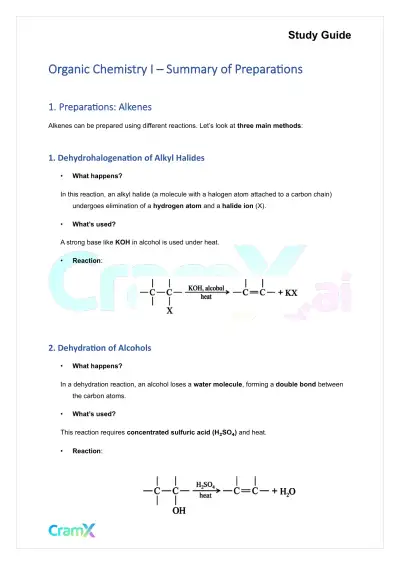 Quick Guides
Organic Chemistry I - Summary of Preparations
Chemistry
9 pagesMar 2026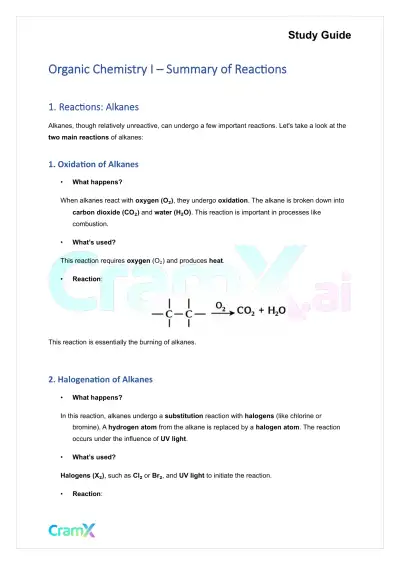 Quick Guides
Organic Chemistry I - Summary of Reactions
Chemistry
14 pagesMar 2026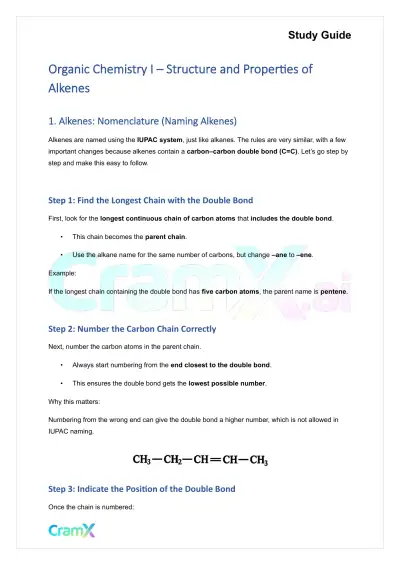 Quick Guides
Organic Chemistry I - Structure and Properties of Alkenes
Chemistry
17 pagesMar 2026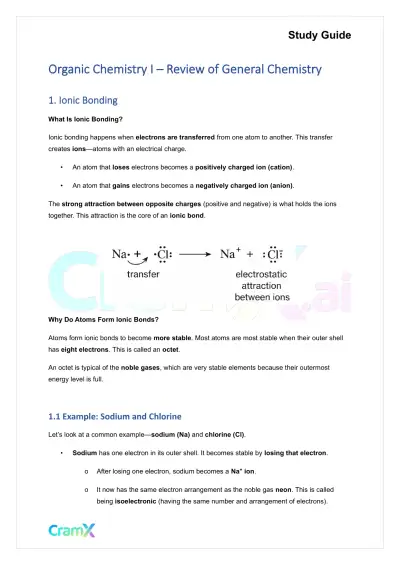 Quick Guides
Organic Chemistry I - Review of General Chemistry
Chemistry
17 pagesMar 2026
Study this document with CramX
Once it is in your library, every tool can work from it.