

Spanish II - Adjectives and Comparisons
- World Languages
- Texas A&M University
- 26 pages
- Shared March 2026
Preview 8 of 26 pages
See the first 8 pages exactly as they appear in the document.
Page 1 Read page 1 as text
Study Guide Spanish II – Adjectives and Comparisons 1. Demonstrative Adjectives Demonstrative adjectives are used to point out nouns and show how close or far something is from the speaker. In simple terms, they help answer questions like: • Is it here ? • Is it there ? • Is it far away ? They always come before a noun and must agree with that noun in gender (masculine or feminine) and number (singular or plural). 1.1 Demonstrative Adjectives in English (Quick Review) English only shows two distances : • Here → this (singular), these (plural) • There → that (singular), those (plural) Examples: • This video is interesting. • Those teachers are very demanding. 1.2 Spanish Uses THREE Distances (Not Two!) Spanish is more specific than English. It shows three different distances : 1. Here (close to the speaker) 2. There (farther away) 3. Way over there (far away from both speaker and listener) Because of this, Spanish has three sets of demonstrative adjectives .
Page 2 Read page 2 as text
Study Guide 1.3 Distance #1: “Here” → este / esta / estos / estas Use these when the noun is close to you . Examples: • Este video es interesante. • Esta película es muy romántica. • Estos apartamentos tienen buenas vistas. • Estas paredes son muy altas. 1.4 Distance #2: “There” → ese / esa / esos / esas Use these when the noun is not close , but also not very far away . Examples: • Ese traje es negro. • Esa falda es azul. • Esos maestros son muy exigentes. • Esas reglas de la clase me molestan mucho.
Page 3 Read page 3 as text
Study Guide 1.5 Distance #3: “Way Over There” → aquel / aquella / aquellos / aquellas Spanish has a special set of demonstratives for things that are far away from everyone . English does not have an exact equivalent, so these are often translated as: • that (way over there) • those (way over there) Examples: • Aquel país tiene muchos problemas. • Aquella nación es pobre. • Aquellos políticos gastan todos los impuestos. • Aquellas familias necesitan comida. 1.6 Time Distance Also Matters Demonstrative adjectives can also show distance in time , not just space. • Esta often refers to something happening now or today • Esa often refers to something that happened in the past Example: • Esta camiseta que llevo hoy es muy cómoda. • (This T - shirt I’m wearing today is very comfortable.) • Esa camisa que llevaba ayer era de lana. • (That shirt I wore yesterday was wool.)
Page 4 Read page 4 as text
Study Guide 1.7 Helpful Memory Trick (Very Important!) “This” and “these” have T’s. “That” and “those” do NOT. • este / esta / estos / estas → have T • ese / esa / esos / esas → no T Chanting this helps students remember the difference quickly. 1.8 The Three Distances and Their Demonstratives Certain words give you a clue about which demonstrative to use. • aquí → este, esta, estos, estas • allí → ese, esa, esos, esas • allá → aquel, aquella, aquellos, aquellas 1.9 Demonstrative Adjectives by Gender and Number Demonstrative adjectives must match the noun.
Page 5 Read page 5 as text
Study Guide Important pattern: • Feminine singular → – a • Masculine plural → – os • Feminine plural → – as • Masculine singular ( este, ese, aquel ) is the only form that breaks the pattern 1.10 Adjectives vs. Pronouns (Don’t Confuse Them!) • Demonstrative adjectives : o Modify a noun o Do NOT have accent marks o Example: Este libro es interesante. • Demonstrative pronouns : o Replace a noun o May look similar but are used differently 2. Comparisons When we compare people or things, we are usually answering questions like: • Who is taller ? • Which is more interesting ? • Who is the best or the worst ? Spanish and English do this in similar ways — but Spanish uses clear formulas that make comparisons very predictable once you learn them.
Page 6 Read page 6 as text
Study Guide 2.1 Comparisons in English (Quick Review) In English, the form of the adjective depends on how long it is. Short adjectives (one syllable) Add – er , and use than . • Mario is tall. • Shelly is taller than Mario. • I am smart. • You are smarter than I am. Longer adjectives (more than one syllable) Use more or less + adjective + than . • Erin is more intelligent than Lisa. • Paul is less annoying than Danny. 2.2 Comparisons in Spanish (Much Easier!) Spanish does not change the adjective itself. Instead, it always uses más (more) or menos (less). The basic comparison formula: (noun) + es/son + más/menos + adjective + que + (noun) The adjective must agree in gender and number with the first noun . Examples: • Marta es más alta que Marco. • Marta is taller than Marco. • Memo y Cristóbal son menos prácticos que sus hermanas. • Memo and Cristóbal are less practical than their sisters.
Page 7 Read page 7 as text
Study Guide 2.3 Comparisons with Numbers: más de / menos de When the second part of the comparison is a number , Spanish does not use que . Instead, it uses de . Examples: • Zobeida tiene más de 30 pares de zapatos. • Zobeida has more than 30 pairs of shoes. • Necesito menos de 10 voluntarios. • I need fewer than 10 volunteers. 2.4 Saying Two Things Are Equal Sometimes you want to say that two people or things are the same in some way. The equality formula: tan + adjective + como Examples: • La criada es tan importante como el abogado. • The maid is as important as the lawyer. • Tus amigos son tan importantes como tu profesión. • Your friends are as important as your career. 2.5 Irregular Comparatives (No más or menos ) Some very common adjectives have special comparative forms . These forms are used instead of más or menos .
Page 8 Read page 8 as text
Study Guide Examples include: • bueno → mejor (better) • malo → peor (worse) • grande → mayor (bigger / older) • pequeño → menor (smaller / younger) 2.6 Superlatives: The Extreme Form Superlatives describe the highest or lowest degree of something: • the biggest • the most beautiful • the least interesting
18 more pages in the full document
Unlock it once and it stays in your library, ready to chat with or turn into flashcards.
Unlock the full documentMore World Languages study materials
See all Quick Guides
Spanish II - Subjunctive Mood II
World Languages
9 pagesMar 2026 Quick Guides
Spanish II - The Present Tense Indicative
World Languages
27 pagesMar 2026 Quick Guides
Spanish II - Past Subjunctive and Sequence of Tenses
World Languages
14 pagesMar 2026 Quick Guides
Spanish II - Pronouns
World Languages
38 pagesMar 2026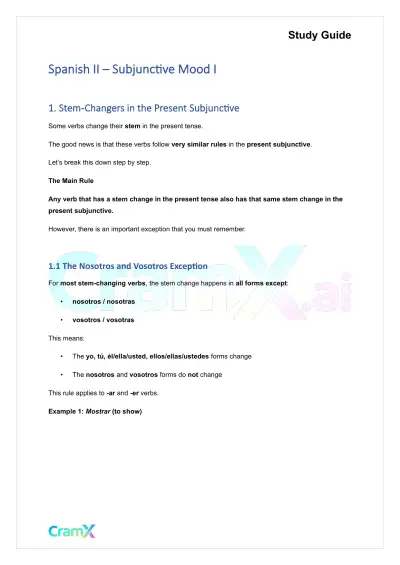 Quick Guides
Spanish II - Subjunctive Mood I
World Languages
29 pagesMar 2026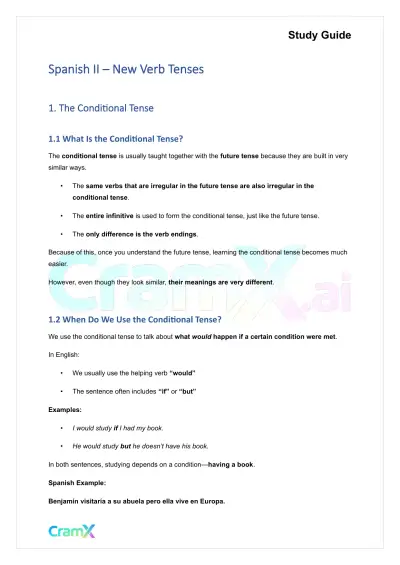 Quick Guides
Spanish II - New Verb Tenses
World Languages
19 pagesMar 2026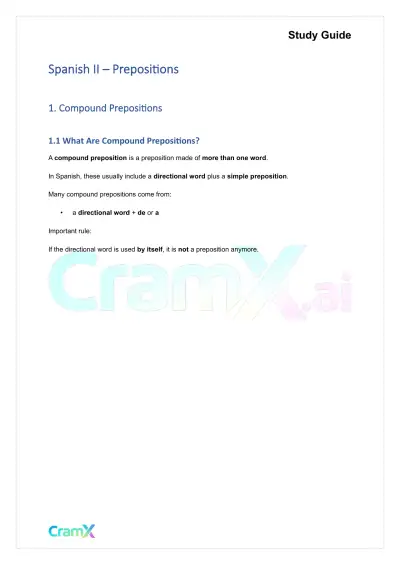 Quick Guides
Spanish II - Prepositions
World Languages
26 pagesMar 2026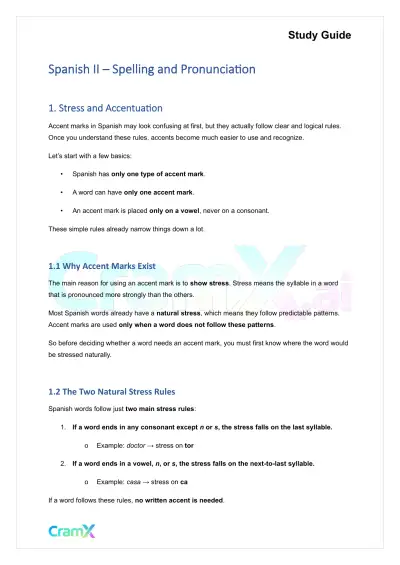 Quick Guides
Spanish II - Spelling and Pronunciation
World Languages
12 pagesMar 2026
Study this document with CramX
Once it is in your library, every tool can work from it.