

Spanish II - The Perfect Tenses
- World Languages
- Texas A&M University
- 15 pages
- Shared March 2026
Preview 5 of 15 pages
See the first 5 pages exactly as they appear in the document.
Page 1 Read page 1 as text
Study Guide Spanish II – The Perfect Tenses 1. The Helping Verb Haber In English, compound tenses are formed with a helping verb and a main verb. The helping verb is “to have” (has, have, had), and it is followed by a past participle . Look at these two sentences: • I have studied. • I have a book. They look similar, but they are not the same. In the first sentence, have is a helping verb because it helps form the action have studied . In the second sentence, have shows possession — it tells us what someone owns. The key difference is simple: If have is followed by a past participle (like studied ), it is a helping verb. 1.1 Choosing the Right Verb in Spanish Spanish makes this distinction very clear by using two different verbs . • Tener = to have (to possess something) • Haber = to have done something (used to form compound tenses) So before you write a sentence, ask yourself: Am I saying that someone has something ? Or am I saying that someone has done something ? If it’s possession, use tener . If it’s an action that already happened, use haber with a past participle.
Page 2 Read page 2 as text
Study Guide 1.2 Using Haber to Form Compound Tenses When haber is used as a helping verb, it works just like “have” in English. It is followed by a past participle , and together they describe an action that has happened. Example idea: • Someone has studied • Someone has finished • Someone has traveled In Spanish, these ideas always use haber + past participle . 1.3 Haber to Express Existence: “There is / There are” There is one special use of haber that does not create a compound tense. Haber can also be used to talk about existence — to say that something exists or is present . In English, this means “there is” or “there are.” Hay (Present Tense) In the present tense, haber becomes hay . • Hay un concierto de Orishas este fin de semana. • There is an Orishas concert this weekend. • Hay muchos admiradores de este grupo aquí. • There are many fans of this group here. Important detail to remember: Hay is used for both singular and plural objects. 1.4 Other Tenses: Always Singular In all other tenses, haber is used only in the third person singular form , no matter how many things follow it. Even if you are talking about many people or objects, the verb stays singular.
Page 3 Read page 3 as text
Study Guide • Había un partido de vólibol ayer. • There was a volleyball game yesterday. (imperfect) • Había muchos espectadores en el gimnasio. • There were many spectators in the gym. (imperfect) • Habrá otra competencia mañana. • There will be another competition tomorrow. (future) • Habrá cinco equipos en el torneo. • There will be five teams in the tournament. (future) • Habría más, pero uno se canceló. • There would be more, but one was canceled. (conditional) Summary • Haber is used to form compound tenses (has done, have studied). • Tener is used to show possession. • Hay means “there is” or “there are” in the present tense. • In other tenses, haber is always singular, even when talking about many things. Once you get used to spotting whether a sentence is about doing or having , choosing between haber and tener becomes much easier. 2. Compound Tenses Spanish uses compound tenses to talk about actions that are completed, already happened, or will be finished by a certain time. These tenses are built using two parts: 1. A form of the helping verb haber 2. A past participle of the main verb The key rule to remember is this: The past participle never changes. Only haber is conjugated to match the subject. The tense you choose for haber determines which compound tense you are using.
Page 4 Read page 4 as text
Study Guide 2.1 Present Perfect Tense The present perfect tense is formed with the present tense of haber plus a past participle. It is used to say that something has already happened or has been completed . Forms of Haber (Present Tense) (Present Tense Conjugation Chart for the Helping Verb Haber ) This chart shows all the present - tense forms of haber . Even though the chart lists haber alone, remember that it is almost always followed by a past participle in real sentences. Example: Present Perfect with a Verb
Page 5 Read page 5 as text
Study Guide (Present Perfect Conjugation Chart for Llamar ) Notice something important in this chart: • The forms of haber change. • The past participle llamado stays the same for every subject. 2.2 Meaning and Use of the Present Perfect The present perfect is translated like this: • I have called • You have called • They have called This tense focuses on completion , not just when the action happened. For example: • Yo he estudiado • I have studied This means the studying is finished , and the result matters now. In English, this is similar to the preterite, but Spanish uses the present perfect when emphasizing that the action is completed. 2.3 Past Perfect (Pluperfect) The past perfect , also called the pluperfect , talks about an action that had already happened before another past event . It is formed just like the present perfect, but instead of the present tense of haber , it uses the imperfect tense of haber . Forms of Haber in the Imperfect
10 more pages in the full document
Unlock it once and it stays in your library, ready to chat with or turn into flashcards.
Unlock the full documentMore World Languages study materials
See all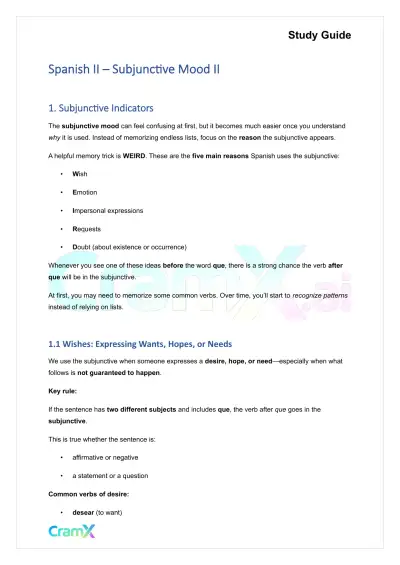 Quick Guides
Spanish II - Subjunctive Mood II
World Languages
9 pagesMar 2026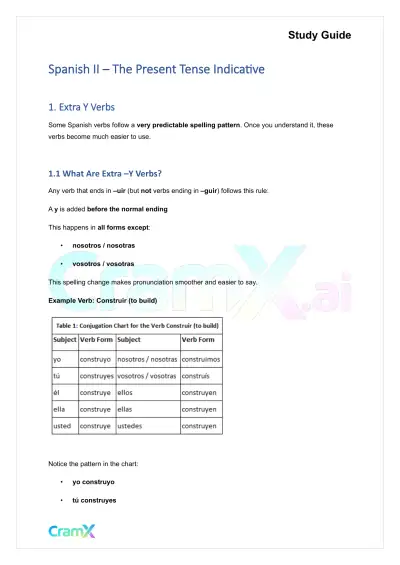 Quick Guides
Spanish II - The Present Tense Indicative
World Languages
27 pagesMar 2026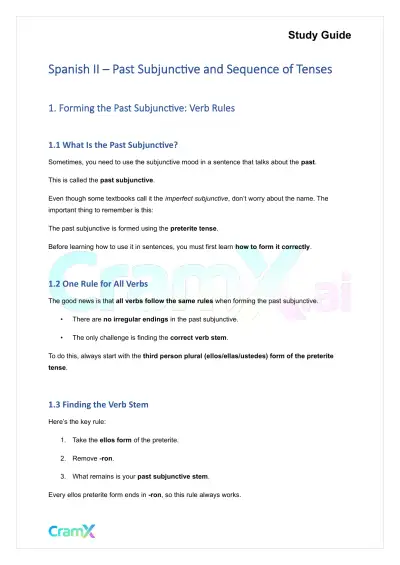 Quick Guides
Spanish II - Past Subjunctive and Sequence of Tenses
World Languages
14 pagesMar 2026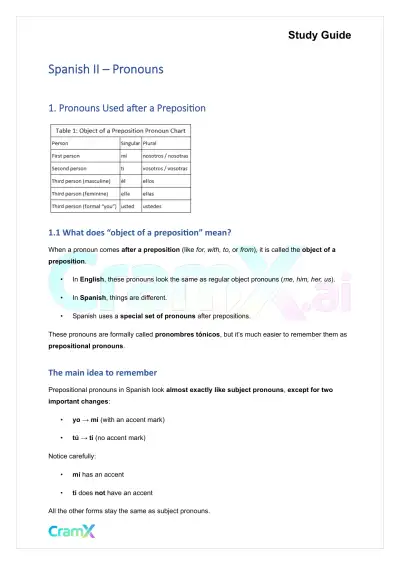 Quick Guides
Spanish II - Pronouns
World Languages
38 pagesMar 2026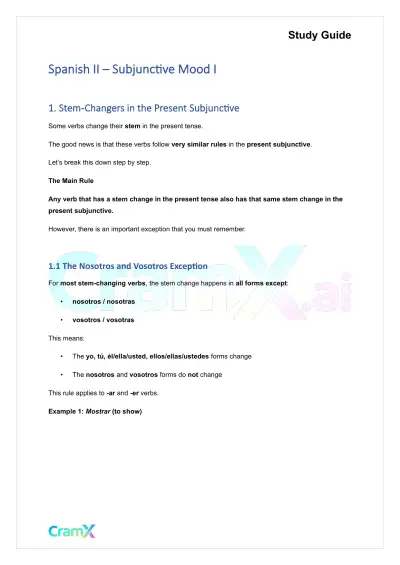 Quick Guides
Spanish II - Subjunctive Mood I
World Languages
29 pagesMar 2026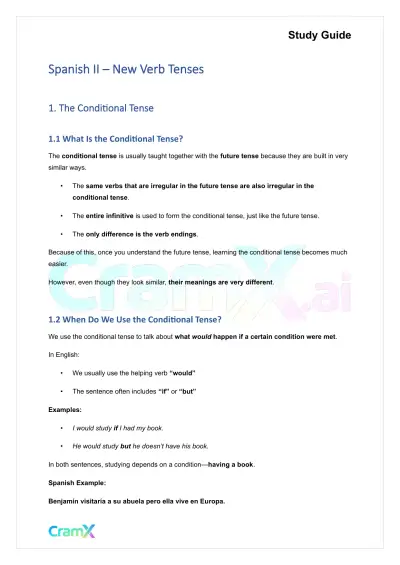 Quick Guides
Spanish II - New Verb Tenses
World Languages
19 pagesMar 2026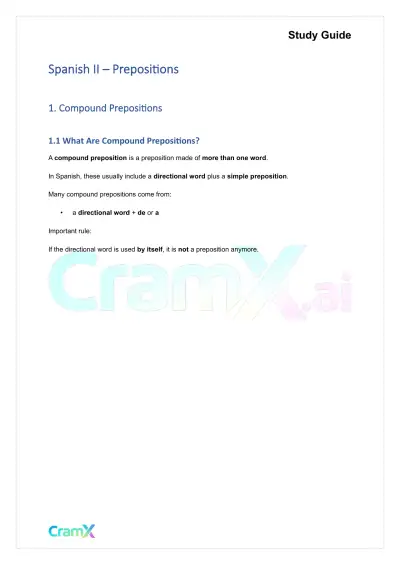 Quick Guides
Spanish II - Prepositions
World Languages
26 pagesMar 2026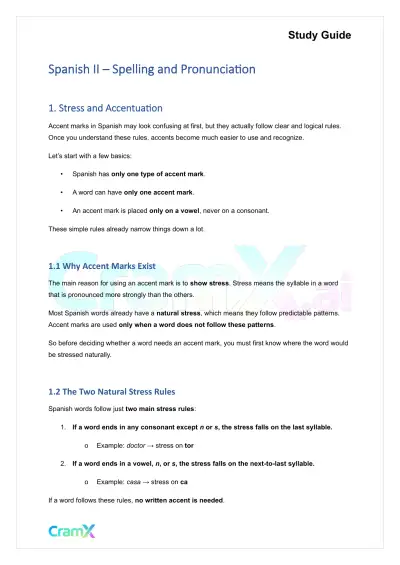 Quick Guides
Spanish II - Spelling and Pronunciation
World Languages
12 pagesMar 2026
Study this document with CramX
Once it is in your library, every tool can work from it.