

Spanish II - The Imperative
- World Languages
- Texas A&M University
- 20 pages
- Shared March 2026
Preview 6 of 20 pages
See the first 6 pages exactly as they appear in the document.
Page 1 Read page 1 as text
Study Guide Spanish II – The Imperative 1. Affirmative Tú Commands Spanish commands can feel tricky at first, especially because not all commands use the subjunctive . Here is the key idea to remember: • The subjunctive mood is used for: o All affirmative and negative commands for Ud., Uds., and nosotros o Only negative commands for tú and vosotros • Affirmative tú commands do NOT use the subjunctive Because affirmative tú commands follow special rules, they deserve extra attention. 1.1 Regular Affirmative Tú Commands Affirmative tú commands are unusual — but once you know the pattern, they are easy to form. The Golden Rule An affirmative tú command looks exactly like the present - tense él/ella form of the verb (indicative mood). • Not the subjunctive • Not the tú form • The él form Because this form can look like a normal statement, Spanish speakers often add tú after the verb for clarity. Example: • Llama cada día. • He calls every day. • Llama tú cada día. • (You) Call every day. The verb form is the same. The meaning changes because of context and the added tú .
Page 2 Read page 2 as text
Study Guide 1.2 How to Form Regular Affirmative Tú Commands 1. Conjugate the verb in the present tense 2. Use the él/ella form 3. Apply any stem change the verb normally has If the verb has a stem change in the present tense, the command keeps that change. Examples: • Produce más comida ahora. • Produce more food now. • Cuenta tú el dinero antes de salir. • Count the money before leaving. • Almuerza durante el descanso. • Eat lunch during the break. The subject pronoun tú may appear, but it is optional. 1.3 Irregular Affirmative Tú Commands Some very common verbs do not follow the él - form rule. These verbs have special command forms that must be memorized.
Page 3 Read page 3 as text
Study Guide 1.4 What You Need to Know About These Verbs • These commands do not look like the present - tense él form • They are extremely common • Memorizing them will save you time and mistakes Examples from the table include commands like: • ten (have) • pon (put) • sal (leave) • ven (come) • haz (do/make) • di (say/tell) • sé (be) • ve (go)
Page 4 Read page 4 as text
Study Guide 1.5 A Common Source of Confusion: sé The command sé (from ser , “to be”) looks exactly like the yo form of saber ( sé , “I know”). The meaning becomes clear when you look at context and pronouns . Examples: • Sé tú médico porque así ganarás mucho dinero. • Be a doctor so you will earn a lot of money. • (affirmative tú command from ser ) • Yo sé que los médicos ganan mucho. • I know that doctors earn a lot. • (present tense yo form of saber ) Using tú or yo helps prevent confusion. 1.6 Negative Tú Commands (Important Reminder) When you tell someone not to do something, the rules change. • Negative tú commands DO use the subjunctive • Affirmative tú commands do NOT Only tú and vosotros have different forms for affirmative and negative commands. For Ud. and Uds. , the same subjunctive form is used for both affirmative and negative commands. Summary If the command is: • Positive + tú → use él form (or memorized irregular) • Negative + tú → use subjunctive
Page 5 Read page 5 as text
Study Guide 2. Command Forms Using the Subjunctive Spanish commands follow clear patterns once you know which forms use the subjunctive and which do not . This section will help you understand how commands work and how spelling and irregularities affect them. 2.1 Which Commands Use the Subjunctive? The present subjunctive is used for: • Affirmative and negative commands for Ud. and Uds. • Negative commands for tú and vosotros The affirmative tú command is the only command form that does NOT use the subjunctive . Helpful mantra to remember: “Form the yo form, drop the - o, add the opposite ending.” This mantra helps you create all subjunctive - based command forms . 2.2 Sample Command Forms (Overview) The table below shows how the same verb looks in different command forms. Notice that: • All Ud., Uds., and negative tú commands use the subjunctive • The affirmative tú command does not
Page 6 Read page 6 as text
Study Guide Reminder All spelling changes and stem changes that appear in the present subjunctive also appear in command forms. • Stem - changing verbs keep the same stem change • Spelling - change verbs keep the same spelling change This applies to all command forms except affirmative tú . 2.3 Commands with - go Verbs Many common verbs end in - go in the yo form (digo, tengo, pongo, etc.). These verbs: • Follow regular subjunctive command rules for Ud., Uds., and negative tú • Have irregular affirmative tú commands
14 more pages in the full document
Unlock it once and it stays in your library, ready to chat with or turn into flashcards.
Unlock the full documentMore World Languages study materials
See all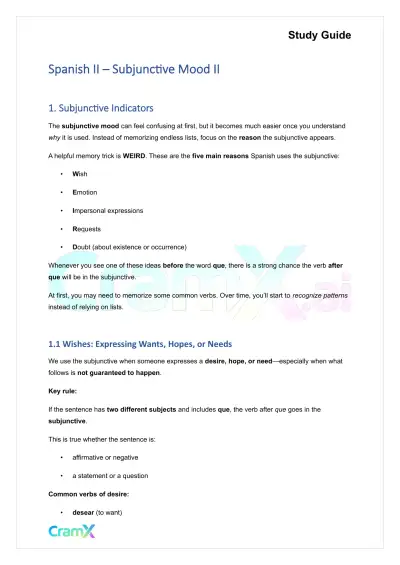 Quick Guides
Spanish II - Subjunctive Mood II
World Languages
9 pagesMar 2026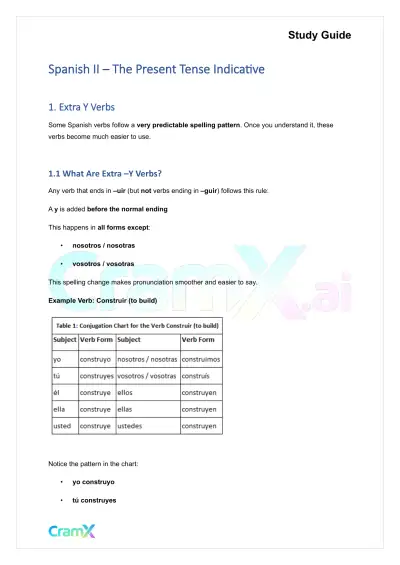 Quick Guides
Spanish II - The Present Tense Indicative
World Languages
27 pagesMar 2026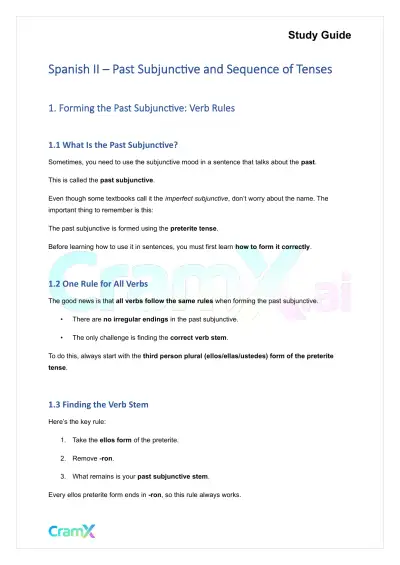 Quick Guides
Spanish II - Past Subjunctive and Sequence of Tenses
World Languages
14 pagesMar 2026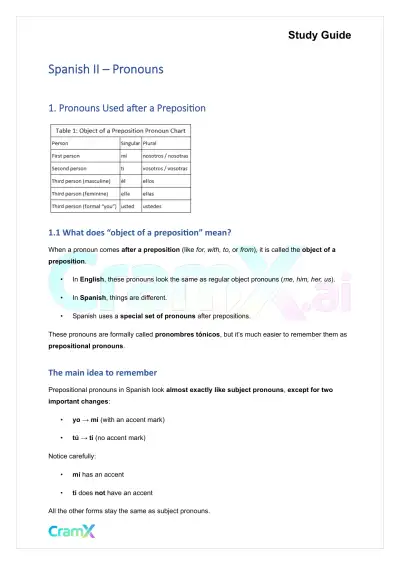 Quick Guides
Spanish II - Pronouns
World Languages
38 pagesMar 2026 Quick Guides
Spanish II - Subjunctive Mood I
World Languages
29 pagesMar 2026 Quick Guides
Spanish II - New Verb Tenses
World Languages
19 pagesMar 2026 Quick Guides
Spanish II - Prepositions
World Languages
26 pagesMar 2026 Quick Guides
Spanish II - Spelling and Pronunciation
World Languages
12 pagesMar 2026
Study this document with CramX
Once it is in your library, every tool can work from it.