

Spanish II - Subjunctive Mood I
- World Languages
- Texas A&M University
- 29 pages
- Shared March 2026
Preview 9 of 29 pages
See the first 9 pages exactly as they appear in the document.
Page 1 Read page 1 as text
Study Guide Spanish II – Subjunctive Mood I 1. Stem ‐ Changers in the Present Subjunctive Some verbs change their stem in the present tense. The good news is that these verbs follow very similar rules in the present subjunctive . Let’s break this down step by step. The Main Rule Any verb that has a stem change in the present tense also has that same stem change in the present subjunctive. However, there is an important exception that you must remember. 1.1 The Nosotros and Vosotros Exception For most stem - changing verbs , the stem change happens in all forms except : • nosotros / nosotras • vosotros / vosotras This means: • The yo, tú, él/ella/usted, ellos/ellas/ustedes forms change • The nosotros and vosotros forms do not change This rule applies to - ar and - er verbs. Example 1: Mostrar (to show)
Page 2 Read page 2 as text
Study Guide (Table 1: Subjunctive Present Tense for Mostrar ) Notice: • muestre, muestres, muestre, muestren → stem change o → ue • mostremos, mostréis → no stem change Example 2: Entender (to understand) Notice: • entienda, entiendas, entiendan → stem change e → ie • entendamos, entendáis → no stem change
Page 3 Read page 3 as text
Study Guide 1.2 Special Rule for - IR Verbs Only - ir verbs behave differently. - ir verbs DO have stem changes in the nosotros and vosotros forms , but the change is different from the others. For these forms only: • o → u • e → i Example 3: Dormir (to sleep) (Table 3: Subjunctive Present Tense for Dormir ) Notice: • duerma, duermas, duerman → o → ue • durmamos, durmáis → o → u This happens only because dormir is an - ir verb .
Page 4 Read page 4 as text
Study Guide 1.3 A Special Case: Jugar The verb jugar (to play) is especially important. It is tricky because: • It is a stem - changing verb • It also has a spelling change ( g → gu ) to keep the correct sound Because jugar is very common, it is worth memorizing. Example 4: Jugar (to play) (Table 4: Subjunctive Present Tense for Jugar ) Notice: • juegue, juegues, jueguen → u → ue • juguemos, juguéis → spelling change + no stem change Summary • Stem - changing verbs keep the same stem change in the present subjunctive • Nosotros and vosotros usually do not change • Only - ir verbs change in nosotros and vosotros: o o → u o e → i • Dormir shows this special - ir pattern • Jugar is both a stem - changer and a spelling - changer
Page 5 Read page 5 as text
Study Guide 2. Present Subjunctive: Truly Irregular Verbs Some verbs in Spanish are called truly irregular in the present subjunctive . These verbs do not follow the normal pattern for forming the subjunctive. Why Are These Verbs Irregular? Most verbs form the present subjunctive by: 1. Taking the yo form of the present tense 2. Dropping the - o 3. Adding subjunctive endings However, some verbs do not end in - o in the present tense . Because of this, you cannot use the normal rule with them. These verbs must be memorized , because their subjunctive forms are unique. There are five truly irregular verbs in the present subjunctive: • dar (to give) • estar (to be) • ir (to go) • saber (to know) • ser (to be) Each one is shown in the tables below.
Page 6 Read page 6 as text
Study Guide 2.1 Dar (to give) Important notes: • Forms like dé, des, den have an accent mark • The accent helps distinguish dé (the verb) from de (the preposition) • The vosotros/vosotras form ( deis ) does not have an accent because it is only one syllable 2.2 Estar (to be) (Table 2: Subjunctive Present Tense for Estar )
Page 7 Read page 7 as text
Study Guide Important notes: • Most forms of estar in the subjunctive have an accent • The nosotros/nosotras form ( estemos ) does not have an accent • This follows the general rules of Spanish accentuation 2.3 Ir (to go) Key idea: • All forms are based on vaya • These forms are completely irregular and must be memorized
Page 8 Read page 8 as text
Study Guide 2.4 Saber (to know) Key idea: • All forms come from sepa • The endings follow the subjunctive pattern, but the stem is irregular 2.5 Ser (to be) (Table 5: Subjunctive Present Tense for Ser ) Key idea: • Forms are based on sea • Like the others, these forms do not follow normal subjunctive rules
Page 9 Read page 9 as text
Study Guide Important Reminders • Dar has accents to avoid confusion with the preposition de • Estar has accents on all forms except nosotros/nosotras • Accent placement follows Spanish stress rules , not randomness Summary • Truly irregular verbs do not follow normal subjunctive rules • They do not come from dropping the - o of the yo form • The five verbs to memorize are: o dar o estar o ir o saber o ser • Accent marks are meaningful and important 3. The Present Subjunctive The first step to using the present subjunctive is learning how to form the verb correctly . The good news is that this tense is based on the present tense you already know . If you are comfortable with present - tense verbs — especially the yo form — the present subjunctive will feel much easier.
20 more pages in the full document
Unlock it once and it stays in your library, ready to chat with or turn into flashcards.
Unlock the full documentMore World Languages study materials
See all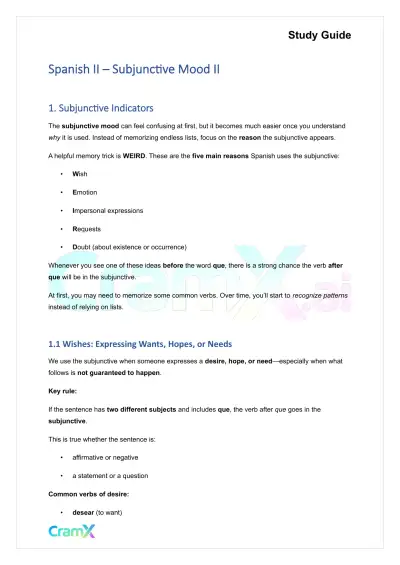 Quick Guides
Spanish II - Subjunctive Mood II
World Languages
9 pagesMar 2026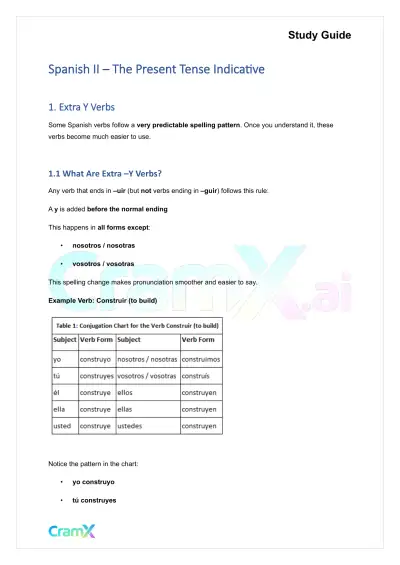 Quick Guides
Spanish II - The Present Tense Indicative
World Languages
27 pagesMar 2026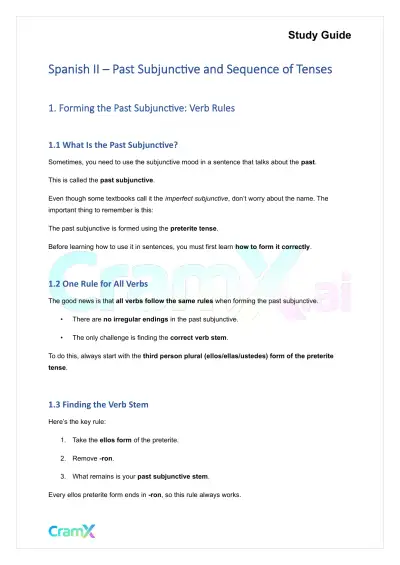 Quick Guides
Spanish II - Past Subjunctive and Sequence of Tenses
World Languages
14 pagesMar 2026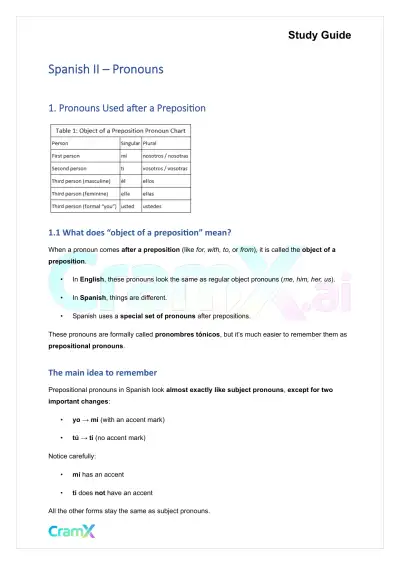 Quick Guides
Spanish II - Pronouns
World Languages
38 pagesMar 2026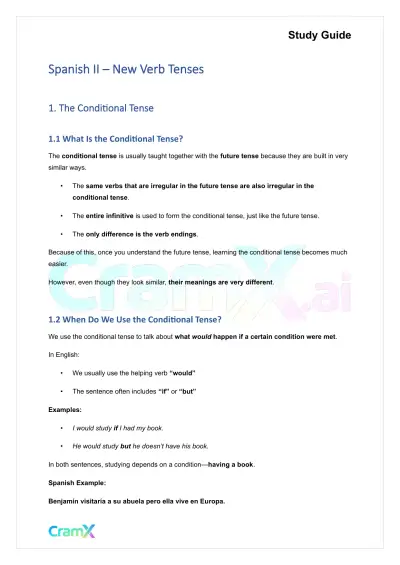 Quick Guides
Spanish II - New Verb Tenses
World Languages
19 pagesMar 2026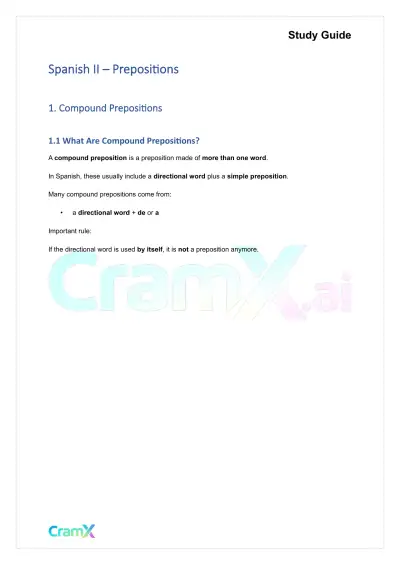 Quick Guides
Spanish II - Prepositions
World Languages
26 pagesMar 2026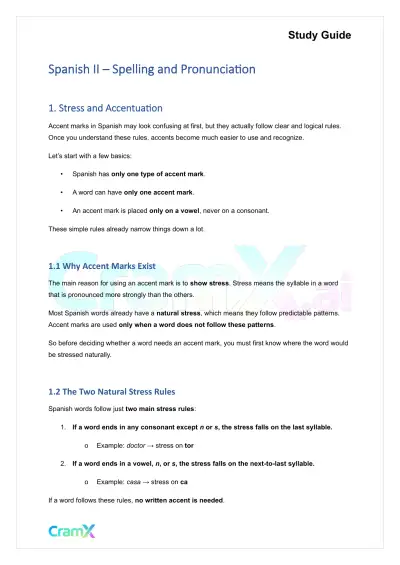 Quick Guides
Spanish II - Spelling and Pronunciation
World Languages
12 pagesMar 2026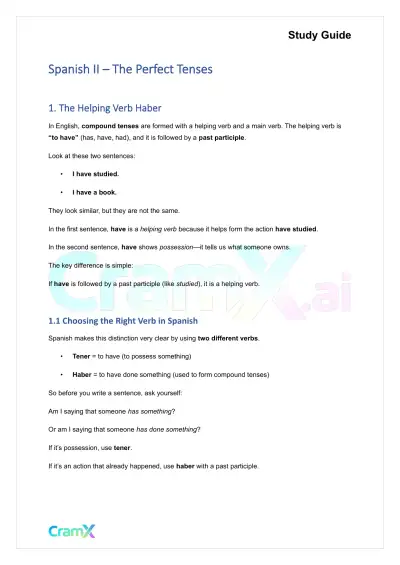 Quick Guides
Spanish II - The Perfect Tenses
World Languages
15 pagesMar 2026
Study this document with CramX
Once it is in your library, every tool can work from it.