

Spanish II - Spelling and Pronunciation
- World Languages
- Texas A&M University
- 12 pages
- Shared March 2026
Preview 4 of 12 pages
See the first 4 pages exactly as they appear in the document.
Page 1 Read page 1 as text
Study Guide Spanish II – Spelling and Pronunciation 1. Stress and Accentuation Accent marks in Spanish may look confusing at first, but they actually follow clear and logical rules. Once you understand these rules, accents become much easier to use and recognize. Let’s start with a few basics: • Spanish has only one type of accent mark . • A word can have only one accent mark . • An accent mark is placed only on a vowel , never on a consonant. These simple rules already narrow things down a lot. 1.1 Why Accent Marks Exist The main reason for using an accent mark is to show stress . Stress means the syllable in a word that is pronounced more strongly than the others. Most Spanish words already have a natural stress , which means they follow predictable patterns. Accent marks are used only when a word does not follow these patterns . So before deciding whether a word needs an accent mark, you must first know where the word would be stressed naturally. 1.2 The Two Natural Stress Rules Spanish words follow just two main stress rules : 1. If a word ends in any consonant except n or s , the stress falls on the last syllable. o Example: doctor → stress on tor 2. If a word ends in a vowel, n , or s , the stress falls on the next - to - last syllable. o Example: casa → stress on ca If a word follows these rules, no written accent is needed .
Page 2 Read page 2 as text
Study Guide 1.3 When an Accent Mark Is Required If a word is meant to be stressed on a different syllable than the rules predict, a written accent mark shows exactly where the stress belongs. This is why accent marks are so helpful — they tell you how a word should be pronounced, even if you have never seen it before. 1.4 A Common Pattern: Words Ending in - ción Many Spanish words are similar to English words ending in - tion , such as nation , liberation , and condition . In Spanish, these words usually end in - ción : • nación • liberación • condición According to the rules, a word ending in n should be stressed on the next - to - last syllable. However, these words are pronounced with stress on the last syllable , not the one the rule predicts. To show this change, an accent mark is placed on the o in - ción . 1.5 What Happens When a Word Becomes Plural Accent marks can change or disappear when a word changes form. For example: • nación → naciones When - es is added to make the word plural, the word now ends in s . This means the natural stress automatically falls on the next - to - last syllable , which is already the o . Because the stress now follows the normal rule, the accent mark is no longer needed , so it is removed.
Page 3 Read page 3 as text
Study Guide 1.6 Diphthongs and Vowel Strength Understanding vowels is especially important when deciding whether an accent mark is needed. Spanish vowels are grouped into: • Strong vowels : a, e, o • Weak vowels : i, u When one strong vowel and one weak vowel appear together, they usually form one syllable . This combination is called a diphthong . 1.7 How Accent Marks Can Break a Diphthong Take the word iglesia as an example. It ends in a vowel, so the stress naturally falls on the next - to - last syllable. Because the vowels form a diphthong, the word does not need an accent mark. However, sometimes an accent mark is added to a weak vowel, such as in - ía . When this happens, the weak vowel is pronounced more strongly. This breaks the diphthong and creates two syllables instead of one . The accent mark shows both pronunciation and stress in these cases. 1.8 How These Rules Help You Knowing these rules helps you in two important ways: • You can decide whether a word you hear needs a written accent when spelling it. • You can pronounce written words correctly by stressing the right syllable. Accent marks are not random — they are pronunciation guides. 1.9 Accent Marks That Change Meaning Sometimes, accent marks have nothing to do with stress . Instead, they are used to tell two identical - looking words apart . For example: • sí = yes • si = if Even though these words sound similar, the accent mark shows a difference in meaning. When speaking, the context of the sentence helps listeners understand which word is intended.
Page 4 Read page 4 as text
Study Guide Summary Accent marks may seem tricky at first, but they follow consistent rules. With practice, you’ll start to recognize patterns and feel more confident using them. Once you understand why accents are used, they become a helpful tool instead of something to memorize blindly. 2. Consonants Most Spanish consonants sound very similar to English consonants. This is good news for learners. However, Spanish spelling and pronunciation follow a few important rules that can help you avoid common mistakes. Let’s go step by step. 2.1 Double Consonants: Less Common Than in English In English, double consonants like bb , nn , ss , and ff appear often. Spanish, however, rarely uses double consonants of the same letter . There are a few important exceptions: • ll • rr • cc • nn Examples include: • diccionario • carro • connotación • llave Aside from these cases, Spanish usually sticks to single consonants , which actually makes spelling easier.
8 more pages in the full document
Unlock it once and it stays in your library, ready to chat with or turn into flashcards.
Unlock the full documentMore World Languages study materials
See all Quick Guides
Spanish II - Subjunctive Mood II
World Languages
9 pagesMar 2026 Quick Guides
Spanish II - The Present Tense Indicative
World Languages
27 pagesMar 2026 Quick Guides
Spanish II - Past Subjunctive and Sequence of Tenses
World Languages
14 pagesMar 2026 Quick Guides
Spanish II - Pronouns
World Languages
38 pagesMar 2026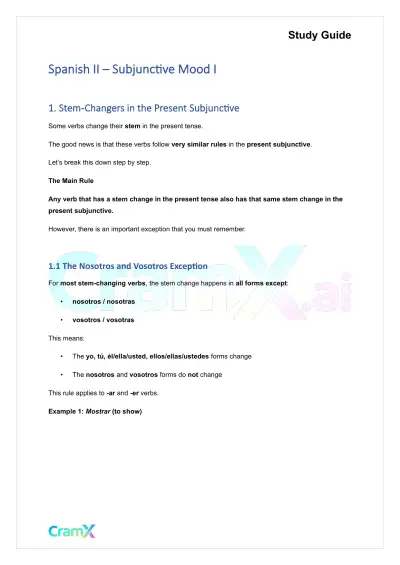 Quick Guides
Spanish II - Subjunctive Mood I
World Languages
29 pagesMar 2026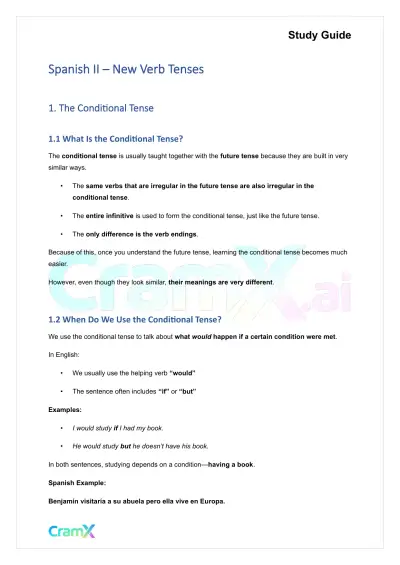 Quick Guides
Spanish II - New Verb Tenses
World Languages
19 pagesMar 2026 Quick Guides
Spanish II - Prepositions
World Languages
26 pagesMar 2026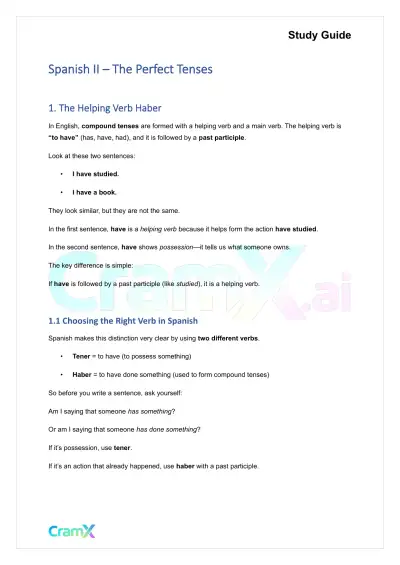 Quick Guides
Spanish II - The Perfect Tenses
World Languages
15 pagesMar 2026
Study this document with CramX
Once it is in your library, every tool can work from it.