

Spanish II - Pronouns
- World Languages
- Texas A&M University
- 38 pages
- Shared March 2026
Preview 10 of 38 pages
See the first 10 pages exactly as they appear in the document.
Page 1 Read page 1 as text
Study Guide Spanish II – Pronouns 1. Pronouns Used after a Preposition 1.1 What does “object of a preposition” mean? When a pronoun comes after a preposition (like for, with, to, or from ), it is called the object of a preposition . • In English , these pronouns look the same as regular object pronouns ( me, him, her, us ). • In Spanish , things are different. • Spanish uses a special set of pronouns after prepositions. These pronouns are formally called pronombres tónicos , but it’s much easier to remember them as prepositional pronouns . The main idea to remember Prepositional pronouns in Spanish look almost exactly like subject pronouns , except for two important changes : • yo → mí (with an accent mark) • tú → ti (no accent mark) Notice carefully: • mí has an accent • ti does not have an accent All the other forms stay the same as subject pronouns.
Page 2 Read page 2 as text
Study Guide 1.2 Why this may feel confusing at first For English speakers, these pronouns can sound unusual because: • In English , pronouns after prepositions sound like object pronouns ( me, him, her ). • In Spanish , pronouns after prepositions sound like subject pronouns (except mí and ti ). This is normal — don’t worry! With practice, it becomes natural. Examples in Spanish and English La clase de álgebra es mejor para ella. The algebra class is best for her. Quiero viajar con ellos porque ellos conocen bien la nación. I want to travel with them because they know the nation well. Elena nos invita a nosotros porque somos buenos amigos. She invites us because we are good friends. Notice how the pronouns ella, ellos, nosotros are used after prepositions like para, con, and a . 1.3 Special case: con + mí / ti When the preposition con ( with ) is followed by mí or ti , the words combine into one word . • con + mí → conmigo ( with me ) • con + ti → contigo ( with you ) Important detail: • The accent mark on mí disappears when it becomes conmigo . You must use these combined forms — never con mí or con ti . Examples with conmigo and contigo Alejandro debe explorar conmigo porque yo conozco todas las cuevas de Guadix. Alejandro should explore with me because I know all the caves of Guadix. Memo no quiere bailar contigo. Él desea bailar conmigo. Memo doesn’t want to dance with you. He wants to dance with me.
Page 3 Read page 3 as text
Study Guide Summary • Pronouns after prepositions in Spanish are prepositional pronouns . • They look like subject pronouns , except: o yo → mí o tú → ti • mí has an accent; ti does not. • con + mí = conmigo • con + ti = contigo With these rules in mind, you’ll feel much more confident using pronouns after prepositions in Spanish! 2. Demonstrative Pronouns 2.1 What are demonstratives? Demonstratives are words like this, that, these, and those . They help show how close or far something is from the speaker. There are two types in Spanish: 1. Demonstrative adjectives – describe a noun 2. Demonstrative pronouns – replace a noun 2.2 Demonstrative adjectives vs. demonstrative pronouns A demonstrative adjective is placed before a noun . • ese cuchillo → that knife A demonstrative pronoun replaces the noun when it is already understood. • ese → that (one) If the noun is not stated , you must use a demonstrative pronoun , not an adjective.
Page 4 Read page 4 as text
Study Guide 2.3 Important spelling detail Demonstrative pronouns look almost exactly the same as demonstrative adjectives. The only difference is in writing , not pronunciation. • Demonstrative pronouns have accent marks • Demonstrative adjectives do not This means: • You can’t hear the difference • You must see the accent to know the function Example Do you need that knife? No, I can use this (one). • ¿Necesitas ese cuchillo? • No, puedo usar éste. Éste replaces ese cuchillo , so it needs an accent mark . 2.4 Demonstrative Pronouns (Table 1) Key idea from Table 1 • These pronouns agree in gender and number • They match the noun they replace: o masculine / feminine o singular / plural • Every form in this table has an accent mark
Page 5 Read page 5 as text
Study Guide 2.5 Neutral demonstrative pronouns Sometimes, a demonstrative does not replace a specific noun. Instead, it refers to: • an idea • a situation • a concept • 강조 In these cases, Spanish uses neutral demonstrative pronouns . 2.6 Neutral Demonstrative Pronouns (Table 2) 2.7 Why these are different • They do not replace a noun • They have no gender • There is only one form • They are the only demonstrative pronouns without accent marks Examples with neutral demonstratives La venganza; eso es el problema. Revenge; that is the problem. Eso es su motivación. That is her motivation.
Page 6 Read page 6 as text
Study Guide S ummary • Demonstrative pronouns replace nouns • They are used when the noun is understood but not stated • Most demonstrative pronouns have accent marks • Neutral demonstratives : o refer to ideas or situations o have no gender o do not have accent marks With these rules, you’ll be able to choose the correct demonstrative pronoun with confidence! 3. Possessive Pronouns 3.1 What are possessive pronouns? Possessive pronouns are used to show ownership when the noun is not stated because it is already understood. In English, we do this too: • my book → the book is mine • your pictures → the pictures are yours Spanish works in a similar way, but the grammar rules are very important. 3.2 Possessive adjectives vs. possessive pronouns Spanish possessive adjectives come in two forms : • Short form – used to describe a noun o mi libro (my book) • Long form – used with a definite article to make a possessive pronoun When the noun is replaced , not described, you must use a possessive pronoun .
Page 7 Read page 7 as text
Study Guide 3.3 How possessive pronouns are formed (Table 1) Key idea A possessive pronoun is formed by: • the definite article ( el, la, los, las ) • plus the long form of the possessive adjective When the noun is not stated, the long form becomes the pronoun . 3.4 Gender and number rules (very important!) Possessive pronouns do NOT agree with the owner. They agree with the noun being owned , even if that noun is not said. Ask yourself: • Is the noun masculine or feminine ? • Is it singular or plural ? That decides the form of the possessive pronoun.
Page 8 Read page 8 as text
Study Guide 3.5 Possessive pronoun forms (Table 2) 3.6 How the chart is organized • The order matches the subject pronouns of the owner: o yo → el mío / la mía / los míos / las mías • The number (singular or plural) matches the thing owned , not the owner. • It does not matter how many people own the noun . Example: • el suyo only becomes plural if the noun is plural , not because multiple people own it. 3.7 Using possessive pronouns with ser and estar A very common use of possessive pronouns is after linking verbs like ser or estar . In English, possession changes form: • my book → the book is mine Spanish works the same way. Examples el libro mío (my book) El libro es mío. The book is mine.
Page 9 Read page 9 as text
Study Guide las fotografías bonitas tuyas (your pretty pictures) Las fotografías bonitas son tuyas. The pretty pictures are yours. la casa nuestra (our house) La casa es nuestra. The house is ours. las niñas suyas (his / her / their / your [formal] girls) Las niñas son suyas. The girls are his / hers / theirs / yours. S ummary • Possessive pronouns replace nouns • They are formed using: o a definite article o the long form of a possessive adjective • They agree with the noun being owned , not the owner • They are often used after ser or estar Once you focus on the noun being owned , possessive pronouns become much easier to use! 4. Pronoun Placement In Spanish, where you place pronouns matters . At first, it can feel confusing — but once you learn a few clear rules, it becomes much easier. Let’s break it down step by step. 4. 1 Types of Object Pronouns and Their Order There are three kinds of object pronouns you’ll work with most often: • Reflexive pronouns (myself, yourself, etc.)
Page 10 Read page 10 as text
Study Guide • Indirect object pronouns (to/for someone) • Direct object pronouns (the thing being acted on) When more than one pronoun appears in the same sentence, they must follow a specific order : RID = Reflexive → Indirect → Direct Think of RID as your memory trick: • R = Reflexive • I = Indirect • D = Direct You might use: • a reflexive + direct object • an indirect + direct object It’s rare to use all three together, but the order never changes. 4. 2 Special Rule: Two Pronouns Starting with “L” If both object pronouns start with the letter “l” (like le and lo ), the first one changes to se . Important: This se is not reflexive , even though it looks like one. 4. 3 Where Pronouns Go with One Verb Every sentence needs at least one verb . If there is only one conjugated verb , the RID pronouns go directly in front of that verb (unless it’s a command). Examples: • La señora Gómez enseña las lecciones. • (Mrs. Gomez teaches the lessons.) • La señora Gómez las enseña.
28 more pages in the full document
Unlock it once and it stays in your library, ready to chat with or turn into flashcards.
Unlock the full documentMore World Languages study materials
See all Quick Guides
Spanish II - Subjunctive Mood II
World Languages
9 pagesMar 2026 Quick Guides
Spanish II - The Present Tense Indicative
World Languages
27 pagesMar 2026 Quick Guides
Spanish II - Past Subjunctive and Sequence of Tenses
World Languages
14 pagesMar 2026 Quick Guides
Spanish II - Subjunctive Mood I
World Languages
29 pagesMar 2026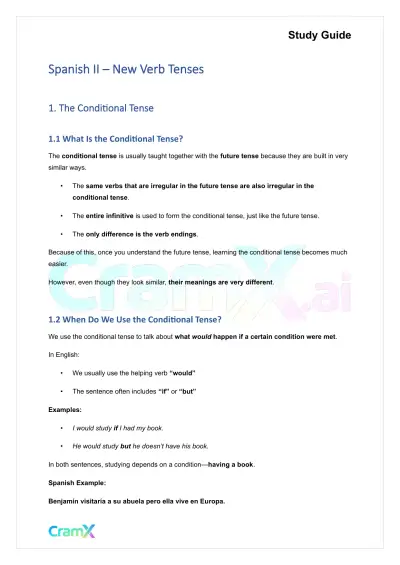 Quick Guides
Spanish II - New Verb Tenses
World Languages
19 pagesMar 2026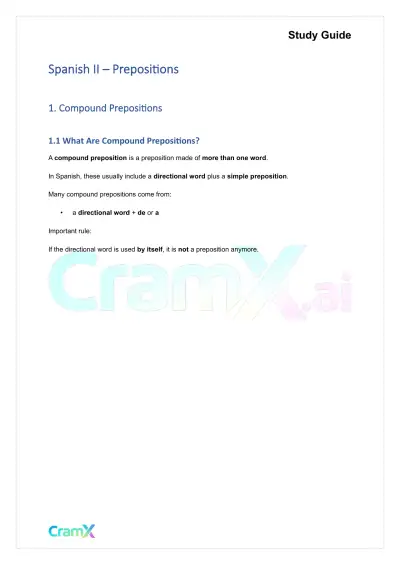 Quick Guides
Spanish II - Prepositions
World Languages
26 pagesMar 2026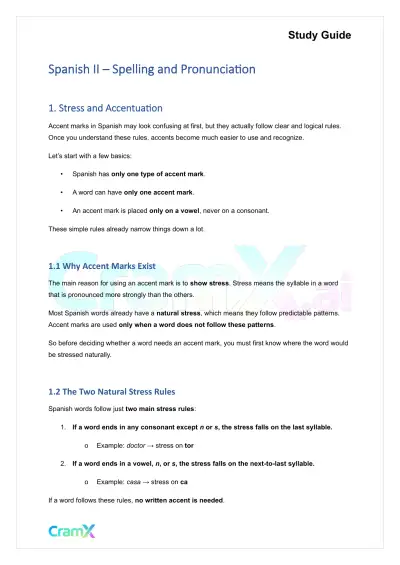 Quick Guides
Spanish II - Spelling and Pronunciation
World Languages
12 pagesMar 2026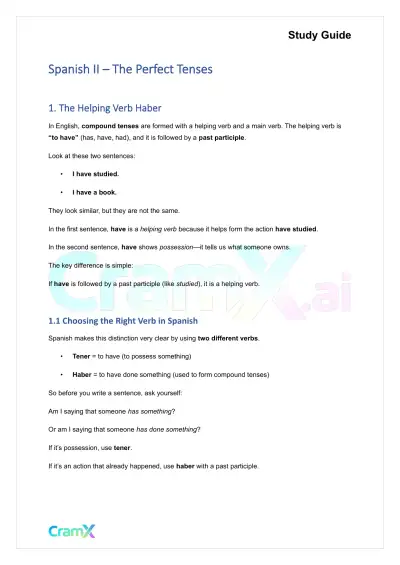 Quick Guides
Spanish II - The Perfect Tenses
World Languages
15 pagesMar 2026
Study this document with CramX
Once it is in your library, every tool can work from it.