

Spanish II - Subjunctive Mood II
- World Languages
- Texas A&M University
- 9 pages
- Shared March 2026
Preview 3 of 9 pages
See the first 3 pages exactly as they appear in the document.
Page 1 Read page 1 as text
Study Guide Spanish II – Subjunctive Mood II 1. Subjunctive Indicators The subjunctive mood can feel confusing at first, but it becomes much easier once you understand why it is used. Instead of memorizing endless lists, focus on the reason the subjunctive appears. A helpful memory trick is WEIRD . These are the five main reasons Spanish uses the subjunctive: • W ish • E motion • I mpersonal expressions • R equests • D oubt (about existence or occurrence) Whenever you see one of these ideas before the word que , there is a strong chance the verb after que will be in the subjunctive. At first, you may need to memorize some common verbs. Over time, you’ll start to recognize patterns instead of relying on lists. 1. 1 Wishes: Expressing Wants, Hopes, or Needs We use the subjunctive when someone expresses a desire, hope, or need — especially when what follows is not guaranteed to happen . Key rule: If the sentence has two different subjects and includes que , the verb after que goes in the subjunctive . This is true whether the sentence is: • affirmative or negative • a statement or a question Common verbs of desire: • desear (to want)
Page 2 Read page 2 as text
Study Guide • esperar (to hope) • necesitar (to need) • querer (to want) Examples: • Él no desea que yo lo llame . • Mi perro espera que demos un paseo. • Necesitamos que tú nos presentes a tus padres. • Carlos no quiere que su hija toque el tambor. When NOT to use the subjunctive (same subject) If one person does both actions, Spanish uses the infinitive , not que . Examples: • Yo quiero bailar. • Él desea comprar una computadora nueva. • Esperamos ganar muchos partidos. Tip: Ask yourself: Who does each action? If it’s the same person → infinitive If it’s different → que + subjunctive Special Expression: Ojalá Ojalá means “hopefully” or “if only.” It always uses the subjunctive , even without que . Examples: • Ojalá que traigas las direcciones. • Ojalá veamos a su novio esta noche. • Ojalá que no pierda su pasaporte.
Page 3 Read page 3 as text
Study Guide 1. 2 Emotion: Reacting to What Happens When someone expresses an emotional reaction to an action, Spanish uses the subjunctive after que . Many emotion expressions work like gustar : • The sentence is impersonal • The verb stays in the él form • An indirect object shows who feels the emotion Common emotion expressions: • le gusta que • le molesta que • le sorprende que • le enfada / enoja que • le entristece que Examples: • Nos encanta que ustedes nos visiten . • No me gusta que tú siempre olvides mi cumpleaños. • Le entristece que los pobres vivan en las calles. Negatives still use the subjunctive. Emotion verbs that ARE conjugated Some emotion verbs agree with the subject and may be reflexive. Examples: • Me alegro de que Raquel utilice el idioma extranjero. • Toni lamenta que yo no esquíe cada día. • ¿Temes que tu hijo crea en monstruos?
6 more pages in the full document
Unlock it once and it stays in your library, ready to chat with or turn into flashcards.
Unlock the full documentMore World Languages study materials
See all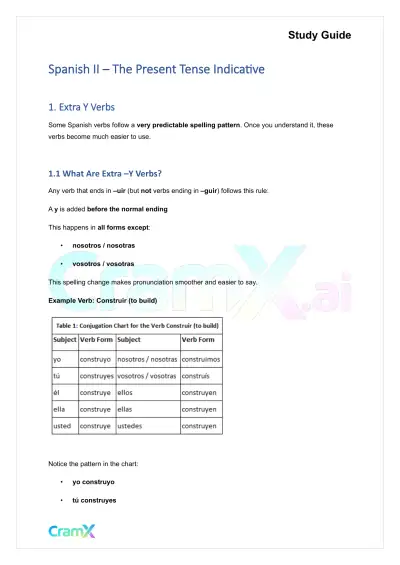 Quick Guides
Spanish II - The Present Tense Indicative
World Languages
27 pagesMar 2026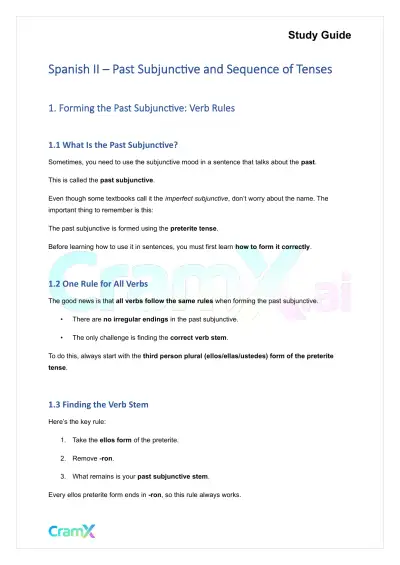 Quick Guides
Spanish II - Past Subjunctive and Sequence of Tenses
World Languages
14 pagesMar 2026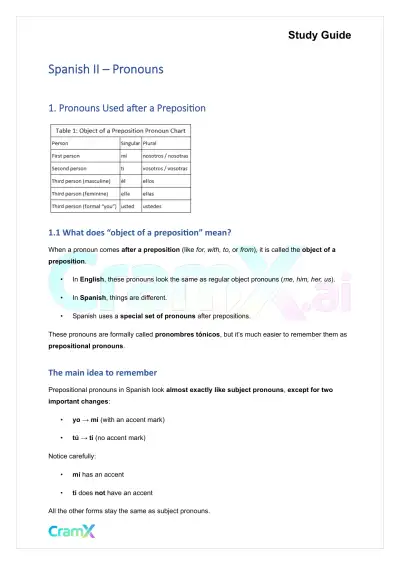 Quick Guides
Spanish II - Pronouns
World Languages
38 pagesMar 2026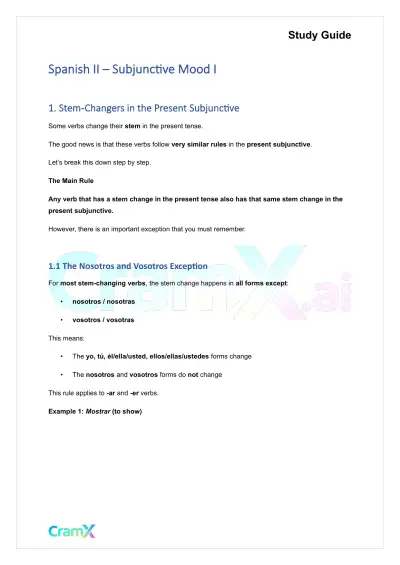 Quick Guides
Spanish II - Subjunctive Mood I
World Languages
29 pagesMar 2026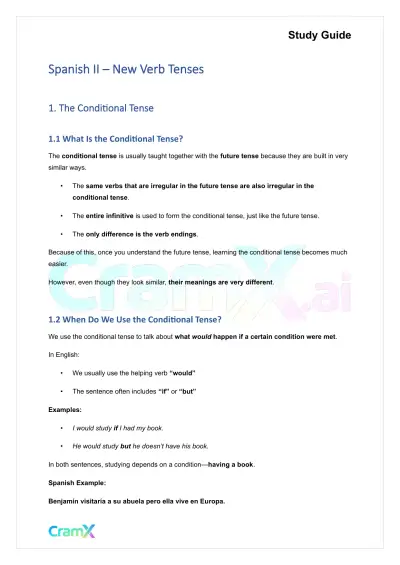 Quick Guides
Spanish II - New Verb Tenses
World Languages
19 pagesMar 2026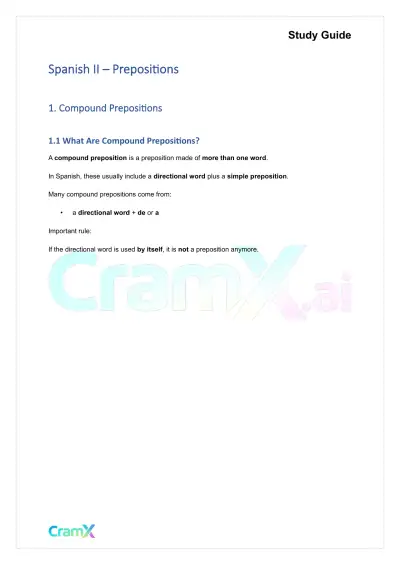 Quick Guides
Spanish II - Prepositions
World Languages
26 pagesMar 2026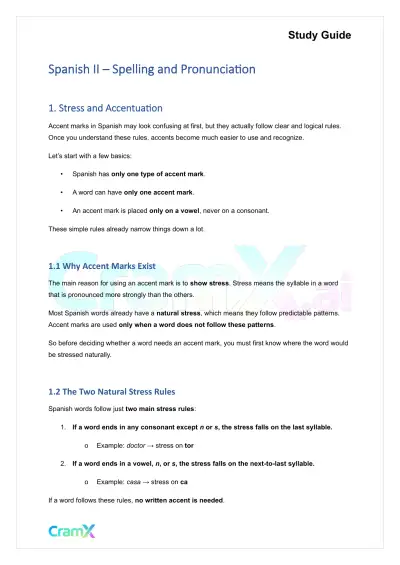 Quick Guides
Spanish II - Spelling and Pronunciation
World Languages
12 pagesMar 2026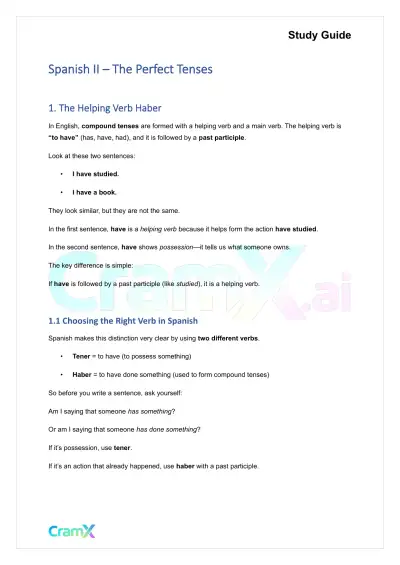 Quick Guides
Spanish II - The Perfect Tenses
World Languages
15 pagesMar 2026
Study this document with CramX
Once it is in your library, every tool can work from it.