

Spanish II - Sentence and Question Structure
- World Languages
- Texas A&M University
- 17 pages
- Shared March 2026
Preview 6 of 17 pages
See the first 6 pages exactly as they appear in the document.
Page 1 Read page 1 as text
Study Guide Spanish II – Sentence and Question Structure 1. Interrogative Pronouns (Question Words) Big grammar terms like interrogative pronouns can sound intimidating, but don’t worry — they are simply question words . A question word is a pronoun because it stands in for the noun that would answer the question. For example, in the question Who is coming? , the word who replaces the name of the person. 1.1 Accent Marks on Question Words One very important detail: all Spanish question words have accent marks . A helpful learning trick is to: • Say the word out loud • Clap on the syllable with the accent This helps you: • Stress the correct syllable • Remember that the word needs an accent mark when written 1.2 Common Spanish Question Words Here are the most important question words you’ll use in Spanish: • ¿Quién? – who • ¿Quiénes? – who (plural, when you expect more than one person) • ¿Qué? – what • ¿Cuál? – which, what • ¿Cuáles? – which ones, what (used with plural nouns) • ¿Cómo? – how • ¿Dónde? – where • ¿Cuándo? – when
Page 2 Read page 2 as text
Study Guide Quantity Question Words These change depending on gender and number: • ¿Cuánto? – how much (masculine, singular) • ¿Cuánta? – how much (feminine, singular) • ¿Cuántos? – how many (masculine, plural) • ¿Cuántas? – how many (feminine, plural) “Why” Questions Spanish has two different ways to say “why” : • ¿Por qué? – why (because of what / reason) • ¿Para qué? – why (for what purpose) 1.3 The Three Spanish Ways to Say “What” English uses one word — what — but Spanish uses three different words depending on the situation. These words are not interchangeable , but the rules are simple once you understand them. “What” Rule 1: Qué + Noun Always use qué directly in front of a noun . Examples: • ¿Qué coche condujiste tú? • What car did you drive? • ¿Qué programas prefieren ellos? • What programs do they prefer? If “what” is immediately followed by a noun, qué is the correct choice .
Page 3 Read page 3 as text
Study Guide “What” Rule 2: Qué vs. Cuál with “Ser” This rule applies when “what” appears before a form of the verb ser (to be) . Use qué for definitions or explanations Ask yourself: Am I asking “What does it mean?” or “What is it in general?” Example: • ¿Qué es dirección? • What is “address”? • (You are asking for an explanation or definition.) Possible answer: • La dirección es el número, la calle, la ciudad, el estado y el código postal. • (An explanation of what an address is.) 1.4 Use cuál for specific answers Ask yourself: Am I asking for one specific thing? Example: • ¿Cuál es tu dirección? • What is your address? • (You want the actual address, not a definition.) Possible answer: • 322 4th St., Carrollton, OH 44615. 1.5 A Clear Comparison Example These two questions look similar, but they ask for very different answers . Question 1: • ¿Qué es la fecha? • What is the date?
Page 4 Read page 4 as text
Study Guide Answer: • La fecha es el día, mes y año. • (A definition.) Question 2: • ¿Cuál es la fecha? • What is the date? Answer: • La fecha es el 5 de junio del 2002. • (A specific date.) The difference is not the translation — it’s what kind of answer the question expects . “What” Rule 3: Cómo Does NOT Mean “What” In English, if you don’t hear something, you say: • “What?” In Spanish, the correct response is: • ¿Cómo? This means “How?” but is used to ask someone to repeat what they said. Important: • Cómo can only mean “What?” in this situation • It should not be used to mean “what” in general questions Summary When choosing a Spanish question word, always think about: • What kind of answer you expect • Whether you want a definition , a specific answer , or a repetition Once you focus on meaning instead of translation, question words become much easier — and much more accurate — to use.
Page 5 Read page 5 as text
Study Guide 2. Creating and Answering Questions Yes or No Questions: The Easiest to Form In English, we need a helping verb like do , does , or did to ask yes - or - no questions. Example: • Erin dates Mario. • Does Erin date Mario? Notice what happens: • The helping verb does is added. • The verb form changes. Spanish works differently. Spanish does NOT use helping verbs to form questions. Instead, Spanish simply switches the subject and the verb . 2.1 How to Turn an English Question into Spanish (3 Simple Steps) Whenever you see do or does in an English question, follow this process: Step 1: Remove “do” or “does” • Do I need this job? • → I need this job. Step 2: Translate the sentence into Spanish • Yo necesito este trabajo. Step 3: Switch the verb and the subject, and add question marks • ¿Necesito yo este trabajo? That’s it. No helping verb. No extra word.
Page 6 Read page 6 as text
Study Guide 2.2 Questions with Question Words Now let’s move beyond yes - or - no questions. When a Spanish question starts with a question word (like how , where , or when ), you still follow the same basic structure . Helpful Trick Pretend the question word is not there. First, create a yes - or - no question. Then, place the question word at the front. Example Base Question • Does she speak Russian? • ¿Habla ella ruso? Now we can add different question words: • ¿Cómo habla ella ruso? • How does she speak Russian? • ¿Dónde habla ella ruso? • Where does she speak Russian? • ¿Cuándo habla ella ruso? • When does she speak Russian? • ¿Por qué habla ella ruso? • Why does she speak Russian? • ¿Cuánto habla ella ruso? • How much does she speak Russian? The pattern stays the same: verb + subject , with the question word added at the beginning.
11 more pages in the full document
Unlock it once and it stays in your library, ready to chat with or turn into flashcards.
Unlock the full documentMore World Languages study materials
See all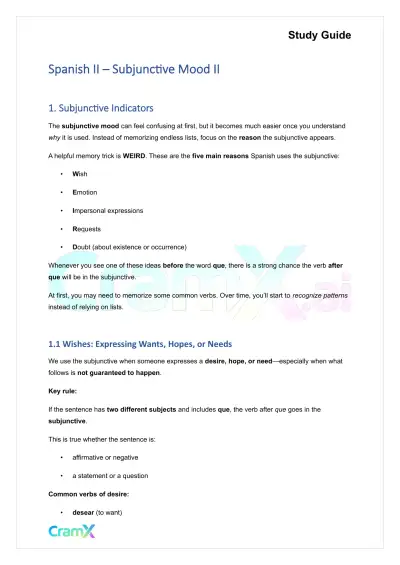 Quick Guides
Spanish II - Subjunctive Mood II
World Languages
9 pagesMar 2026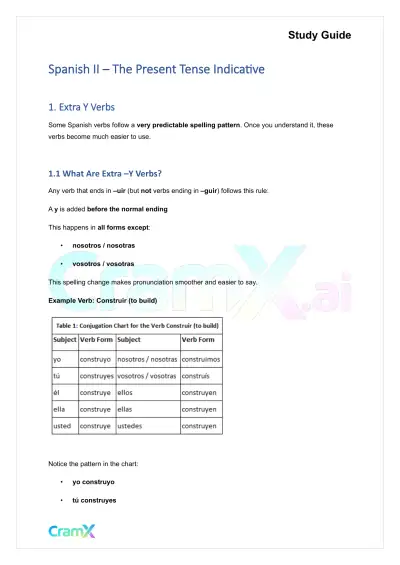 Quick Guides
Spanish II - The Present Tense Indicative
World Languages
27 pagesMar 2026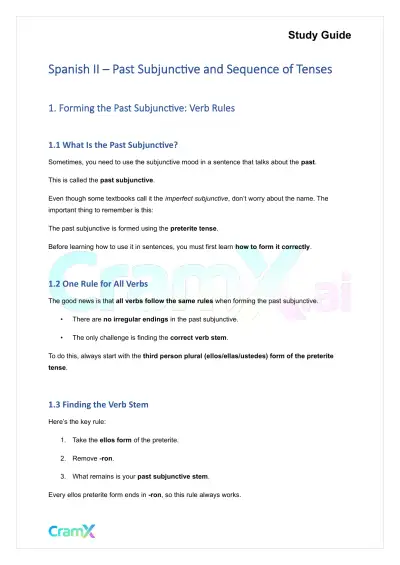 Quick Guides
Spanish II - Past Subjunctive and Sequence of Tenses
World Languages
14 pagesMar 2026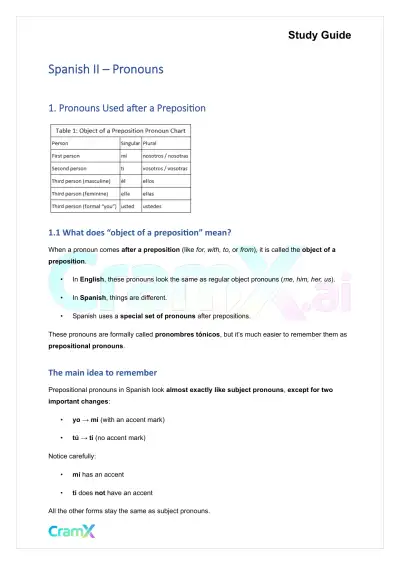 Quick Guides
Spanish II - Pronouns
World Languages
38 pagesMar 2026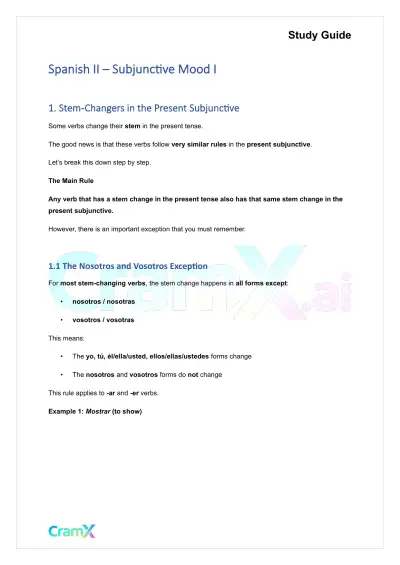 Quick Guides
Spanish II - Subjunctive Mood I
World Languages
29 pagesMar 2026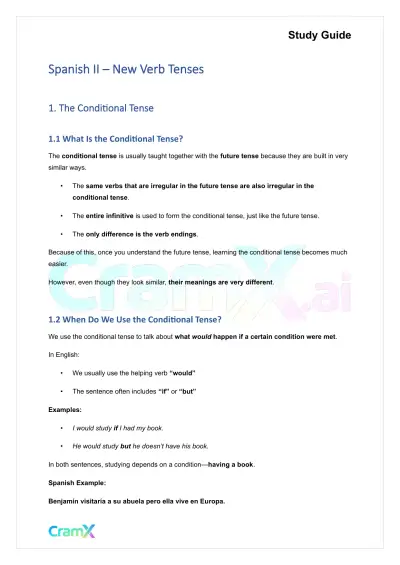 Quick Guides
Spanish II - New Verb Tenses
World Languages
19 pagesMar 2026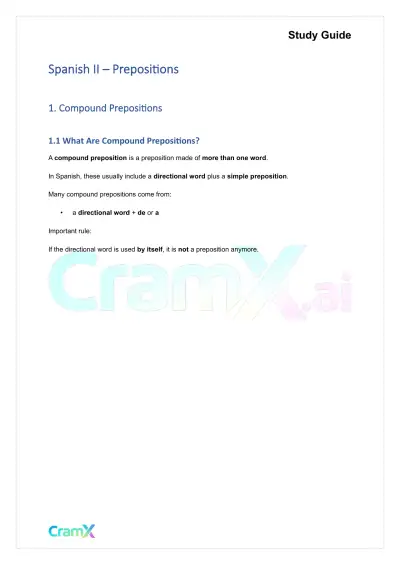 Quick Guides
Spanish II - Prepositions
World Languages
26 pagesMar 2026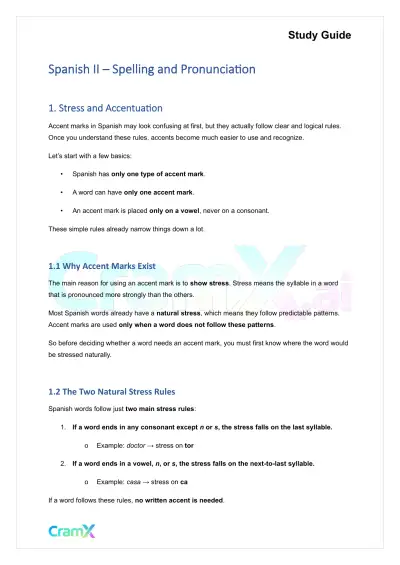 Quick Guides
Spanish II - Spelling and Pronunciation
World Languages
12 pagesMar 2026
Study this document with CramX
Once it is in your library, every tool can work from it.