

Spanish II - Antonyms and Synonyms
- World Languages
- Texas A&M University
- 18 pages
- Shared March 2026
Preview 6 of 18 pages
See the first 6 pages exactly as they appear in the document.
Page 1 Read page 1 as text
Study Guide Spanish II – Antonyms and Synonyms 1. Antonyms In many classroom tests and competitive or standardized exams, you are often asked to find the antonym , which means the opposite of a word. Knowing antonyms helps you understand vocabulary better and improves reading, writing, and exam performance. In this chapter, you will learn common Spanish words and their opposites . Each list is grouped by verbs, nouns, adjectives, and other useful words so that learning feels organized and easier. As you study, remember these tips: • Learn both the meaning of the word and its opposite . • Pay attention to stem - changing verbs . These are marked in parentheses (for example, e → ie ). • Practice using each word in a sentence to remember it better. 1. 1 Verbs and Their Opposites Verbs are action words. Knowing opposite verbs helps you clearly express contrasting actions , such as open vs close or buy vs sell . In this section, you will see: • A Spanish verb • Its meaning in English • The opposite verb with its English meaning • Notes about stem changes , when needed Study these pairs carefully and try to connect them in your mind as opposites.
Page 2 Read page 2 as text
Study Guide
Page 3 Read page 3 as text
Study Guide
Page 4 Read page 4 as text
Study Guide 1. 2 Nouns and Their Opposites Nouns name people, places, things, or ideas . Learning noun opposites helps you understand contrasts like success vs failure or peace vs war . Important notes for this section: • If a noun is listed without an article (el / la), and it refers to a person, it can be masculine or feminine . • All other nouns include a definite article that shows their gender. • Learn the noun together with its article to avoid mistakes.
Page 5 Read page 5 as text
Study Guide
Page 6 Read page 6 as text
Study Guide 1. 3 Adjectives and Their Opposites Adjectives describe nouns and pronouns . They tell us how someone or something looks, feels, or behaves. Key reminders: • Adjectives must agree in gender and number with the noun they describe. • Most adjectives have singular and plural forms . • Learning adjective opposites helps you describe things more clearly, such as big vs small or easy vs difficult .
12 more pages in the full document
Unlock it once and it stays in your library, ready to chat with or turn into flashcards.
Unlock the full documentMore World Languages study materials
See all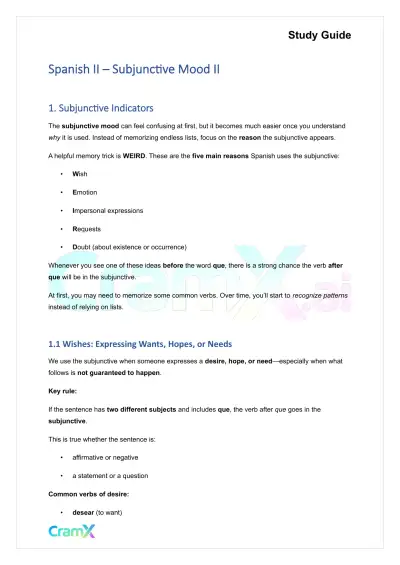 Quick Guides
Spanish II - Subjunctive Mood II
World Languages
9 pagesMar 2026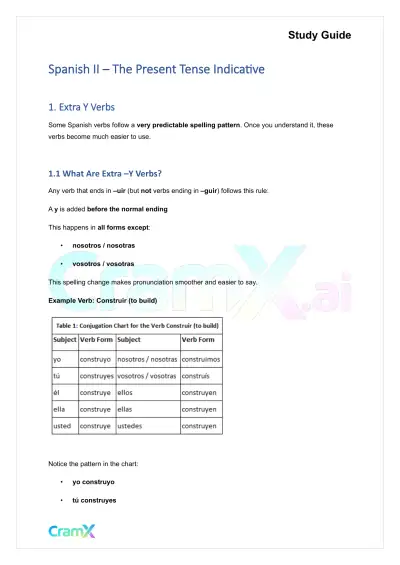 Quick Guides
Spanish II - The Present Tense Indicative
World Languages
27 pagesMar 2026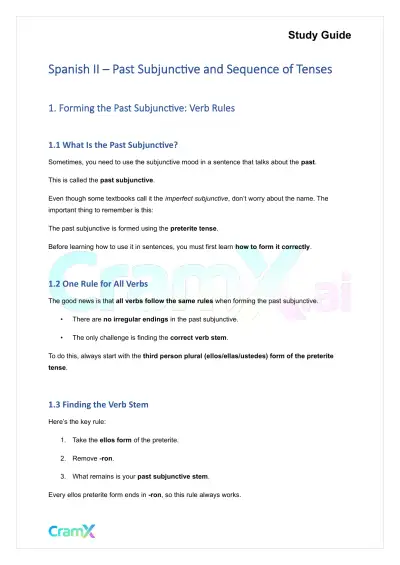 Quick Guides
Spanish II - Past Subjunctive and Sequence of Tenses
World Languages
14 pagesMar 2026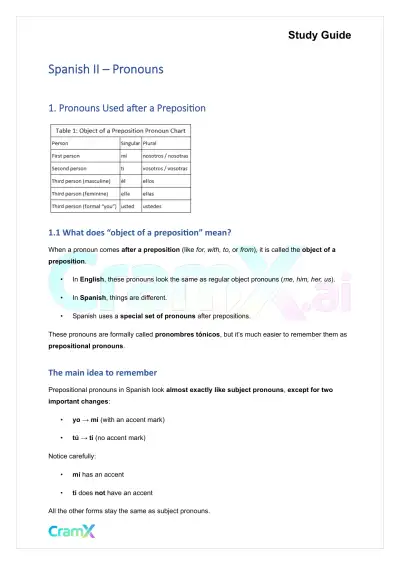 Quick Guides
Spanish II - Pronouns
World Languages
38 pagesMar 2026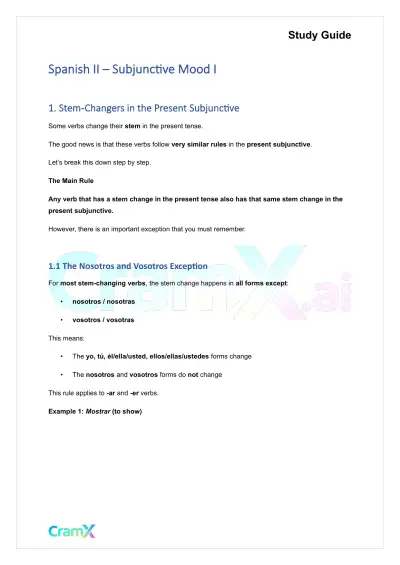 Quick Guides
Spanish II - Subjunctive Mood I
World Languages
29 pagesMar 2026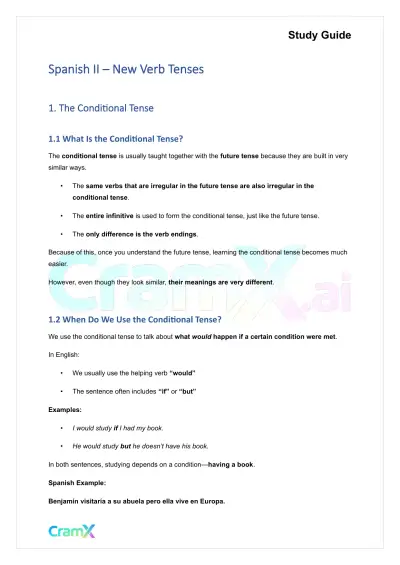 Quick Guides
Spanish II - New Verb Tenses
World Languages
19 pagesMar 2026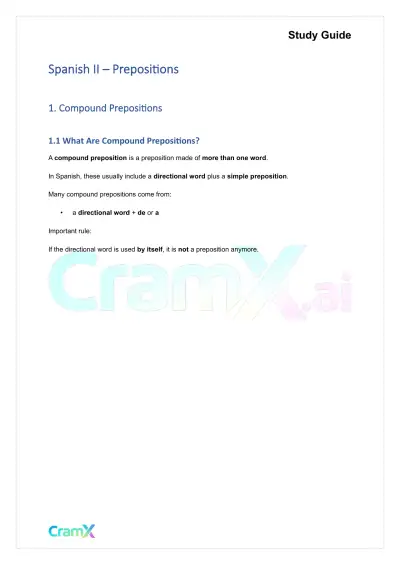 Quick Guides
Spanish II - Prepositions
World Languages
26 pagesMar 2026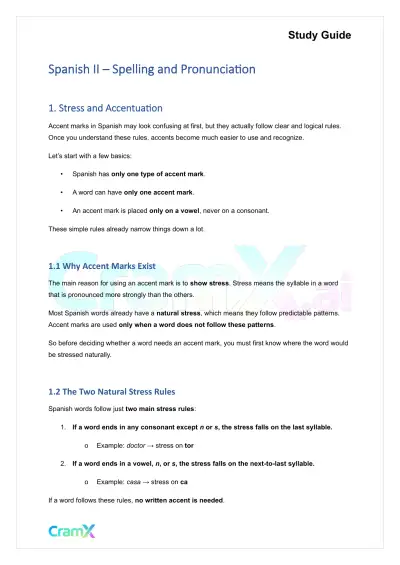 Quick Guides
Spanish II - Spelling and Pronunciation
World Languages
12 pagesMar 2026
Study this document with CramX
Once it is in your library, every tool can work from it.