

Spanish II - New Verb Tenses
- World Languages
- Texas A&M University
- 19 pages
- Shared March 2026
Preview 6 of 19 pages
See the first 6 pages exactly as they appear in the document.
Page 1 Read page 1 as text
Study Guide Spanish II – New Verb Tenses 1. The Conditional Tense 1.1 What Is the Conditional Tense? The conditional tense is usually taught together with the future tense because they are built in very similar ways. • The same verbs that are irregular in the future tense are also irregular in the conditional tense . • The entire infinitive is used to form the conditional tense, just like the future tense. • The only difference is the verb endings . Because of this, once you understand the future tense, learning the conditional tense becomes much easier. However, even though they look similar, their meanings are very different . 1.2 When Do We Use the Conditional Tense? We use the conditional tense to talk about what would happen if a certain condition were met . In English: • We usually use the helping verb “would” • The sentence often includes “if” or “but” Examples: • I would study if I had my book. • He would study but he doesn’t have his book. In both sentences, studying depends on a condition — having a book . Spanish Example: Benjamín visitaría a su abuela pero ella vive en Europa.
Page 2 Read page 2 as text
Study Guide Benjamin would visit his grandmother, but she lives in Europe. This sentence implies a condition , even though it isn’t directly stated. The condition is that his grandmother would need to live closer . 1.3 Conditional + “si” (If) in Spanish When a sentence uses the conditional tense and the word si (if) , the verb that follows si is not in the conditional tense. Instead, it is in the imperfect subjunctive . Examples: • Yo hablaría español si yo tuviera mi diccionario. • I would speak Spanish if I had my dictionary. • Britanía viajaría a África si tuviera el dinero. • Britanía would travel to Africa if she had the money. Notice that hablaría / viajaría are conditional, but tuviera is imperfect subjunctive. 1.4 “Would” Does NOT Always Mean Conditional Sometimes “would” does NOT express a condition . Instead, it describes something that used to happen regularly in the past . Example: • I would study every night when I was in high school. This sentence does not mean: • “I would study if…” • “I would study but…” Instead, it means “I used to study.” In Spanish, this idea is expressed using the imperfect tense , not the conditional.
Page 3 Read page 3 as text
Study Guide 1.5 Easy Trick: Conditional or Imperfect? Use this simple test: Replace “would” with “used to.” • If the sentence still makes sense → use the imperfect • If it sounds wrong → use the conditional Compare These Sentences: • Cuando niña, Tatiana hablaba con su tía todas las noches. • As a child, Tatiana would / used to speak with her aunt every night. • → Imperfect tense • Tatiana hablaría con su tía si ella tuviera teléfono. • Tatiana would speak to her aunt if she had a phone. (“used to” doesn’t work) • → Conditional tense 1.6 Forming the Conditional Tense: Regular Verbs To form the conditional tense of regular verbs , follow this rule: Use the entire infinitive + conditional endings There is only ONE set of endings for: • - ar • - er • - ir verbs Conditional Endings
Page 4 Read page 4 as text
Study Guide 1.7 Regular - ar Verbs in the Conditional 1.8 Regular - er Verbs in the Conditional
Page 5 Read page 5 as text
Study Guide 1.9 Regular - ir Verbs in the Conditional Notice in all three tables: • The infinitive stays complete • The ending changes based on the subject 1.10 Irregular Verbs in the Conditional Just like the future tense, there are only 12 irregular verbs in the conditional tense — and they are the same verbs . Group 1: Verbs That Drop the Final - e
Page 6 Read page 6 as text
Study Guide Place Table 5 here. Examples: • saber → sabr - • poder → podr - • querer → querr - Example Conjugation: Querer Group 2: Verbs That Change the Last Vowel to d
13 more pages in the full document
Unlock it once and it stays in your library, ready to chat with or turn into flashcards.
Unlock the full documentMore World Languages study materials
See all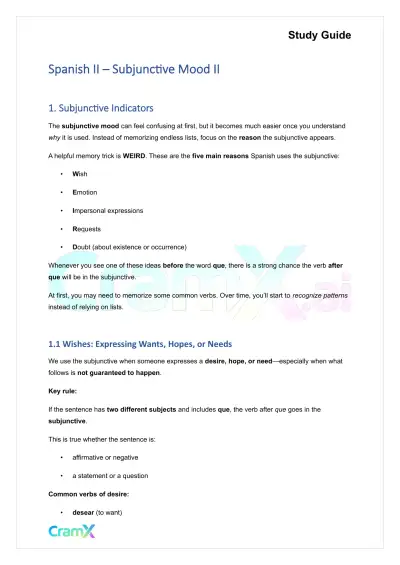 Quick Guides
Spanish II - Subjunctive Mood II
World Languages
9 pagesMar 2026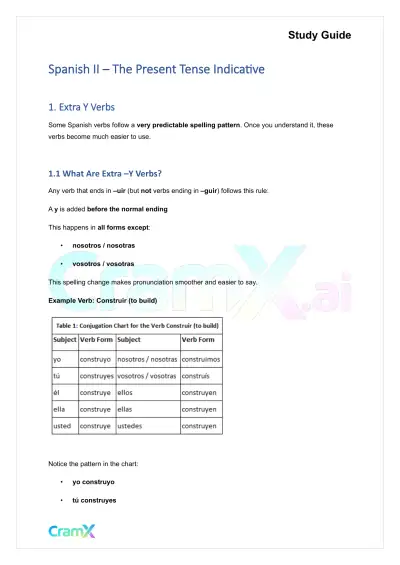 Quick Guides
Spanish II - The Present Tense Indicative
World Languages
27 pagesMar 2026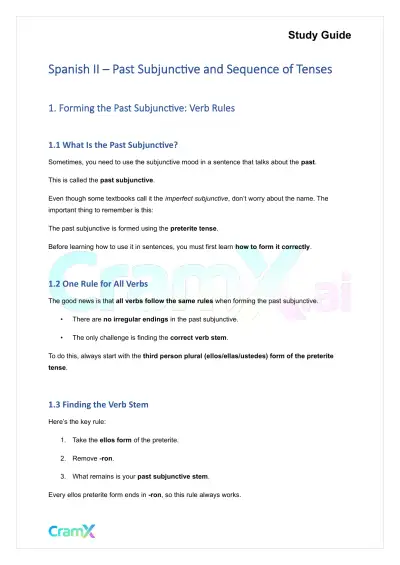 Quick Guides
Spanish II - Past Subjunctive and Sequence of Tenses
World Languages
14 pagesMar 2026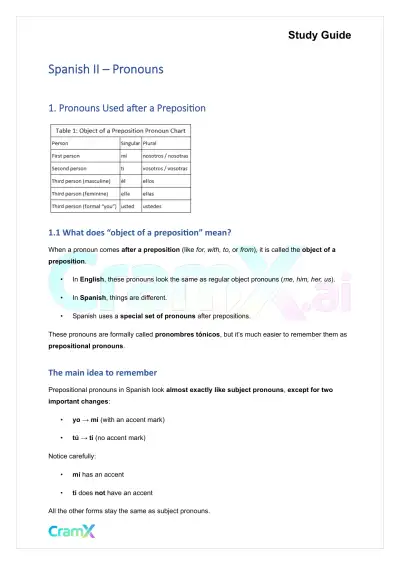 Quick Guides
Spanish II - Pronouns
World Languages
38 pagesMar 2026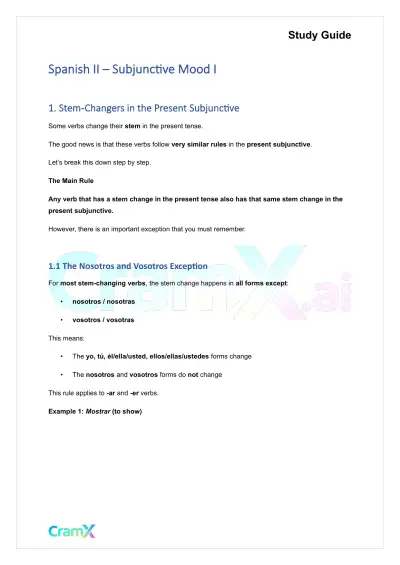 Quick Guides
Spanish II - Subjunctive Mood I
World Languages
29 pagesMar 2026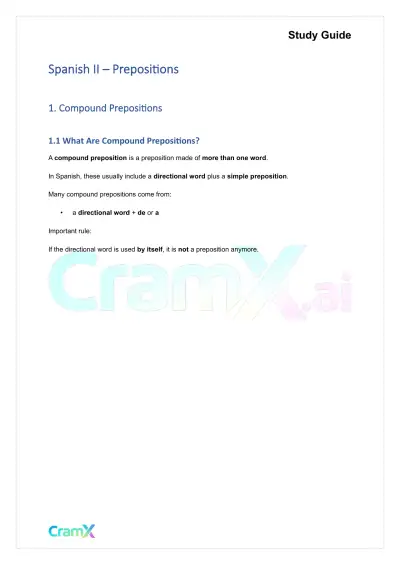 Quick Guides
Spanish II - Prepositions
World Languages
26 pagesMar 2026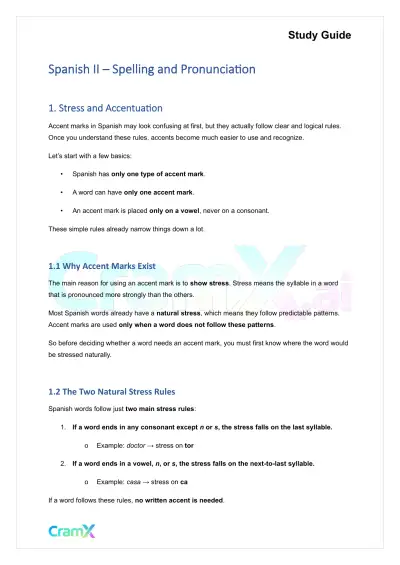 Quick Guides
Spanish II - Spelling and Pronunciation
World Languages
12 pagesMar 2026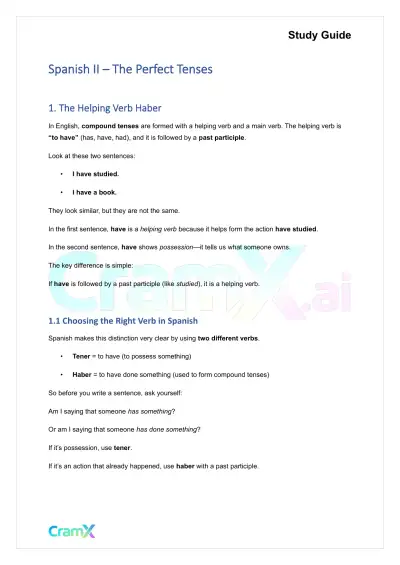 Quick Guides
Spanish II - The Perfect Tenses
World Languages
15 pagesMar 2026
Study this document with CramX
Once it is in your library, every tool can work from it.