

Spanish II - Passive Voice Conjunctions Sentence Variations
- World Languages
- Texas A&M University
- 21 pages
- Shared March 2026
Preview 7 of 21 pages
See the first 7 pages exactly as they appear in the document.
Page 1 Read page 1 as text
Study Guide Spanish II – Passive Voice Conjunctions Sentence Variations 1. Conjunctions 1.1 What Is a Conjunction? A conjunction is a word that connects ideas. Most of the time, it joins two phrases or two complete sentences. In English, we use words like and , but , and or . Spanish uses similar words, but some of them work a little differently. This chapter explains the most common Spanish conjunctions and how to use them correctly. 1.2 Pero and Mas – Saying “But” Pero The conjunction pero means “but” and connects two independent ideas, just like however in English. Example: Quieren asistir al concierto de Orishas pero no pueden viajar a Francia. They want to attend the Orishas concert, but they can’t travel to France. Mas The word mas also means “but.” It is a synonym of pero , but it is used less often and sounds more formal. Example: No compraría un nuevo coche mas lo necesito tanto. I wouldn’t buy a new car, but I need it so much. When “but” means “other than” or “except,” Spanish uses mas que . Example: Nadie mas que Luis quiere asistir al concierto de Ranchero. Nobody but Luis wants to attend the Ranchero concert.
Page 2 Read page 2 as text
Study Guide 1.3 Sino – “But Rather” When to Use Sino Use sino when: • The first part of the sentence is negative • The second part corrects or contradicts the first Example: Shakira no canta su nueva canción en inglés sino en español. Shakira doesn’t sing her new song in English but rather in Spanish. 1.4 Sino + Infinitive If a verb comes right after sino , it must stay in the infinitive form . Example: No queremos trabajar sino escaparnos a la playa. We don’t want to work but rather escape to the beach. 1.5 Sino que If sino is followed by a subject and a conjugated verb , you must use sino que . Example: Tú no hiciste tus quehaceres sino que jugaste juegos de video. You didn’t do your chores but rather played video games. 1.6 No solamente … sino también Spanish uses no solamente … sino también to say “not only … but also.” Example: No solamente los niños sino también los padres querrán ver la nueva película de Disney. Not only the kids but also the parents will want to see the new Disney movie.
Page 3 Read page 3 as text
Study Guide 1.7 O and Y – “Or” and “And” O – “Or” Use o to give choices. • If two singular nouns are joined by o , the verb is singular because only one subject acts. Example: Juan o Carlos baila el flamenco hoy. Juan or Carlos dances flamenco today. • If both nouns are plural , the verb is plural . Example: Mis vecinos o mis amigos cuidan a mis perros cuando viajo. My neighbors or my friends take care of my dogs when I travel. 1.8 O → U O changes to u before a word that starts with o or ho to avoid awkward sounds. Examples: Miami u Orlando Buenos días u hola 1.9 Y – “And” The conjunction y means “and.” It creates a compound subject , so the verb is plural . Example: Memo y Amberina bailan bien la salsa. Memo and Amberina dance salsa well.
Page 4 Read page 4 as text
Study Guide 1.10 Y → E Y changes to e before words that start with i or hi . Examples: Lilia e Ignacio se casan este junio. Agua e hielo 1.11 Ni … ni – “Neither … nor” In negative sentences, Spanish uses ni … ni . Important difference from English: Even with ni … ni , the verb is plural in Spanish. Example: Ni Julia ni Manolo entienden la lección. Neither Julia nor Manolo understands the lesson. 1.12 Subordinate Conjunctions What Are They? Subordinate conjunctions introduce dependent clauses — clauses that cannot stand alone. These conjunctions often work with the indicative or subjunctive , depending on meaning. Common Subordinate Conjunctions Some frequently used ones include: • a menos que (unless) • antes de que (before) • para que (so that) • en caso de que (in case that) • como si (as if – followed by past subjunctive)
Page 5 Read page 5 as text
Study Guide 1.13 Conjunctions That Always Use the Indicative These express certainty : • porque (because) • ya que (now that) • puesto que (since/because) • desde que (since a moment in time) 1.14 Conjunctions That Can Use Indicative or Subjunctive These depend on certainty vs. uncertainty : • cuando (when) • aunque (although / even if) • si (if) • hasta que (until) • después de que (after) 1.15 Aunque – A Key Difference • Subjunctive → “even if” (uncertain outcome) La amará para siempre aunque ella se case con otro hombre. He will love her forever even if she marries another man. • Indicative → “even though” (known fact) J.Lo no se casará con él aunque él escribió esa canción sobre ella. J.Lo will not marry him even though he wrote that song about her. 1.16 Así que / De modo que / De manera que – “So That” These mean “so that.” • Use indicative if the result is expected or already happening. • Use subjunctive if the result is not yet real .
Page 6 Read page 6 as text
Study Guide Examples: Enviamos muchas cartas así que recibiremos algo en el correo. Alberto rompió la carta de manera que nunca pudiera arreglarla. 1.17 Como – Multiple Meanings Como can mean: • “Like” / “as” • “In the same way as” • “Since” (when giving a reason) Examples: Te amo como amo a mi hermano. Como tienes 15 años, ya puedes conducir. 1.18 Para que vs. Porque Para que – Purpose Use para que when the second clause explains the goal of the first. → Always followed by subjunctive . Ana estudia mucho para que sus padres se sientan orgullosos. Porque – Reason Use porque to explain why something happens. Question and answer pattern: ¿Por qué trajiste esa maleta? Porque tengo que salir para Chicago.
Page 7 Read page 7 as text
Study Guide 1.19 Puesto que and Ya que – “Since” • Puesto que usually comes between clauses . • Ya que can come at the beginning or middle. • Use a comma when it starts the sentence. Examples: Ya que llegaste temprano, podemos tomar el próximo autobús. Podemos tomar el próximo autobús ya que llegaste temprano. 1.20 Correlative Conjunctions These come in pairs and work together: • ni … ni (neither … nor) • o … o (either … or) • tanto … como (as much … as) • no sólo … sino también (not only … but also) 1.21 Other Useful Conjunctive Phrases • sin embargo (however) • no obstante (nevertheless) • mientras tanto (meanwhile) • ni siquiera (not even)
14 more pages in the full document
Unlock it once and it stays in your library, ready to chat with or turn into flashcards.
Unlock the full documentMore World Languages study materials
See all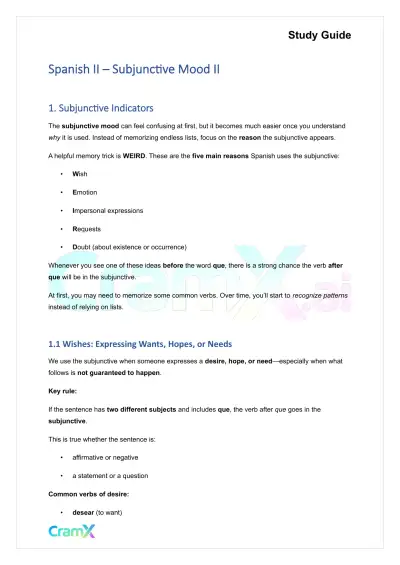 Quick Guides
Spanish II - Subjunctive Mood II
World Languages
9 pagesMar 2026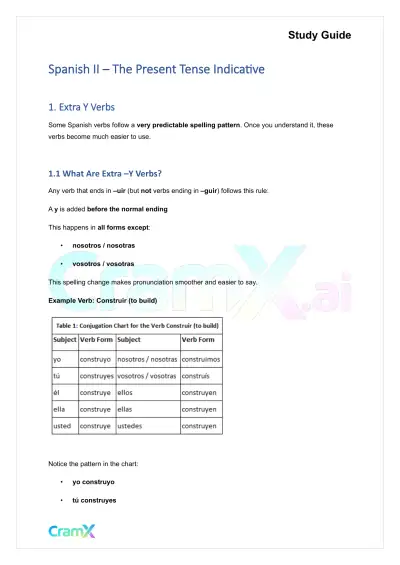 Quick Guides
Spanish II - The Present Tense Indicative
World Languages
27 pagesMar 2026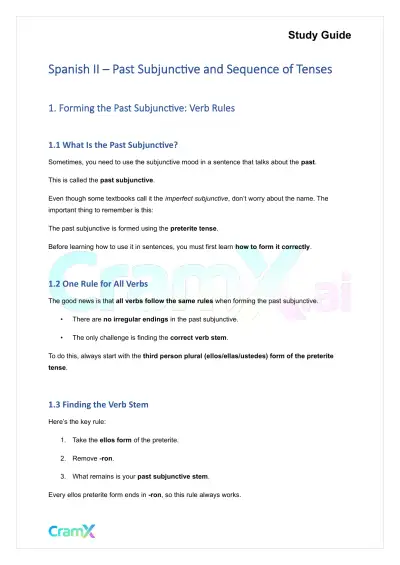 Quick Guides
Spanish II - Past Subjunctive and Sequence of Tenses
World Languages
14 pagesMar 2026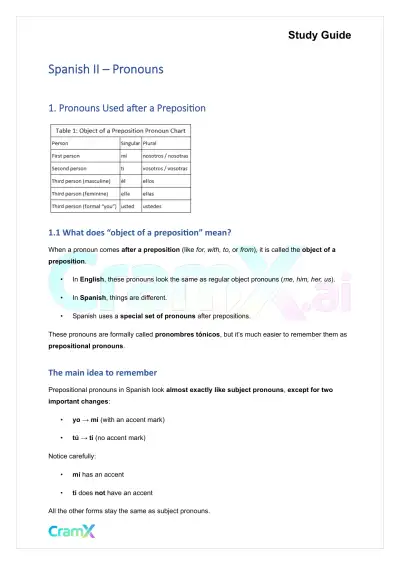 Quick Guides
Spanish II - Pronouns
World Languages
38 pagesMar 2026 Quick Guides
Spanish II - Subjunctive Mood I
World Languages
29 pagesMar 2026 Quick Guides
Spanish II - New Verb Tenses
World Languages
19 pagesMar 2026 Quick Guides
Spanish II - Prepositions
World Languages
26 pagesMar 2026 Quick Guides
Spanish II - Spelling and Pronunciation
World Languages
12 pagesMar 2026
Study this document with CramX
Once it is in your library, every tool can work from it.