

Spanish II - Past Subjunctive and Sequence of Tenses
- World Languages
- Texas A&M University
- 14 pages
- Shared March 2026
Preview 5 of 14 pages
See the first 5 pages exactly as they appear in the document.
Page 1 Read page 1 as text
Study Guide Spanish II – Past Subjunctive and Sequence of Tenses 1. Forming the Past Subjunctive: Verb Rules 1. 1 What Is the Past Subjunctive? Sometimes, you need to use the subjunctive mood in a sentence that talks about the past . This is called the past subjunctive . Even though some textbooks call it the imperfect subjunctive , don’t worry about the name. The important thing to remember is this: The past subjunctive is formed using the preterite tense . Before learning how to use it in sentences, you must first learn how to form it correctly . 1. 2 One Rule for All Verbs The good news is that all verbs follow the same rules when forming the past subjunctive. • There are no irregular endings in the past subjunctive. • The only challenge is finding the correct verb stem . To do this, always start with the third person plural (ellos/ellas/ustedes) form of the preterite tense . 1. 3 Finding the Verb Stem Here’s the key rule: 1. Take the ellos form of the preterite. 2. Remove - ron . 3. What remains is your past subjunctive stem . Every ellos preterite form ends in - ron , so this rule always works.
Page 2 Read page 2 as text
Study Guide 1. 4 Adding the Past Subjunctive Endings ( - ra Forms) Once you have the stem, add the endings below. Important note: The nosotros/nosotras form always has an accent mark on the vowel right before the ending. 1. 5 Example with an Irregular Preterite: Tener Tener is a great example because its preterite form looks very different from the infinitive. Steps: • Preterite ellos form: tuvieron • Remove - ron → tuvie - • Add past subjunctive endings
Page 3 Read page 3 as text
Study Guide 1. 6 Example with a Regular Verb: Hablar Now let’s look at a regular verb. Steps: • Preterite ellos form: hablaron • Remove - ron → habla - • Add past subjunctive endings 1. 7 The Second Set of Endings ( - se Forms) Spanish also has another set of past subjunctive endings . These are used less often , but they are still correct and important to recognize.
Page 4 Read page 4 as text
Study Guide These endings: • Replace - ra with - se • Replace - ramos with - semos • Replace - rais with - seis • Replace - ran with - sen The verb stem is formed the same way (using the ellos preterite form). 1. 8 Example Using Tener with – se Endings
Page 5 Read page 5 as text
Study Guide 1. 9 Example Using Hablar with – se Endings • Preterite ellos form: hablaron • Remove - ron → habla - • Add – se endings Summary The preterite tense has many irregular forms , so it’s very important to review it carefully — especially the ellos/ellas form . If you know the ellos preterite form , you can always form the past subjunctive correctly . 2. Sequence of Tenses 2.1 What Does “Sequence of Tenses” Mean? Once you know how to form the past subjunctive , the next step is learning when to use it . This is where the sequence of tenses comes in. The sequence of tenses explains which subjunctive tense to use — present or past — based on the tense of the verb before the word que .
9 more pages in the full document
Unlock it once and it stays in your library, ready to chat with or turn into flashcards.
Unlock the full documentMore World Languages study materials
See all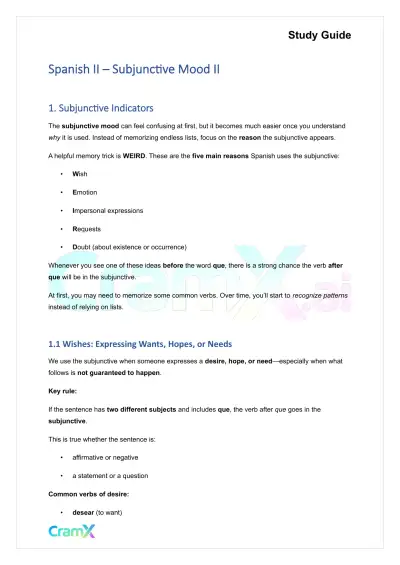 Quick Guides
Spanish II - Subjunctive Mood II
World Languages
9 pagesMar 2026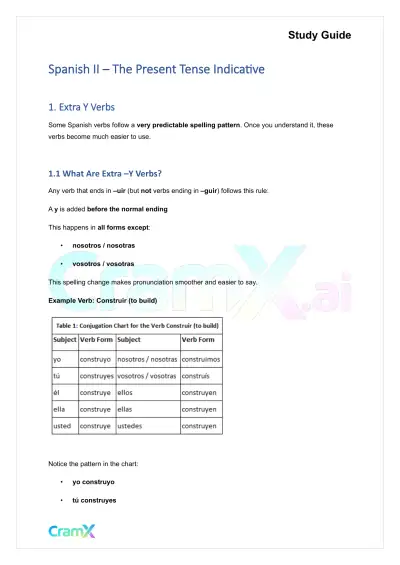 Quick Guides
Spanish II - The Present Tense Indicative
World Languages
27 pagesMar 2026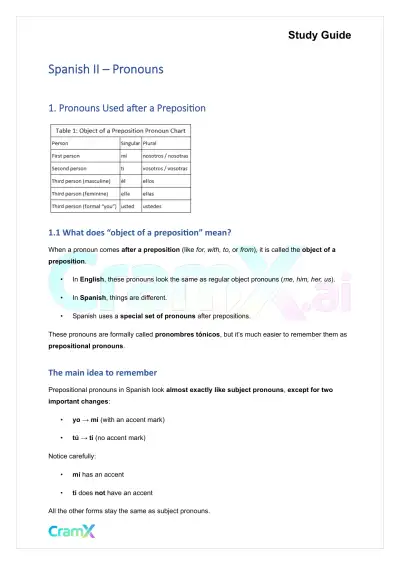 Quick Guides
Spanish II - Pronouns
World Languages
38 pagesMar 2026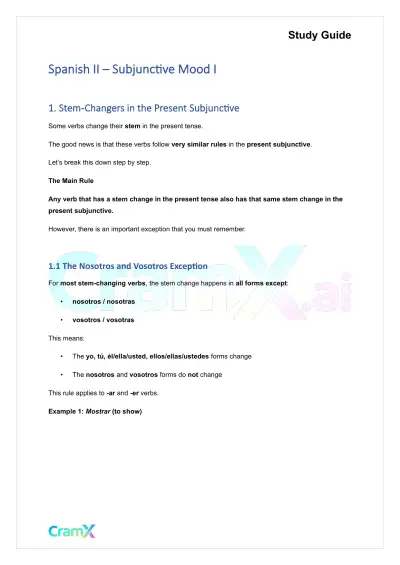 Quick Guides
Spanish II - Subjunctive Mood I
World Languages
29 pagesMar 2026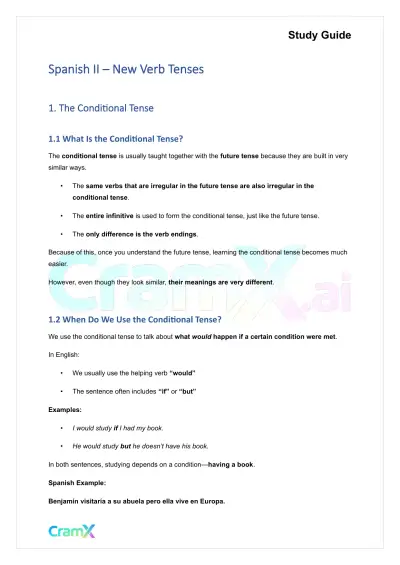 Quick Guides
Spanish II - New Verb Tenses
World Languages
19 pagesMar 2026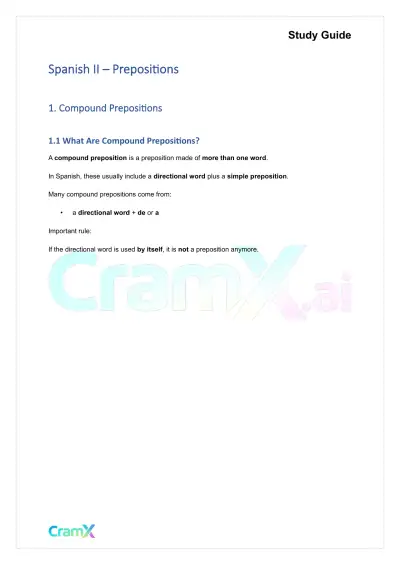 Quick Guides
Spanish II - Prepositions
World Languages
26 pagesMar 2026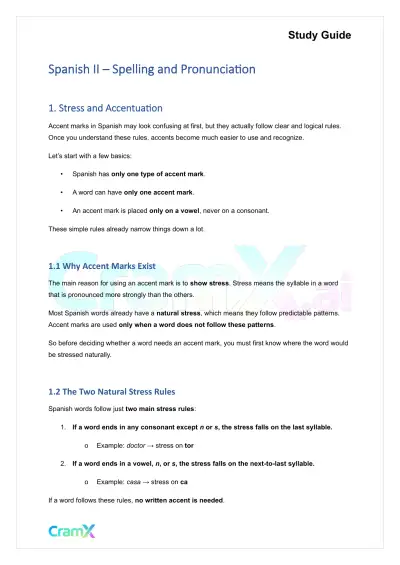 Quick Guides
Spanish II - Spelling and Pronunciation
World Languages
12 pagesMar 2026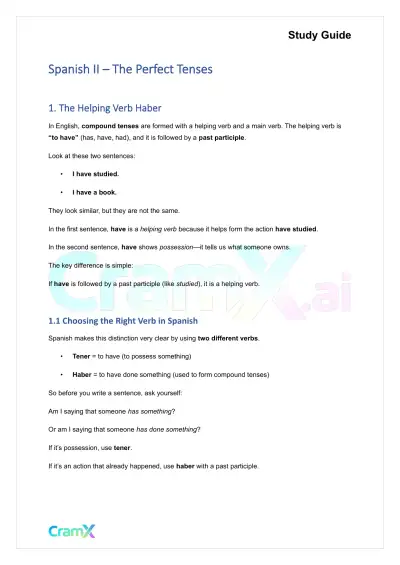 Quick Guides
Spanish II - The Perfect Tenses
World Languages
15 pagesMar 2026
Study this document with CramX
Once it is in your library, every tool can work from it.